
How to Build a Household Budget: A Step-by-Step Guide
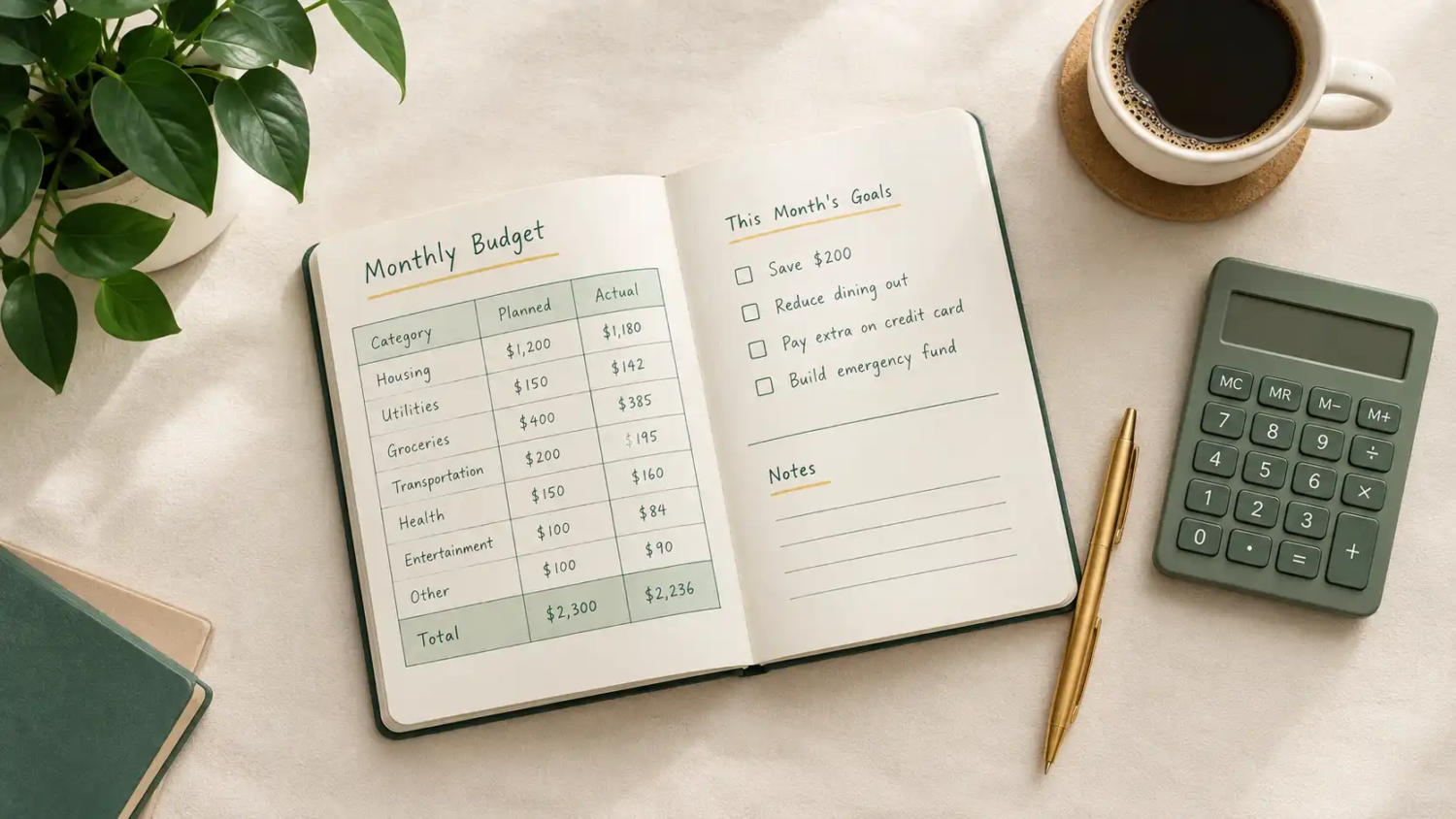
A household budget is not a spreadsheet full of restrictions. It is a plan that says, in advance, where every dollar of income is going before it disappears into groceries, bills, and small purchases that are easy to forget by the end of the month. This guide walks through a complete, beginner-friendly method for building one from scratch, using only information already sitting in a pay stub and a bank statement — no finance background, app subscription, or spreadsheet skills required. Anyone just getting oriented can start with the Start Here guide first for an overview of how the budgeting, saving, and frugal living guides on this site fit together.
Quick Answer
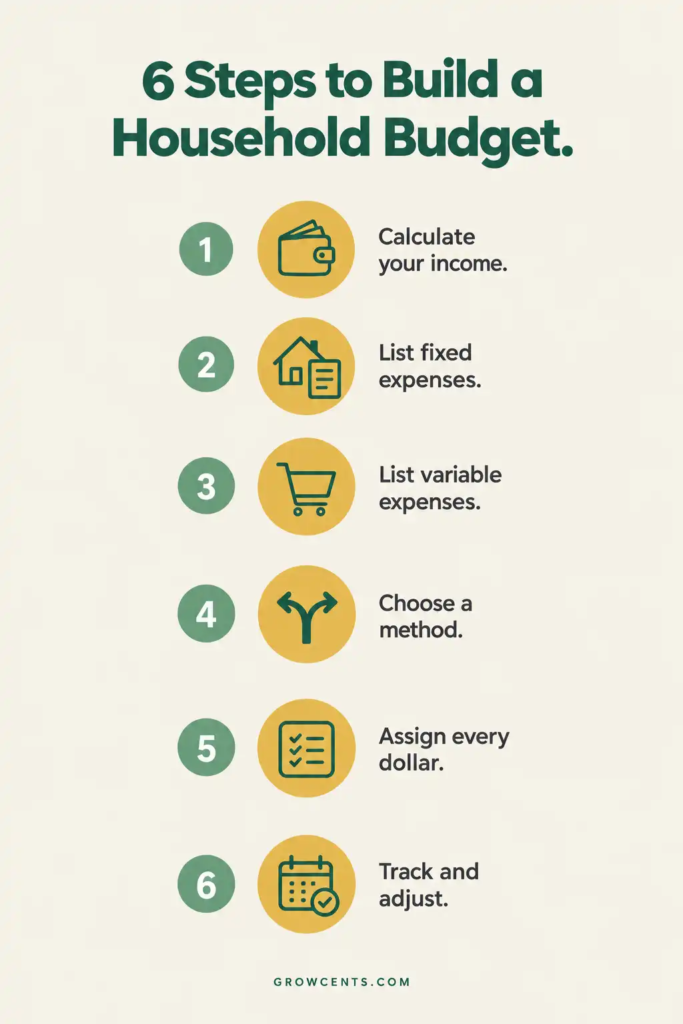
Building a household budget comes down to six steps: add up total monthly take-home income, list every fixed expense, list variable and irregular expenses, pick a budgeting method that fits the household, assign every remaining dollar a specific job, and then track actual spending for a full month before making adjustments. The rest of this guide walks through each step in detail, with a sample budget and a list of the mistakes that most often cause a new budget to fall apart in the first few weeks.
Why a Household Budget Matters
Without a written plan, spending tends to expand to match whatever is available in the account, and irregular costs — car repairs, holiday spending, an annual insurance premium — show up as unpleasant surprises instead of expected line items. A budget does not eliminate those costs. It makes them visible ahead of time, which is what allows a household to prepare for them instead of reacting to them. The Federal Trade Commission’s consumer education site frames this plainly: a budget’s job is to make sure there is enough money every month, and to show clearly where that money is actually going, not just where it was intended to go.
What to Gather Before Starting
Building an accurate budget in one sitting is much easier with the right documents on hand rather than trying to recall numbers from memory. Before starting, gather:
- The last 2–3 pay stubs, or a recent bank statement showing deposits, for anyone contributing income to the household
- The last month or two of bank and credit card statements
- Any bills that are paid outside of a checking account (cash rent, informal loan payments, etc.)
- A list of subscriptions and recurring charges, since these are the ones most often forgotten
How to Build a Household Budget in 6 Steps
Each step below builds on the one before it. Skipping ahead to “choosing a method” before totaling real income and expenses is one of the most common reasons a budget stops matching reality within the first month.
Step 1: Calculate Total Monthly Income
Start with take-home pay — the amount that actually lands in the account after taxes and deductions — not the salary figure on an offer letter. Add every source: primary job, secondary income, child support, benefits, or side income. For households with variable income (freelance work, hourly shifts, commission), use the lowest typical month from the last six to twelve months as the baseline, rather than an average. Budgeting against a bad month protects the plan; budgeting against an average risks a shortfall in the months that come in below it.
Step 2: List Every Fixed Expense
Fixed expenses are the costs that stay roughly the same every month regardless of behavior: rent or mortgage, insurance premiums, minimum loan payments, childcare, and subscriptions. Pull the actual figure from a recent statement for each one rather than estimating, since small rounding errors across a dozen fixed costs add up to a meaningfully wrong total.
Step 3: List Variable and Irregular Expenses
Variable expenses change month to month — groceries, fuel, utilities that fluctuate by season, dining out. Irregular expenses happen a few times a year rather than monthly — car registration, annual memberships, holiday spending, back-to-school costs. A common budgeting mistake is leaving irregular expenses out entirely because they do not appear in a typical month; instead, divide the annual total by 12 and treat that amount as its own monthly line item, so the cost is already accounted for when it eventually comes due.
Step 4: Choose a Budgeting Method
With income and expenses both listed, the next decision is which framework to use to organize them. A percentage-based approach (splitting income across needs, wants, and savings) suits households that want general guardrails without tracking every category closely. A zero-based approach, where every dollar of income is assigned a specific job until nothing is left unassigned, suits households that want tighter control or have irregular income. Either approach works with the numbers already gathered in Steps 1–3; the method changes how the categories are organized, not the underlying math.
Step 5: Give Every Dollar a Job
Whatever is left after fixed and variable expenses should be assigned somewhere specific — savings, debt payoff, discretionary spending — rather than left as an unlabeled leftover. The goal is for income minus planned spending to equal zero, meaning every dollar has a destination, not that there is nothing left over. Money assigned to a “leftover” category with no name tends to disappear the fastest.
Step 6: Track, Review, and Adjust Every Month
The first month of any new budget will be wrong in a few places, and that is a normal part of the process rather than a sign that the budget failed. Track actual spending against the plan for a full month, then adjust categories based on what actually happened rather than guessing twice. A simple notebook, a printable worksheet, or a budgeting app or spreadsheet all work for this step; the tool matters less than doing it consistently for at least one full billing cycle before declaring a category “wrong.”
6 Steps to Build a Household Budget — Infographic
Sample Household Budget (Illustrative Example)
The figures below are a simplified, illustrative example built around a hypothetical monthly take-home income of $4,000 — not a prescription for what any household should spend in each category. Actual proportions depend heavily on location, household size, and existing debt.
| Category | Monthly Amount | % of Income |
|---|---|---|
| Housing (rent/mortgage, insurance) | $1,200 | 30% |
| Utilities & phone/internet | $250 | 6% |
| Groceries | $500 | 12.5% |
| Transportation | $350 | 9% |
| Debt payments (minimums) | $300 | 7.5% |
| Irregular expenses (1/12 of annual total) | $150 | 4% |
| Savings & emergency fund | $500 | 12.5% |
| Discretionary spending | $400 | 10% |
| Unassigned buffer | $350 | 8.5% |
Common Budgeting Mistakes That Derail a New Budget
- Forgetting irregular expenses. Annual costs that are not divided into a monthly amount tend to blow up the budget the month they come due.
- Budgeting from salary instead of take-home pay. Taxes and deductions mean the real number to plan around is smaller than the number on an offer letter.
- Leaving categories too vague. A single “miscellaneous” category that absorbs anything unplanned makes it impossible to see where money is actually going.
- Forgetting recurring subscriptions. Small recurring charges are easy to overlook individually but add up quickly; reviewing them is one of the fastest frugal living wins available.
- Changing the budget after one bad week instead of one full month. A single overspent week is not enough data to know whether a category limit is actually unrealistic.
How to Stick to a Budget Long-Term
A budget that survives past the first month usually has a few things in common: it is reviewed on a fixed schedule (weekly or monthly, not only when something feels wrong), it has a small buffer category for the spending that does not fit neatly anywhere else, and it treats savings as a required line item rather than whatever happens to be left at the end of the month. Building an emergency fund from that savings line is usually the next practical step once a budget is stable; see the saving money guides on this site for how to structure that specifically.
Frequently Asked Questions
How much of my income should go toward each budget category?
There is no single correct percentage that fits every household, since housing costs, family size, and debt levels vary widely. Percentage-based guidelines (like splitting income across needs, wants, and savings) are a useful starting point, not a fixed rule; the sample table above illustrates one possible breakdown, not a target.
What if my expenses are higher than my income?
This is common in the first month of budgeting, once irregular and forgotten expenses are actually written down. The next step is reviewing variable and discretionary categories first for cuts, since fixed expenses like rent are harder to change quickly.
Do I need a budgeting app to do this?
No. A notebook, a printable worksheet, or a basic spreadsheet works for every step in this guide. Apps can make tracking faster once the categories are set, but they are not required to build the initial budget.
How often should a household budget be updated?
A monthly review is typical, comparing planned amounts to actual spending and adjusting categories that were consistently over or under. Larger changes — a new job, a move, a new dependent — usually call for rebuilding the budget from Step 1 rather than a small adjustment.
Should both partners in a household see the same budget?
For shared households, a budget works best when everyone contributing income or making shared purchases can see the same categories and totals, since a budget only one person can see is difficult to stick to as a household.
How This Guide Was Built
This guide was researched and written using publicly available consumer education material rather than personal anecdote or invented statistics. The step-by-step structure draws on the budgeting process outlined by the Federal Trade Commission’s consumer.gov, the Consumer Financial Protection Bureau’s Your Money, Your Goals toolkit, and the “Spend” principle published by the U.S. Treasury’s MyMoney.gov. The sample budget figures are illustrative examples built for this guide, not sourced statistics, and are labeled as such above. GrowCents’ full research and sourcing approach is described on the Editorial Policy page, along with more on how and why the site is put together on the About page.
This article is general educational information, not personalized financial advice, and does not account for any individual household’s full financial situation. See the Disclaimer page for details.
