
How to Start an Emergency Fund When Money Is Tight

Last verified: September 2026.
Starting an emergency fund can feel like a contradiction when there is barely enough left at the end of the month to cover the next bill. The good news is that a starter emergency fund is not built from what is left over after everything else — it is built in small, fixed amounts that come off the top, before anything else has a chance to absorb them. This guide covers a realistic starting goal, where to put the money, and a step-by-step method for building it even on a tight budget. Anyone who has not yet built a working monthly budget may want to start with building a household budget first, since a budget is what reveals how much is actually available to redirect toward savings.
Quick Answer: Start with a small, specific goal — $500 to $1,000 — rather than the often-quoted three to six months of expenses, which comes later. Keep it in a separate, FDIC-insured savings account that is not linked to a debit card, automate a small fixed transfer on payday, and redirect windfalls (tax refunds, gifts, rebates) directly into it. Once the starter goal is reached, the same account keeps growing in stages toward a fuller emergency fund.
Why “Money Is Tight” Doesn’t Rule Out an Emergency Fund
The recommendation to save three to six months of expenses is aimed at a fully-funded emergency fund, not a starting point, and treating it as a first-month goal is one of the most common reasons people give up on saving altogether. According to the Federal Reserve’s most recent Survey of Household Economics and Decisionmaking, only 63 percent of U.S. adults said they could cover a hypothetical $400 emergency expense entirely with cash or its equivalent in 2024 — meaning more than a third could not. A starter fund exists specifically to close that gap without requiring a large amount saved up front.
How Much Should a Starter Emergency Fund Be?
A realistic first target is $500 to $1,000, or roughly one to two weeks of essential expenses for households with very little room in the budget. This amount will not replace a job for months, but it is usually enough to absorb the kind of expense that most often knocks a tight budget off track: a car repair, a higher-than-usual utility bill, a broken appliance. Reaching this smaller goal first also builds the habit of saving automatically, which matters more long-term than the size of the very first deposit.
| Stage | Target Amount | What It Typically Covers |
|---|---|---|
| Starter fund | $500 – $1,000 | A single unexpected bill: car repair, appliance replacement, urgent vet bill |
| One month of expenses | Varies by household | A short gap in income or a cluster of smaller unexpected costs |
| Three months of expenses | Varies by household | A short-term job loss or an extended reduction in income |
| Six months of expenses | Varies by household | A longer job search, especially for single-income households or unstable industries |
How to Start an Emergency Fund, Step by Step
Step 1: Set a Small, Specific First Goal
Pick a single number ($500 or $1,000 are common starting points) rather than an open-ended “save what’s left” approach. A specific, smaller goal is easier to reach and easier to stay motivated toward than an abstract, larger one.
Step 2: Open a Separate Savings Account
Keep the fund in its own account, separate from checking, ideally without a debit card attached to it. The goal is friction: money that requires a deliberate transfer to access is less likely to get spent on a non-emergency than money sitting in the same account used for everyday spending. Confirm the account is at an FDIC-insured bank or an NCUA-insured credit union, so the balance is protected even in the unlikely event the institution fails.
Step 3: Automate a Small, Fixed Transfer
Set up an automatic transfer for a fixed, small amount on payday — even $10 or $20 — before that money has a chance to be absorbed into other spending. Consistency matters more than size at this stage; a $10 transfer made every payday for a year adds up to a meaningful starter fund without requiring a large one-time decision.
Step 4: Redirect One-Time Money
Tax refunds, cash gifts, rebates, reimbursements, and other irregular windfalls are easier to save than regular income, since the household was not depending on them to cover routine expenses. Sending some or all of a windfall directly to the emergency fund can build the starter goal faster than payday transfers alone.
Step 5: Free Up Room in the Existing Budget
Reviewing fixed and variable expenses for small, painless cuts — an unused subscription, a lower-cost phone plan, a smaller grocery bill — can free up a few dollars a week to redirect into the fund without a major lifestyle change. The frugal living guides on this site cover specific ways to find that room in a tight budget.
Step 6: Grow the Fund in Stages
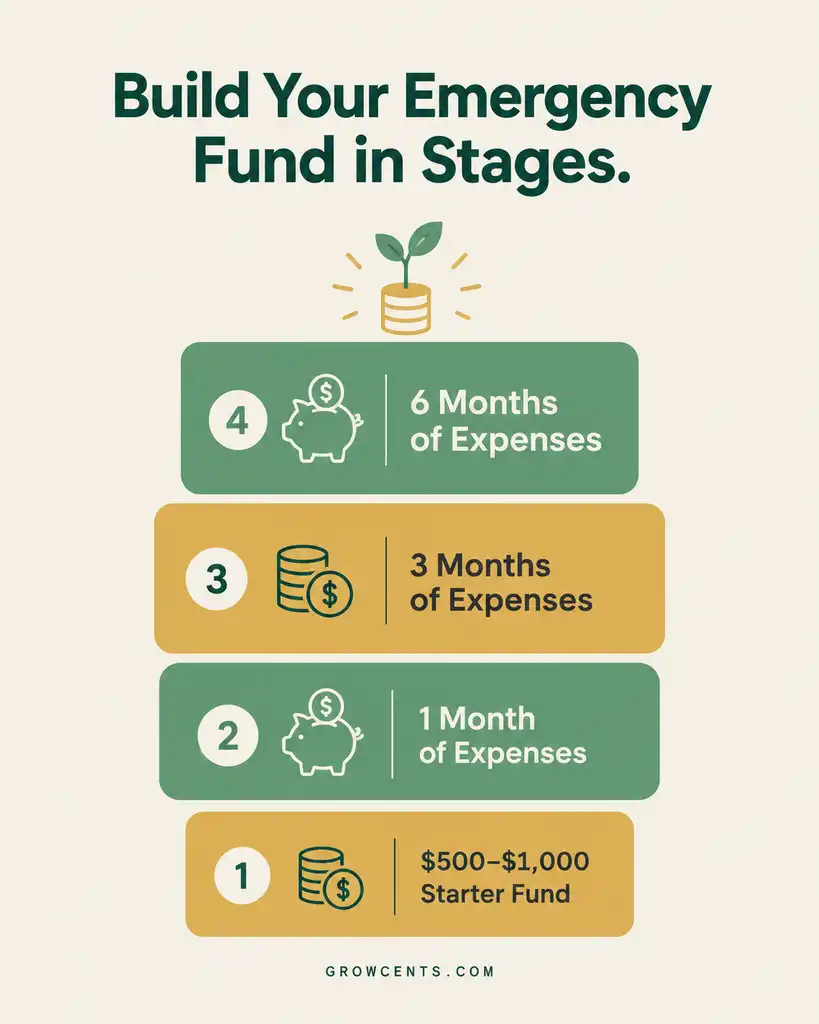
Once the starter goal is reached, the next stage is one month of essential expenses, then three, then six, using the same account and the same automated habit. There is no fixed timeline for reaching a full emergency fund; the amount already saved is protection regardless of how far it is from the eventual target.
Starter Emergency Fund Ladder — Infographic
Where to Keep an Emergency Fund
The right account balances two things: it should be safe, and it should be reasonably easy to reach in a real emergency without being so easy to reach that it gets spent casually. A standard or high-yield savings account at an FDIC-insured bank or NCUA-insured credit union satisfies both. Under current FDIC deposit insurance rules, balances are protected up to $250,000 per depositor, per insured bank, per ownership category — far above what a starter or even a full emergency fund typically holds.
| Account Type | Typical Access Speed | Best For |
|---|---|---|
| Regular savings account (same bank as checking) | Immediate | Convenience; easiest to start with today |
| High-yield savings account (separate online bank) | 1–2 business days to transfer | Earning more interest while keeping some friction against impulse spending |
| Money market account | Immediate to 1 business day | Households that want a small amount of extra interest with easy access |
| Checking account | Immediate, including via debit card | Not recommended for an emergency fund — too easy to spend on non-emergencies |
Common Mistakes When Building an Emergency Fund on a Tight Budget
- Setting the first goal too high. A target of three to six months of expenses can feel so far away that saving never actually starts; a $500 goal is more achievable and still meaningfully useful.
- Keeping it in the same account as everyday spending. Without separation, the fund tends to get spent gradually on non-emergencies without a clear decision ever being made to spend it.
- Waiting for “extra” money instead of automating a fixed amount. Leftover money rarely appears reliably; a small automatic transfer does.
- Treating irregular expenses as emergencies. Annual costs like car registration or holiday spending are predictable and belong in a budget category, not the emergency fund.
- Stopping contributions after reaching the starter goal. The starter fund is a milestone, not a finish line; the same habit should continue toward the next stage.
What Actually Counts as an Emergency
A useful test: an emergency is unexpected, necessary, and urgent. A car repair needed to get to work qualifies; a planned vacation does not. A medical bill qualifies; a predictable annual expense that was simply not budgeted for does not — that is a budgeting gap, not an emergency, and it is worth revisiting the budget so the same situation is accounted for next time.
Frequently Asked Questions
Is $1,000 really enough for an emergency fund?
As a full emergency fund, no — $1,000 will not replace months of income. As a starter fund, it is generally enough to cover the single unexpected expense most likely to derail a tight budget, which is the specific problem a starter fund is meant to solve.
Should debt be paid off before starting an emergency fund?
Many households build a small starter fund first (even while paying down debt) so that a new unexpected expense does not have to go on a credit card and add to that same debt. The specific order depends on interest rates and individual circumstances, and this guide does not recommend one universal sequence.
How long should it take to build a full emergency fund?
There is no fixed timeline, and it commonly takes many months or longer on a tight budget. Consistency in the automated transfer matters more than speed.
Can retirement accounts count as an emergency fund?
Retirement accounts are generally not treated as emergency funds, since early withdrawals can trigger taxes and penalties and reduce long-term retirement savings. A separate, easily accessible savings account is the more commonly recommended option for this purpose.
What if the emergency fund has to be used?
Using it for an actual emergency is the fund doing its job. The next step afterward is simply restarting the automated transfer to rebuild it, using the same step-by-step process described above.
How This Guide Was Built
This guide was researched using publicly available government data and consumer education resources rather than personal anecdote or invented statistics. The $400 emergency expense figure comes from the Federal Reserve Board’s Survey of Household Economics and Decisionmaking data. The savings-planning framework draws on the Consumer Financial Protection Bureau’s Your Money, Your Goals toolkit. Deposit insurance details are sourced from the FDIC’s official coverage guidance. GrowCents’ full research and sourcing approach is described on the Editorial Policy page and the About page.
This article is general educational information, not personalized financial advice, and does not account for any individual household’s full financial situation. See the Disclaimer page for details.
