
Debt Snowball vs. Debt Avalanche: How to Choose and Calculate Your Payoff

Last verified: September 2026.
Debt snowball and debt avalanche are the two most common frameworks for deciding which debt to pay off first when there is more than one. Both use the same extra money each month; they only differ in which debt that extra money attacks first. This guide defines both methods precisely, walks through a fully calculated example using the same three debts under each method, and covers how to calculate a personal payoff order by hand.
Quick Answer: The avalanche method pays minimums on every debt and puts all extra money toward the highest-interest-rate debt first, which minimizes total interest paid. The snowball method puts extra money toward the smallest balance first regardless of interest rate, which produces a paid-off account sooner and, according to published research, is associated with a higher likelihood of eliminating all debt. Avalanche is the mathematically cheaper choice; snowball is the behaviorally easier one to stick with for many people.
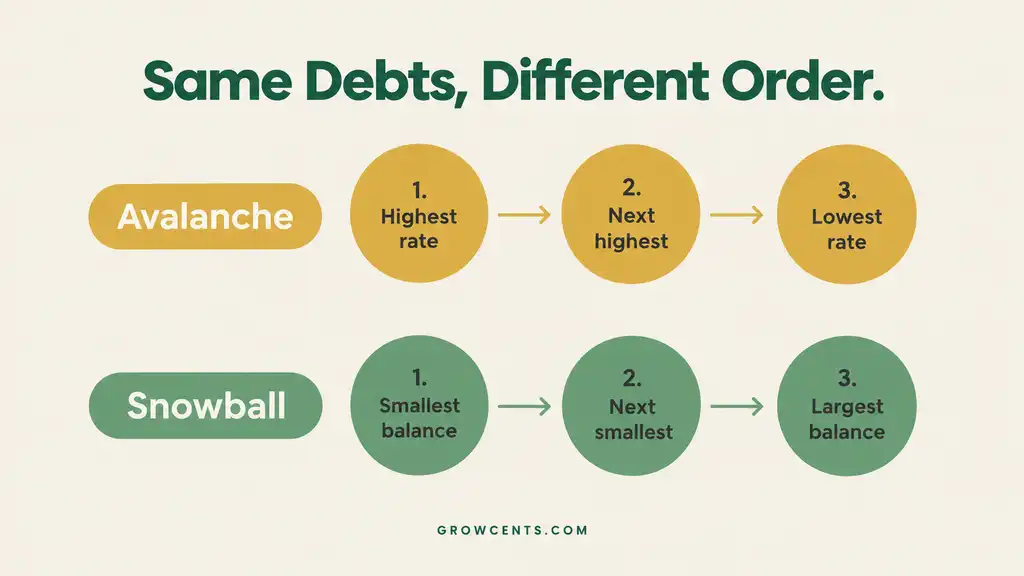
The Two Methods, Defined
| Method | Payoff Order | Main Advantage |
|---|---|---|
| Avalanche | Highest interest rate first, regardless of balance size | Minimizes total interest paid over the life of the payoff |
| Snowball | Smallest balance first, regardless of interest rate | Produces a fully paid-off account sooner, which research links to higher follow-through |
In both methods, minimum payments continue on every debt that is not the current target; the only difference is where any extra money beyond the minimums goes each month.
Worked Example: Same Three Debts, Two Methods
The table below shows a sample set of three debts and an extra $150 a month available beyond the required minimum payments:
| Debt | Balance | Interest Rate (APR) | Minimum Payment |
|---|---|---|---|
| Card A | $300 | 10% | $20 |
| Loan B | $2,500 | 22% | $60 |
| Card C | $1,200 | 15% | $35 |
Running the numbers with monthly compounding, minimum payments on every debt, and the extra $150 applied in full each month to whichever debt each method prioritizes, produces these results:
| Method | Order Paid Off | Total Months | Total Interest Paid |
|---|---|---|---|
| Avalanche | Loan B (month 14) → Card A (month 17) → Card C (month 19) | 19 months | $582.56 |
| Snowball | Card A (month 2) → Card C (month 9) → Loan B (month 21) | 21 months | $764.80 |
In this example, avalanche finishes two months sooner and saves $182.24 in total interest, because it attacks the highest-rate balance (Loan B, at 22%) immediately rather than last. Snowball, in exchange, produces a fully paid-off account by month 2 instead of month 14, which is the “small win” the method is built around. This example keeps the extra $150 fixed each month rather than rolling a paid-off debt’s freed-up minimum payment into the next target; doing that in practice (the common way both methods are actually run) would make both methods finish faster than shown here, though the relative comparison between the two would hold in the same direction.
Why Snowball Can Still Win in Practice
Avalanche is the better choice purely on the math, which is also why it is the approach recommended by government financial education resources. But a widely cited study published in the Journal of Marketing Research examined data from roughly 6,000 people enrolled in a debt settlement program and found that those who paid off accounts starting with the smallest balance — independent of the interest rate — were more likely to eliminate their entire debt balance than those who did not. According to the Kellogg School of Management’s coverage of the research, the researchers concluded that closing individual accounts, regardless of their size, predicted successful debt elimination at any point in the program. In other words, avalanche saves more money if a person follows through to the end, but snowball appears to make following through to the end more likely for many people.
Payoff Order: Avalanche vs. Snowball — Infographic
How to Calculate a Personal Payoff Order by Hand
- List every debt with its current balance, interest rate (APR), and minimum payment, the same way as in the example table above.
- Decide on a method: sort the list by interest rate (highest first) for avalanche, or by balance (smallest first) for snowball.
- Determine the extra amount available each month beyond the sum of all minimum payments.
- Apply minimum payments to every debt, then apply the full extra amount to the first debt in the sorted list.
- Once that debt is paid off, move to the next debt on the list and continue applying the extra amount there, plus the minimum payment that is now freed up from the paid-off debt.
This last step — rolling the freed-up minimum payment into the next target — is what actually creates the “snowball” or “avalanche” effect of a growing payment over time, and it is the detail most often left out of a simplified by-hand calculation.
Which Method Fits Which Person
- Avalanche fits well when the gap between the highest and lowest interest rates is large, since that is where the interest savings are greatest, and for anyone confident they will stay motivated without an early account closure.
- Snowball fits well when past attempts at debt payoff have stalled out, since an early, visible win can matter more than optimizing for the lowest total interest paid.
- A hybrid approach is also common: following snowball order generally, but making an exception to pay off a small, very-low-interest debt last if a much higher-interest debt is only slightly larger.
Common Mistakes
- Switching methods partway through. Comparing progress against a plan that keeps changing makes it hard to tell whether either method is actually working.
- Forgetting to roll the freed-up minimum payment forward. Without this step, the “snowball” never actually grows, and the payoff takes longer than either method is designed to achieve.
- Ignoring minimum payments on non-target debts. Both methods require staying current on every debt, not only the one currently being targeted; a missed minimum payment elsewhere can trigger fees or rate increases that undo the plan’s savings.
- Comparing methods using unrealistic numbers. The relative advantage of avalanche grows with a wider gap between interest rates; for debts with very similar rates, the two methods produce nearly identical results, and the choice comes down mostly to motivation.
Using a Calculator Instead of Doing It by Hand
For more than two or three debts, a spreadsheet (see the guide to building a budget spreadsheet for the underlying formulas) or a dedicated payoff calculator handles the month-by-month compounding far more reliably than manual arithmetic. The Consumer Financial Protection Bureau’s Your Money, Your Goals toolkit includes a debt-planning worksheet that works through the same ordering decision described in this guide.
Frequently Asked Questions
Is avalanche always cheaper than snowball?
Mathematically, yes, assuming both are followed through to completion; avalanche can never cost more in total interest than snowball for the same set of debts and the same extra payment amount, though the size of the difference varies based on how spread out the interest rates are.
Can the two methods be combined?
Yes; a common hybrid pays off one or two very small balances first for an early win, then switches to avalanche order for the remaining, larger debts.
Does it matter which method is used if there’s only one debt?
No; the entire distinction is about deciding an order among multiple debts, so a single debt simply gets all available extra payment regardless of method.
What if the smallest balance also has the highest interest rate?
In that case, both methods recommend the same order, since the smallest-balance debt and the highest-rate debt are the same account; the distinction only matters when the two orderings diverge, as in the worked example above.
Should balance transfers or consolidation loans change this decision?
Consolidating multiple debts into one loan or balance transfer changes the underlying debt list itself (and often the interest rate), so the snowball-versus-avalanche decision would need to be reapplied to the new, consolidated list of debts rather than the original one.
How This Guide Was Built
This guide was researched using published academic research and official consumer financial education resources rather than personal anecdote or invented statistics. The research on snowball-method effectiveness is drawn from the Kellogg School of Management’s coverage of Gal and McShane’s 2012 study, published in the Journal of Marketing Research. The debt-planning framework references the Consumer Financial Protection Bureau’s Your Money, Your Goals toolkit. The worked example above was calculated directly (monthly compounding, minimum payments enforced, a fixed $150 extra payment applied each month) rather than estimated, and its specific figures and example debts are illustrative, not sourced data. GrowCents’ full research and sourcing approach is described on the Editorial Policy page and the About page.
This article is general educational information, not personalized financial advice, and does not account for any individual household’s full financial situation. See the Disclaimer page for details.