
The $5 Savings Challenge: A Simple Way to Build a Saving Habit
Last verified: September 2026.
The $5 savings challenge is popular for a specific reason: the amount is small enough that almost no budget feels it, which removes the biggest obstacle to starting a savings habit in the first place. This guide covers the common ways the challenge is run, the simple math behind why it adds up, and how to set it up so it actually continues past the first week.
Quick Answer: The $5 challenge has a few common versions: setting aside every physical $5 bill that comes into your hands as change, saving a fixed $5 every day or every week, or using $5 as the starting point in a ramped-up weekly challenge. All versions work the same way — a small, consistent amount moved somewhere separate from everyday spending, building toward a specific goal like a starter emergency fund.
What the $5 Challenge Actually Is
There isn’t one official version; this is a widely shared, informal savings method, and three variations are common enough to be worth naming:
| Variant | How It Works | Best For |
|---|---|---|
| The $5-bill challenge | Every time a physical $5 bill is received as change, it gets set aside instead of spent | People who still use cash regularly |
| The fixed $5-a-day challenge | A set $5 is transferred to savings every single day, regardless of spending | People who prefer automation over cash habits |
| The $5 starting-point challenge | Savings start at $5 in week one and increase by a set amount each week (a smaller-scale version of the well-known 52-week challenge) | People who want a sense of progress and don’t mind a growing amount |
Why Such a Small Amount Works
The FDIC’s consumer education materials, published in connection with the national America Saves Week campaign, make a simple point: for anyone who has struggled to start saving, starting small and saving consistently matters more than the size of the amount, since consistency is what turns an action into a habit. Separately, research from University College London on habit formation found that a new behavior becomes automatic through repetition in a consistent context, with missing a single day having little effect on the overall process. A $5 challenge is built around exactly that principle: the amount is small enough to repeat daily or weekly without much friction, which matters more for building a lasting habit than a larger amount that gets abandoned after a few weeks.
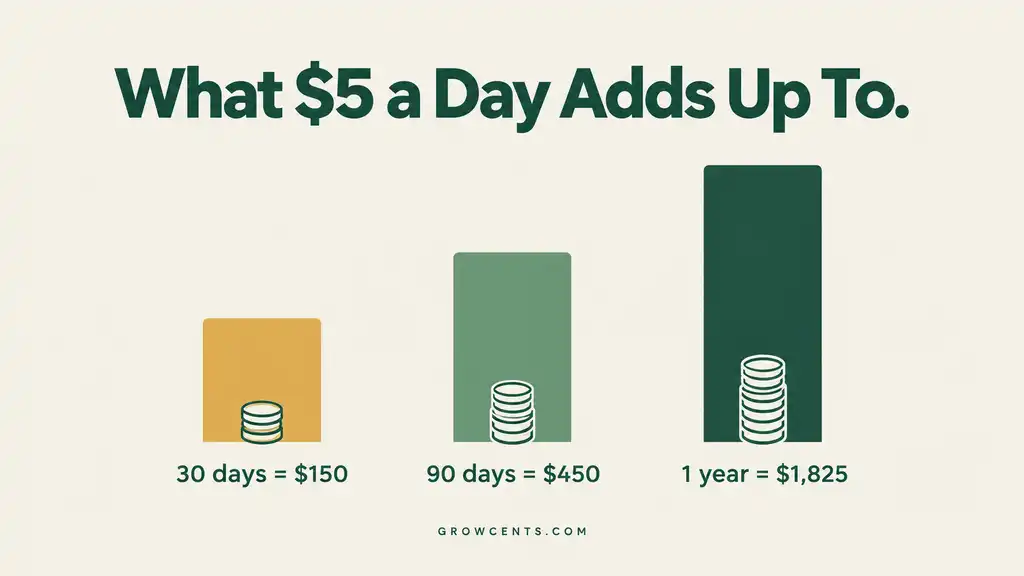
What $5 a Day Adds Up To — Infographic
Setting Up the Challenge, Step by Step
1. Pick a Variant and Write Down the Rule
Choose one of the three variants above (or a personal version) and write the exact rule down: which bills count, which day transfers happen, or how much the weekly amount increases. A vague version (“save some fives when I can”) rarely survives past the first week.
2. Open or Designate a Separate Place for It
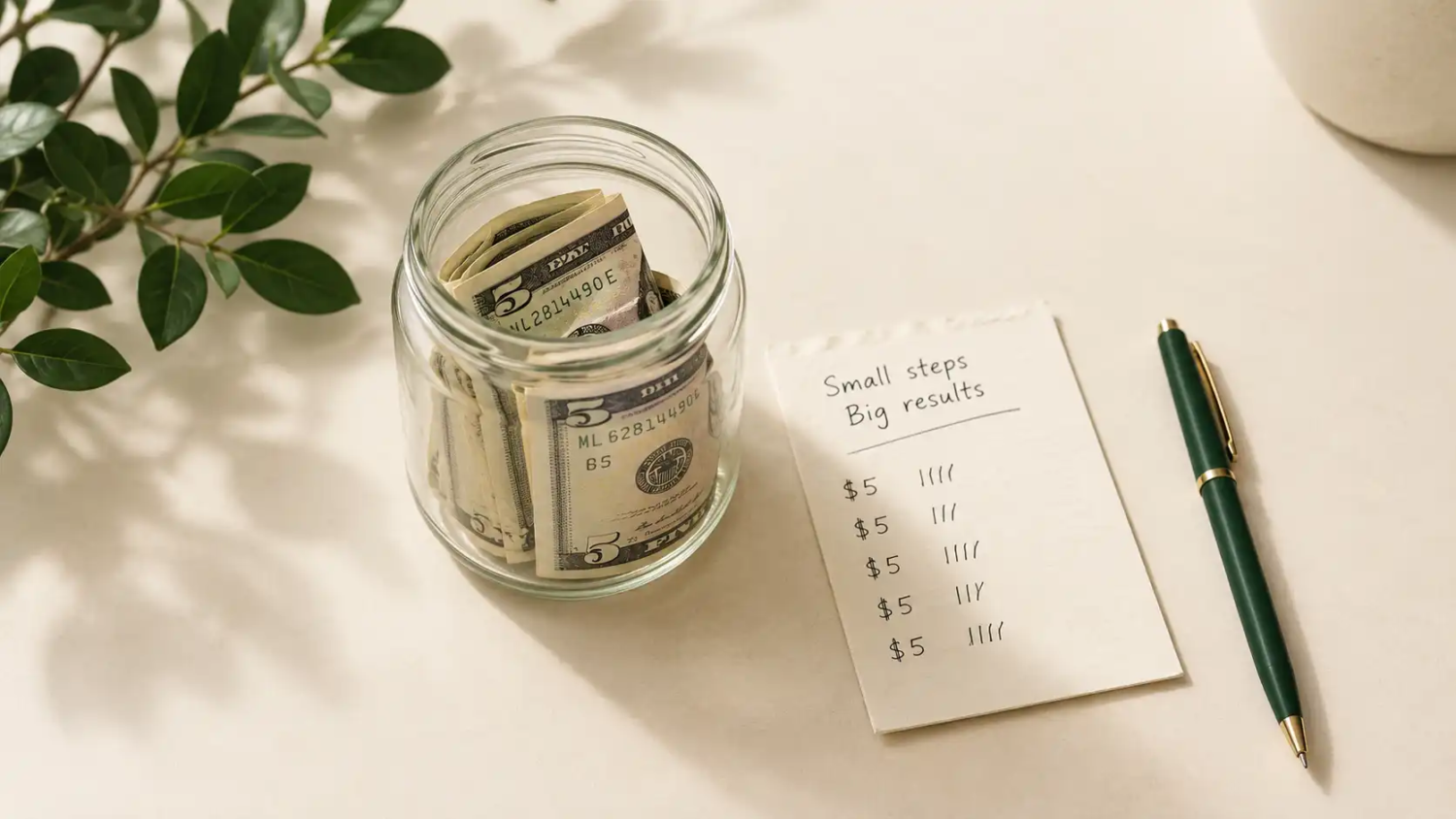
A small jar works for the cash version; a separate savings sub-account or a labeled envelope works for the automated version. Keeping the money physically or functionally separate from everyday spending reduces the chance it quietly gets absorbed back into regular purchases.
3. Attach It to an Existing Habit
Linking the savings action to something already happening daily — emptying pockets at the end of the day, checking a banking app each morning — gives the new behavior a consistent cue, which is the same mechanism behavioral research points to as central to habit formation.
4. Decide Where the Money Goes When the Challenge Ends
Setting a destination in advance, such as a starter emergency fund or a specific short-term goal, turns the challenge into progress toward something rather than a pile of cash with no plan.
Making It Easier to Stick To
- Track visibly. A printed tally sheet, a jar that fills up visibly, or a simple spreadsheet row checked off daily all provide the same kind of feedback that keeps the habit going.
- Pair it with the household budget. Treating the $5 as a fixed line item in the household budget, rather than money that has to be found from nowhere, makes it easier to sustain alongside other categories.
- Allow a grace period, not a restart. A missed day does not need to reset the challenge; simply continuing is more effective than treating one gap as a failure.
- Automate where possible. A recurring transfer removes the daily decision entirely for the fixed-amount version of the challenge.
Common Mistakes
- Choosing the cash variant without using cash regularly. The $5-bill version only works at the pace money actually gets spent and changed in cash; it can take a long time for someone who rarely carries cash.
- Starting too many challenges at once. Combining the $5 challenge with a no-spend month and a decluttering challenge simultaneously often leads to abandoning all three rather than finishing one.
- No destination for the funds. As with other small-savings methods, money without an assigned goal is easier to spend once it accumulates.
- Treating a missed day as the end of the challenge. Consistency over time matters more than a perfect streak.
Frequently Asked Questions
Is $5 a day actually meaningful, or just a gimmick?
On its own, $5 a day is a modest amount; its value is mainly in building a consistent saving habit that can later support larger savings goals, rather than in the dollar amount itself.
What if $5 a day isn’t realistic some weeks?
Many people scale the amount down temporarily during a tight week rather than stopping altogether; the fixed $5-a-day version can also be adjusted to a weekly total instead of a strict daily one.
Can this replace a full emergency fund plan?
Not on its own at this pace; a $5-a-day challenge is a way to practice the saving habit and build an initial amount, which pairs well with the broader step-by-step approach in a dedicated starter emergency fund guide.
Should the money go into a regular bank account or stay as cash?
Cash in a jar works for the $5-bill variant but earns no interest and carries some loss or theft risk; moving accumulated cash into an FDIC-insured savings account periodically combines the visible habit of the jar with the safety of a bank account.
What’s a good next step after finishing a $5 challenge?
Many people move on to a slightly larger fixed amount, a round-up savings tool, or a structured ladder toward a full emergency fund once the saving habit itself feels established.
How This Guide Was Built
This guide was researched using official consumer education resources and published academic research rather than personal anecdote or invented statistics. The “start small and stay consistent” savings principle is sourced from the FDIC’s consumer education materials, published in connection with the America Saves Week campaign. The habit-formation mechanism referenced draws on University College London’s coverage of the Lally et al. (2009) habit formation study. The savings-planning framework references the Consumer Financial Protection Bureau’s Your Money, Your Goals toolkit. The growth figures in the infographic above are simple arithmetic illustrations ($5 multiplied by the number of days), not sourced statistics. GrowCents’ full research and sourcing approach is described on the Editorial Policy page and the About page.
This article is general educational information, not personalized financial advice, and does not account for any individual household’s full financial situation. See the Disclaimer page for details.