
The No-Spend Month Challenge: A Complete Beginner’s Guide
Last verified: September 2026.
A no-spend month is exactly what it sounds like: choosing one month to stop all non-essential spending, then measuring what happens to a budget when discretionary purchases pause completely. It is a short, structured way to interrupt spending habits that have quietly become automatic, and to find out how much money was actually going toward things that were not being tracked. This guide covers what counts as “no spending,” how to set personal rules before day one, and what to do with the money afterward.
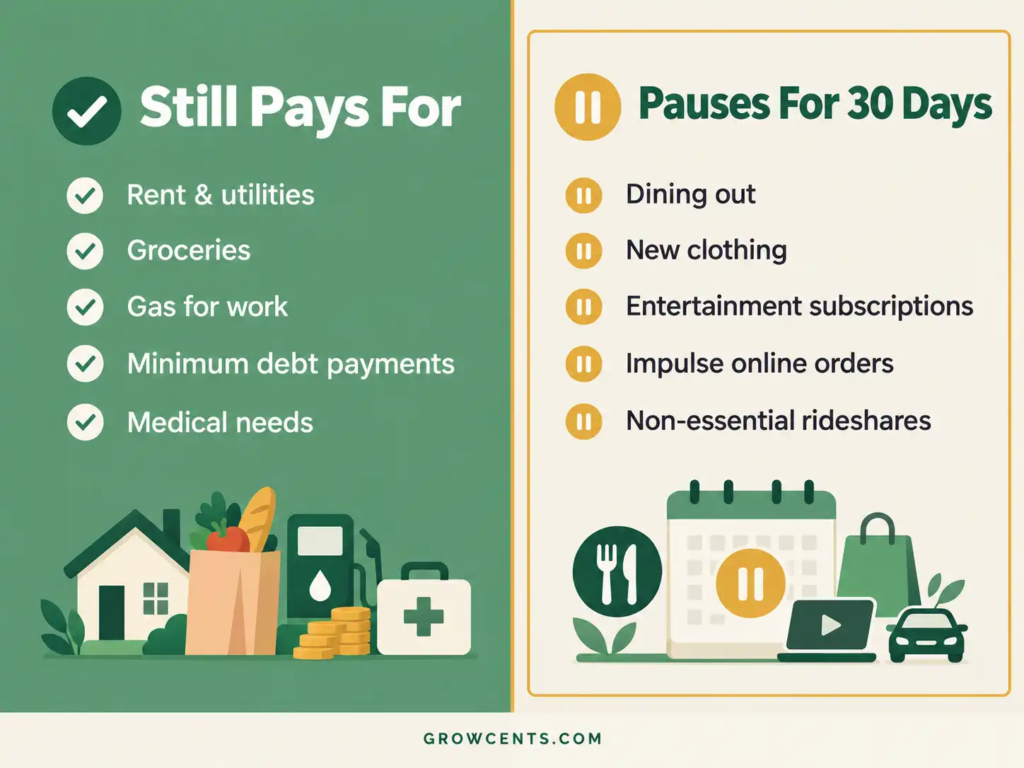
Quick Answer: A no-spend month means paying only for true necessities — housing, utilities, groceries, transportation to work, minimum debt payments, and medical needs — while pausing dining out, entertainment subscriptions, new clothing, and other discretionary purchases for 30 days. The rules are set in advance, in writing, before the month starts, and the money that would have gone to paused categories is redirected to a specific goal, such as a starter emergency fund or debt payoff.
What a No-Spend Month Actually Is
The goal is not to spend zero dollars for 30 days; a household still pays rent, keeps the lights on, and buys groceries. The goal is to pause every purchase that is not a necessity, using a single, clearly defined month as the boundary. Because the challenge has a fixed end date, it works less like a permanent lifestyle change and more like a short, deliberate reset: a way to see current spending clearly by removing it for a while, rather than trying to track it in the moment.
What Counts as “No Spending” (and What Doesn’t)
The specific rules are set by each household, but a workable starting split looks like this:
| Category | Typically Still Paid | Typically Paused |
|---|---|---|
| Housing | Rent or mortgage, utilities, insurance | Home decor, furniture upgrades |
| Food | Groceries for meals at home | Restaurants, takeout, coffee shop drinks |
| Transportation | Gas or transit needed for work, car insurance | Rideshares for convenience, non-essential trips |
| Debt and bills | Minimum payments, phone and internet | Extra discretionary payments beyond minimums (unless that is the specific goal) |
| Personal | Prescriptions, medical needs, existing subscriptions already committed to for the month | New clothing, subscriptions, streaming add-ons, entertainment, hobbies |
Two common gray areas are worth deciding on in advance: gifts for events that fall during the month (a birthday, a wedding), and small planned exceptions like a haircut that was already overdue. Deciding these rules before the month starts, rather than in the moment, is what keeps the challenge from unraveling on day three.
Why a Full Month, Specifically
A single week is often too short to reveal real spending patterns, since many discretionary purchases (a subscription renewal, a once-a-month dinner out) do not happen every week. A full month captures a more complete picture. There is also a behavioral reason a defined stretch of time helps: research from University College London on habit formation found that, on average, it took participants about 66 days for a new behavior to become automatic, though the range across different behaviors and people ran from 18 to as long as 254 days. A single month will not permanently rewire spending habits on its own, but it is long enough to interrupt the automatic pattern and create a clear before-and-after comparison in actual spending.
How to Prepare Before Day One
1. Write the Rules Down
List exactly what is paused and what is still allowed, including the gray-area decisions above. A rule that only exists in someone’s head is easy to renegotiate mid-month.
2. Set a Destination for the Savings
Decide in advance where the paused spending will go: a starter emergency fund, extra debt payments, or a specific savings goal. A challenge with no destination for the money tends to just shift spending to the following month instead of reducing it overall.
3. Stock Up on Real Necessities
Check the pantry, household supplies, and anything that would otherwise trigger an “emergency” purchase mid-month, and make sure genuine necessities are covered before day one so a legitimate need does not get mistaken for a rule violation.
4. Plan Free or Already-Paid-For Activities
A month with nothing to do but stay home often breaks down by the second week. Lining up free activities in advance (library programs, parks, existing hobbies that need no new purchases) fills the gap that discretionary spending used to fill.
5. Tell the People It Affects
A partner, roommate, or regular dinner companions will notice the change. Explaining the challenge and its end date in advance avoids awkward moments and often turns a solo effort into shared accountability.
Running the Month, Week by Week
- Week 1: The hardest week for most people, since old habits and cues (a regular coffee run, a lunch order) are still fresh. Expect friction and treat any minor slip as information, not failure.
- Week 2: Boredom or frustration often peaks here, which is where the free-activity plan from preparation matters most.
- Week 3: Spending decisions typically get easier as new defaults start to form, consistent with the gradual, front-loaded pattern habit-formation research describes.
- Week 4: A good time to look back at what was actually paused and start deciding which changes are worth keeping permanently versus which were only sustainable for a short challenge.
No-Spend Month: Allowed vs. Paused
Common Pitfalls
- Vague rules. “Cut back on eating out” is easy to reinterpret mid-month; “zero restaurant meals in October” is not.
- No plan for boredom. Discretionary spending often fills unstructured time; removing it without a replacement plan makes the challenge harder than it needs to be.
- Treating one slip as total failure. A single unplanned purchase does not undo the rest of the month; research on habit formation specifically found that missing a single opportunity did not meaningfully derail the overall process.
- No destination for the savings. Without a specific goal, paused spending often just resumes the following month instead of building toward something.
- Picking the hardest possible month. A month with a major holiday, a wedding, or a planned trip already built in usually is not the best test case for a first attempt.
After the Month: What to Do With What Was Saved
At the end of the 30 days, two things are worth doing before moving on. First, total the amount redirected to the savings goal and move it there if it has not already been transferred automatically. Second, review the month honestly: which paused categories were genuinely not missed, and which ones are worth reintroducing at a smaller, more intentional level rather than a full return to the previous pattern. This is also a natural point to fold the lesson into an ongoing household budget, so the categories that were easiest to live without get a permanently smaller allocation going forward, rather than the change disappearing the moment the challenge ends.
Frequently Asked Questions
Is a no-spend month the same as extreme frugality?
Not quite. A no-spend month is time-limited by design, which is part of what makes it manageable; ongoing frugal habits are a separate, longer-term practice covered in guides like cutting a grocery bill.
What if an emergency happens during the month?
Genuine emergencies are paid for regardless of the challenge; the point of a no-spend month is to pause discretionary spending, not to avoid necessary expenses. This is exactly the kind of situation a starter emergency fund is meant for.
Can a no-spend month work with kids in the household?
It can, with adjusted rules; most households with children still pay for school-related necessities and existing commitments, and simply pause new, optional purchases (extra toys, entertainment, dining out) rather than anything that affects a child’s basic needs.
Should existing subscriptions be canceled for the month?
That is a household’s own call. Canceling and resubscribing sometimes costs more in hassle than it saves for a single month; pausing new subscriptions while letting existing ones run out naturally is a common middle ground.
What’s a realistic way to try this for the first time?
Starting with a two-week trial run before committing to a full month is a reasonable way to test the rules and adjust anything unrealistic before the real 30-day attempt.
How This Guide Was Built
This guide was researched using published academic research and consumer education resources rather than personal anecdote or invented statistics. The habit-formation timeframe (an average of 66 days, ranging from 18 to 254 days) comes from University College London’s coverage of the Lally et al. (2009) study, published in the European Journal of Social Psychology. The savings-planning framework draws on the Consumer Financial Protection Bureau’s Your Money, Your Goals toolkit. General budgeting categories reference the FTC’s consumer.gov budgeting guide. GrowCents’ full research and sourcing approach is described on the Editorial Policy page and the About page.
This article is general educational information, not personalized financial advice, and does not account for any individual household’s full financial situation. See the Disclaimer page for details.
