How to Budget on an Irregular or Variable Income

Last verified: September 2026.
A budget assumes a number to plan around, and for people whose pay changes from month to month, that number keeps moving. Freelancers, gig workers, seasonal workers, commission earners, and hourly workers with changing schedules all face the same problem: the bills arrive on a fixed schedule, and the income does not. This guide explains how common the problem is, then walks through a practical method built around a baseline, a buffer, and a priority list for the extra money, using a fully worked 12-month example.
Quick Answer: Budget against a baseline instead of an average: the lowest realistic monthly income from the past year. Pay all essentials and goals from that baseline, deposit all income into one holding account, and pay yourself a steady monthly amount from it. In months above the baseline, the extra first builds a buffer worth about one month of expenses, then flows to goals in a set priority order. Self-employed workers also need to set aside money for taxes, which are not withheld automatically.
How Common Variable Income Is
Irregular income is more widespread than it may seem. According to the Federal Reserve’s survey of household economics, 29 percent of U.S. adults in 2024 said their income varied at least occasionally from month to month. The share was much higher among the self-employed, at 59 percent, and 41 percent of adults who had done any gig work in the prior month reported varying income, compared with 26 percent of those who had not. Eleven percent of all adults said they had struggled to pay bills in the past year because their income varied, including 19 percent of adults with incomes under $25,000 and 3 percent of those earning $100,000 or more. The pattern points to a practical lesson: swings in income are manageable with a buffer, and much harder without one.
Step 1: Find the Baseline
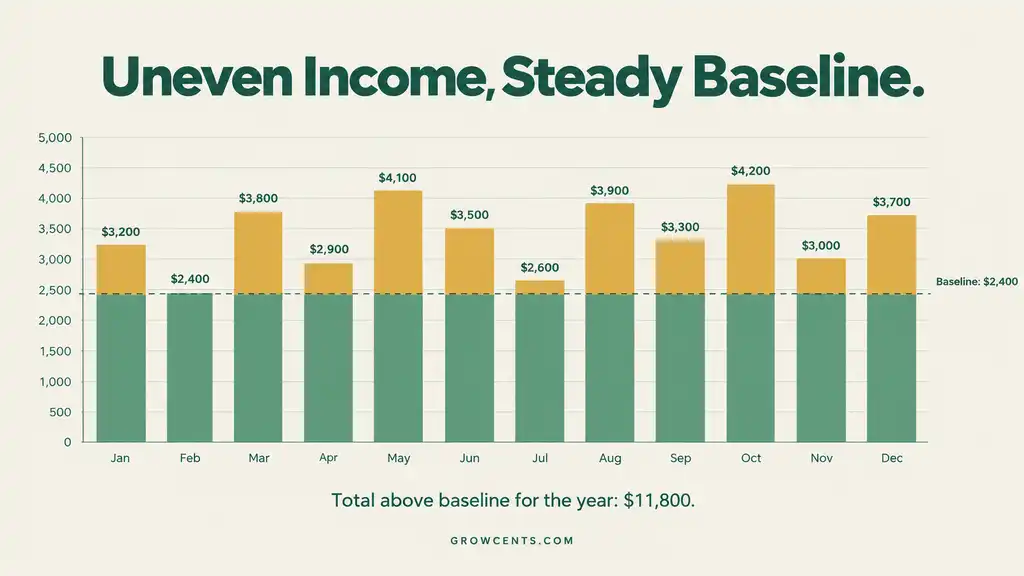
List actual income, after taxes, for each of the last 12 months, using deposits rather than invoices or memory. The table below shows an illustrative year for one household.
| Month | Take-Home Income | Above $2,400 Baseline |
|---|---|---|
| January | $3,200 | $800 |
| February | $2,400 | $0 |
| March | $3,800 | $1,400 |
| April | $2,900 | $500 |
| May | $4,100 | $1,700 |
| June | $3,500 | $1,100 |
| July | $2,600 | $200 |
| August | $3,900 | $1,500 |
| September | $3,300 | $900 |
| October | $4,200 | $1,800 |
| November | $3,000 | $600 |
| December | $3,700 | $1,300 |
| Total | $40,600 | $11,800 |
The average month here is about $3,383, but budgeting against that average would leave the household short in six of the twelve months. The lowest month was $2,400, so that becomes the baseline: the amount the household can count on in a typical bad month. A slightly less conservative option is the average of the three lowest months, which is about $2,633 in this example, though it leaves little margin for a month that comes in below the historical low. For a household with highly seasonal income, another common option is to divide the full year’s total by 12 and treat that amount as a salary, as long as a holding account carries the surplus from busy months into slow ones.
A Year of Uneven Income Against a Baseline — Infographic
Step 2: Budget Only the Baseline
Build the monthly budget around $2,400, not around the best month. Essentials and minimum debt payments go first, then savings and a few wants, using whichever method fits: a zero-based budget applied to the baseline, or the 50/30/20 rule applied to the baseline amount. The FTC’s guide to making a budget recommends starting from the income that actually comes in, and for variable earners that means the dependable floor. If essentials alone cost more than the baseline, the plan has to change on one side or the other: reduce fixed costs, raise the baseline through more reliable work, or both.
Step 3: Use One Holding Account and Pay Yourself a Steady Amount
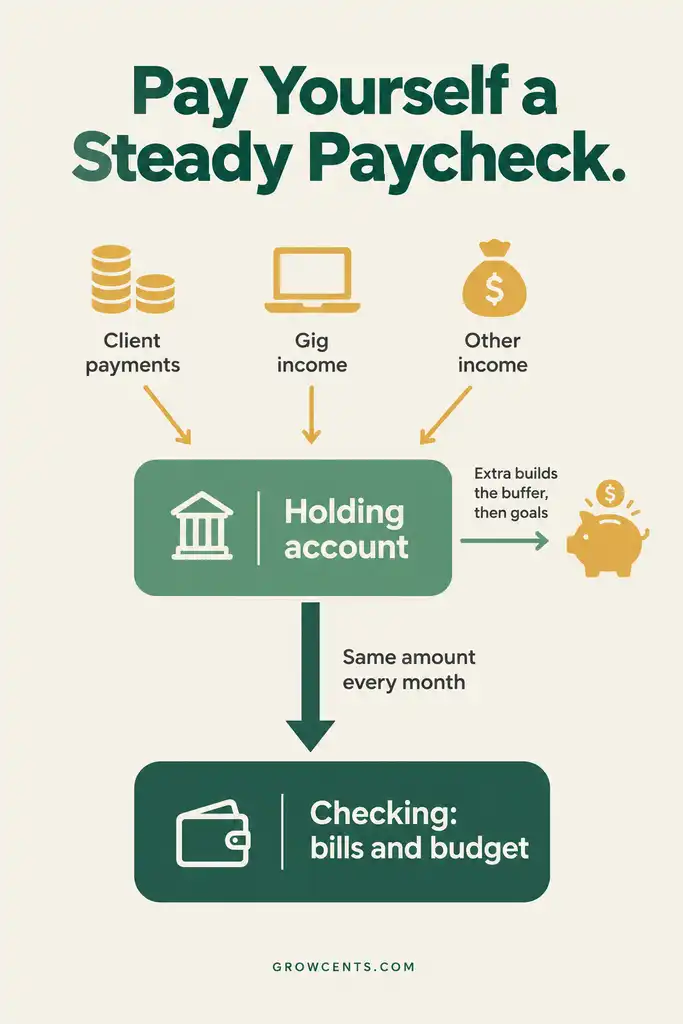
The mechanism that makes a baseline work is a holding account. Every deposit of income goes into it first, and a fixed monthly amount equal to the baseline is transferred out to checking on a set date, which functions like a salary. In a month above the baseline, the extra stays behind in the holding account. In a month below it, the holding account covers the gap. The household’s checking account then sees the same deposit every month, which keeps spending predictable even though the income is not.
The Holding Account Method — Infographic
Step 4: Build a One-Month Buffer First
The first job of the extra money is to build a buffer equal to one month of baseline expenses, which in this example is $2,400. In the illustrative year, the buffer fills in April, when the cumulative amount above the baseline reaches $2,700. Once the buffer exists, the household can live on money already in the bank rather than money still to arrive, which also solves the timing problem of bills due before a client pays. This buffer is separate from the emergency fund, which covers unexpected costs; the buffer exists to smooth income. For anyone with variable earnings, both matter, and the buffer usually comes first because it keeps ordinary months running.
Step 5: Give the Extra Money a Priority List
After the buffer is full, every dollar above the baseline needs a destination decided in advance. Without a list, extra money in a good month tends to be spent in a good month. The table below shows one illustrative way to allocate the remaining $9,400 of the example year ($11,800 minus the $2,400 buffer).
| Priority | Destination | Illustrative Annual Amount |
|---|---|---|
| 1 | Emergency fund | $3,500 |
| 2 | Extra debt payments | $2,500 |
| 3 | Sinking funds for irregular expenses | $1,500 |
| 4 | Longer-term savings goal | $1,200 |
| 5 | Flexible spending | $700 |
| Total | $9,400 |
The order and amounts are examples, not recommendations. What matters is that the order exists before the money arrives. A sinking fund tracker is a natural home for the irregular-expense share.
Step 6: Handle Taxes if the Income Is Self-Employment
Workers paid as employees have taxes withheld from each paycheck. Self-employed workers do not, so the money has to be set aside deliberately. The IRS explains on its estimated taxes page that taxes must be paid as income is earned or received during the year, either through withholding or estimated tax payments, and that estimated tax covers self-employment tax as well as income tax. Self-employment tax runs at a combined rate of 15.3 percent, made up of Social Security and Medicare components, as described in IRS Topic No. 554. The Taxpayer Advocate Service lists the 2026 quarterly due dates as April 15, June 15, September 15, and January 15, 2027, with estimated payments generally required for anyone expecting to owe $1,000 or more when filing.
A practical approach is to move a set share of every payment into a separate tax account the day it arrives, so the money is never mistaken for spendable income. The right share depends on income level, deductions, and location, so a tax professional or the worksheet in Form 1040-ES can set it. The IRS notes that estimated taxes can be paid more often than quarterly if that is easier, which suits a household that sets money aside with every payment. The baseline in this guide should be calculated from after-tax amounts, which means the tax set-aside comes off the top before anything else.
Step 7: Review Every Quarter
A baseline set from last year’s numbers can drift. Recalculating each quarter, using the most recent 12 months, keeps it matched to reality. If the lowest month has risen, the baseline can rise with it. If income has fallen, lowering the baseline early prevents a slow drain on the buffer.
Common Mistakes
- Budgeting against the average. In the example above, the average month would have left the household short in six of twelve months.
- Treating a great month as the new normal. One strong month lifts the average but not the baseline.
- Mixing business and personal money. A holding account kept separate from everyday spending makes the system visible and keeps tax money from disappearing.
- Skipping the tax set-aside. A large tax bill that arrives with no cash set aside is one of the most common sources of trouble for self-employed workers.
- Raising spending after a good stretch. Lifestyle changes made in busy months become hard to sustain in slow ones.
- No plan for the extra. Without a priority list, surplus money gets absorbed into ordinary spending.
Frequently Asked Questions
What if there is no history to calculate a baseline from?
For a new freelancer or a new job, a conservative estimate based on the lowest income that seems realistic is a reasonable start, and the baseline can be adjusted as real months accumulate.
Should the baseline be the lowest month or the average of the lowest months?
The lowest month is the safest choice because it leaves no shortfall in the historical record. The average of the lowest three months is a little less cautious and gives somewhat more to spend, at the risk of a thinner margin if a worse month arrives.
Can this work with a spouse who has steady pay?
Yes. Many couples budget the steady paycheck as the core of the household budget and apply the baseline method to the variable income only, using the extra from busy months for goals and for the buffer.
How big should the buffer be?
One month of baseline expenses is a common first target because it covers the timing gap between bills and payments. Some households build toward two or three months once the first month is in place.
Do I still need an emergency fund?
Yes. The buffer smooths ordinary swings in income, while an emergency fund covers unexpected costs and larger disruptions. Both are useful for variable earners.
How This Guide Was Built
This guide was researched using Federal Reserve survey data, IRS guidance, and consumer education sources rather than personal anecdote or invented statistics. The prevalence of variable income comes from the Federal Reserve’s 2024 Economic Well-Being of U.S. Households report. Tax rules come from the IRS’s estimated taxes page, Topic No. 554, and the Taxpayer Advocate Service’s 2026 due-date guidance. The budgeting basics reference the FTC’s consumer.gov budgeting guide. The holding-account and baseline method is a widely used planning technique rather than a government program, and its example figures (including the 12-month table, the $2,400 baseline, and the $9,400 allocation) are illustrations built for this guide, calculated directly and not sourced data. GrowCents’ full research and sourcing approach is described on the Editorial Policy page and the About page.
This article is general educational information, not personalized financial or tax advice, and does not account for any individual household’s full situation. Tax rules and due dates can change, so confirm current requirements with the IRS or a tax professional. See the Disclaimer page for details.