
How to Use a Sinking Fund Tracker to Stay on Top of Irregular Costs
Last verified: September 2026.
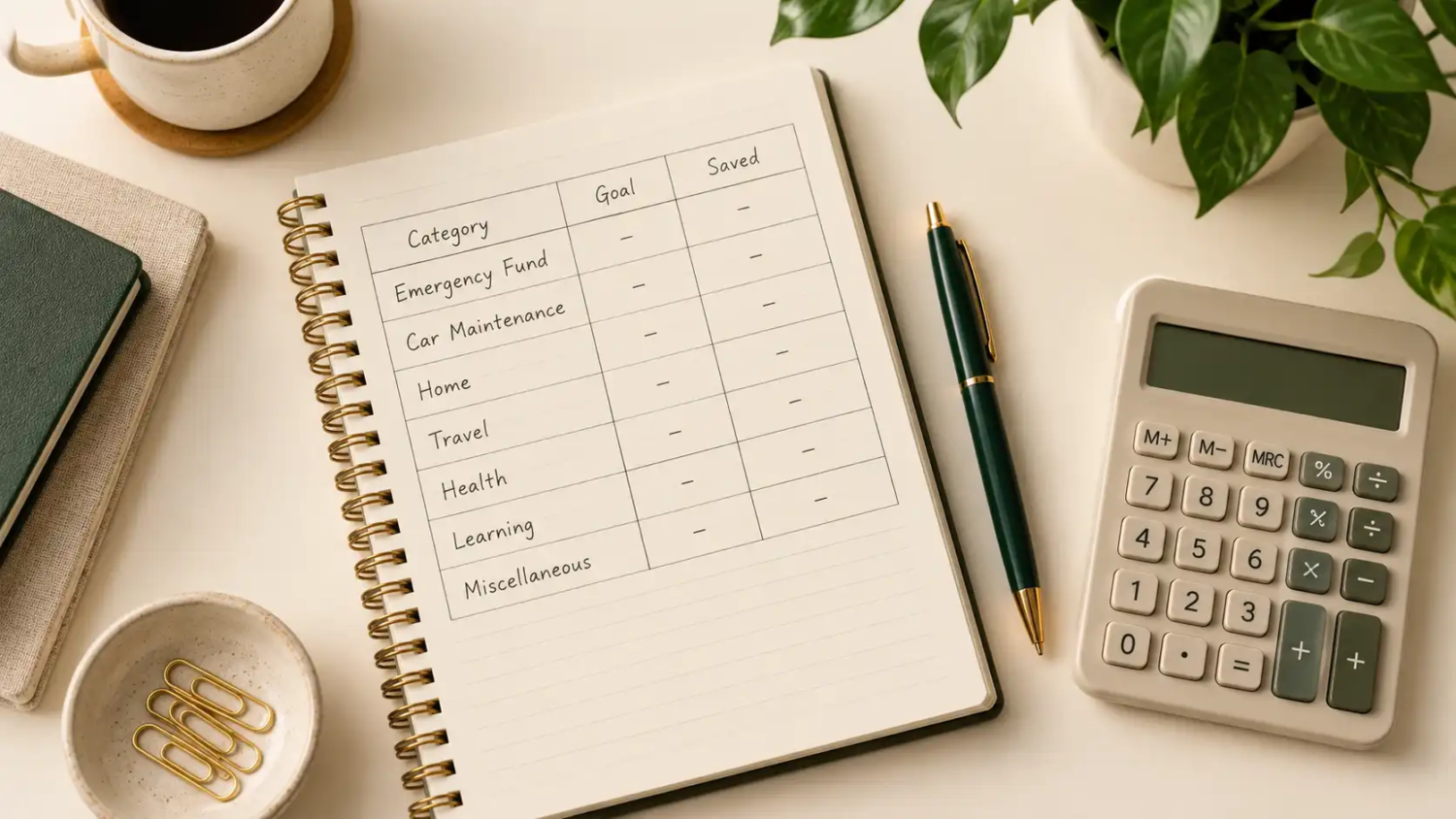
A sinking fund tracker is simply a running record of several small savings goals at once, each one tied to a specific irregular expense — car insurance, holiday gifts, an annual subscription, a dental checkup — rather than one general pool of savings. This guide covers how a sinking fund tracker differs from an emergency fund, how to build one, and how to keep it from becoming more complicated than it needs to be.
Quick Answer: A sinking fund tracker lists each irregular, non-monthly expense, its annual total divided into a monthly savings amount, and a running balance showing how close each one is to fully funded. It can be a few columns in the same spreadsheet already used for a household budget, updated every payday alongside regular budget categories, and kept separate in purpose (though not necessarily in a separate bank account) from a starter emergency fund.
Sinking Fund vs. Emergency Fund
| Header Label | Sinking Fund | Emergency Fund |
|---|---|---|
| Purpose | Known, expected expenses that happen irregularly | Unknown, unexpected expenses |
| Example | Car registration, holiday gifts, annual insurance premium | A sudden medical bill, a job loss, an urgent repair |
| When it’s “done” | Refills after each use, on a predictable cycle | Stays intact; ideally only touched for genuine emergencies |
Both are useful, and neither replaces the other. A household that only has an emergency fund often ends up draining it for predictable costs like holiday spending, which defeats the purpose of keeping that money reserved for true emergencies.
What a Sinking Fund Tracker Actually Tracks
At minimum, a sinking fund tracker needs four pieces of information per fund: the name of the expense, the total amount needed, the monthly amount being set aside, and the current running balance. Everything else (due dates, notes, a progress bar) is optional on top of that core structure.
Step 1: List Irregular Expenses and Their Annual Totals
Start by listing every expense that is not monthly but still predictable over the course of a year:
| Expense | Annual Total | Monthly Amount (Annual ÷ 12) |
|---|---|---|
| Car insurance (paid twice yearly) | $900 | $75 |
| Holiday gifts | $600 | $50 |
| Car maintenance | $480 | $40 |
| Annual subscriptions (software, memberships) | $240 | $20 |
| Dental and vision care | $360 | $30 |
In this example, the total monthly amount across all five funds is $215, which is the figure that belongs in the household budget as its own category, rather than being absorbed silently into “miscellaneous.”
Step 2: Build the Tracker
A spreadsheet handles this well, using the same tab-and-formula structure covered in the guide to building a budget spreadsheet: one row per fund, a column for the target amount, a column for the monthly contribution, and a running balance column that adds the monthly contribution each time it is logged. A simple =previous balance + monthly contribution formula keeps the running total current without retyping anything by hand each month.
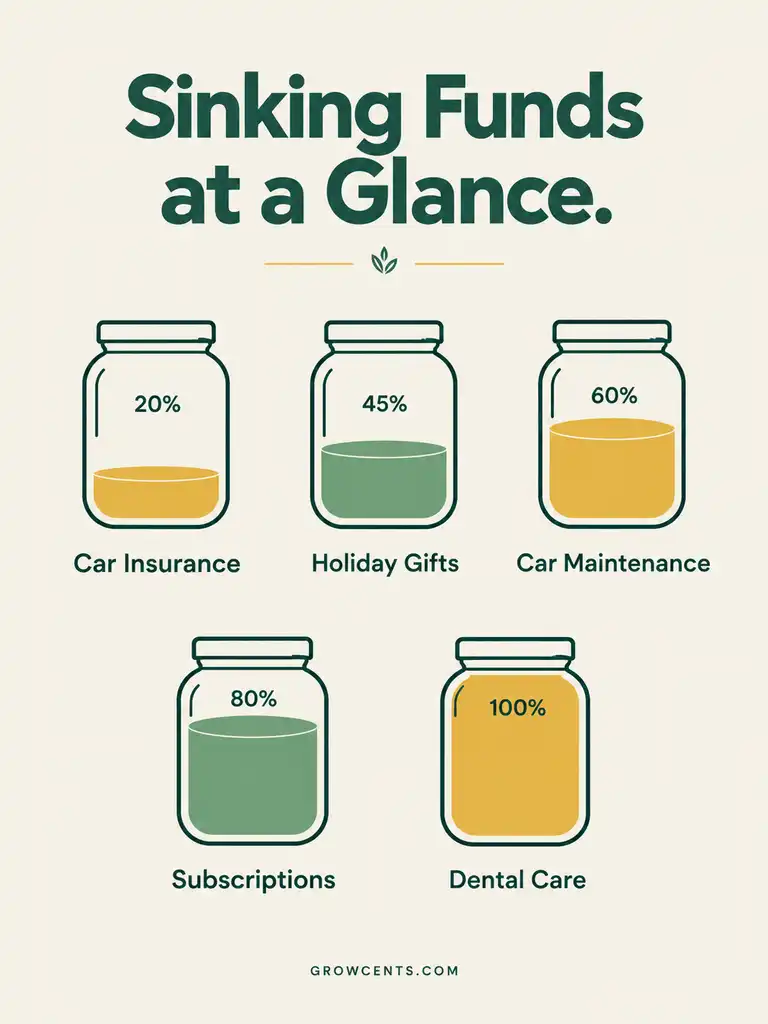
Sinking Funds at Different Fill Levels — Infographic
Step 3: Decide Where to Keep the Money
Two common approaches both work: keeping all sinking funds in one savings account and tracking the breakdown only in the spreadsheet, or opening several named sub-accounts at a bank that supports them, with one sub-account per fund. The single-account approach is simpler to set up; the multiple-sub-account approach makes it harder to accidentally spend one fund’s money on another fund’s expense. Either way, keeping the money in an FDIC-insured savings account, rather than a checking account attached to a debit card, adds the same protection and friction benefits that apply to an emergency fund.
Step 4: Update It Every Payday
The tracker is only useful if the running balances stay current. Updating it on the same schedule as regular budget contributions, immediately after each paycheck, takes a few minutes and avoids the situation where a car registration bill arrives and nobody is sure whether the fund actually has enough in it.
Common Sinking Fund Categories
- Car insurance, registration, and maintenance
- Holiday gifts and seasonal spending
- Annual subscriptions and memberships
- Home maintenance and appliance repairs
- Medical, dental, and vision costs not covered by routine budgeting
- Pet care, including annual vet visits
- Travel and vacations
Not every household needs all of these; the right list is whichever irregular expenses have actually caused budget trouble in the past.
Common Mistakes
- Creating too many separate funds. A sinking fund tracker with fifteen tiny categories becomes tedious to maintain; starting with the three or four expenses that have caused the most budget disruption in the past is more sustainable.
- Forgetting to refill a fund after it’s used. A sinking fund is meant to be a recurring cycle, not a one-time save-and-spend; the monthly contribution should continue after each use.
- Mixing sinking fund money with the emergency fund. Using the emergency fund for a predictable holiday season, or vice versa, defeats the purpose of having two separate categories in the first place.
- Setting the monthly amount without checking the actual annual total. Guessing at a round number instead of dividing the real annual cost by 12 often leaves a fund short right when it is needed.
Frequently Asked Questions
Is a sinking fund the same as a separate savings account?
Not necessarily; a sinking fund is a budgeting concept (money earmarked for a specific future expense), while a separate account is just one possible place to physically keep it. The tracker itself is what actually separates the funds for planning purposes.
How many sinking funds should a household have?
There is no fixed number; starting with three to five of the most disruptive irregular expenses and adding more only if they prove genuinely useful tends to work better than starting with a long list.
What happens if an expense costs more than expected?
The tracker’s monthly contribution for that fund can simply be adjusted going forward; a sinking fund estimate is a starting point based on past costs, not a guarantee of the exact future amount.
Should sinking fund money earn interest?
Where practical, yes; keeping sinking fund balances in a high-yield savings account rather than a non-interest checking account earns a small amount of extra money with no added risk, since the funds are typically needed within a year.
Can a sinking fund tracker replace a full household budget?
No; it is a companion to a household budget, specifically handling the irregular-expense category that a monthly budget alone often misses.
How This Guide Was Built
This guide was researched using official consumer financial education resources rather than personal anecdote or invented statistics. The principle of dividing annual irregular expenses into monthly amounts reflects the budgeting approach described by the FTC’s consumer.gov budgeting guide and the Consumer Financial Protection Bureau’s Your Money, Your Goals toolkit, both of which address planning for expenses that fall outside a typical month. Deposit insurance details reference the FDIC’s official coverage guidance. The example figures in the tables above are illustrative only, not sourced data. GrowCents’ full research and sourcing approach is described on the Editorial Policy page and the About page.
This article is general educational information, not personalized financial advice, and does not account for any individual household’s full financial situation. See the Disclaimer page for details.