Zero-Based Budgeting for Beginners: A Step-by-Step Household Guide

Last verified: September 2026.
Zero-based budgeting has one rule: income minus planned spending, saving, and debt payments equals zero. Every dollar gets a job before the month begins, and nothing is left floating in checking to be spent on whatever comes up. It is one of the most structured ways to budget, which makes it a strong fit for some households and an annoying one for others. This guide explains what the method does and does not mean, walks through a complete worked example, and covers the situations where it needs adjusting, such as irregular income and irregular expenses.
Quick Answer: To build a zero-based budget, add up expected take-home income for the month, list every expense, savings goal, and debt payment, and keep adjusting amounts until income minus all of them equals exactly zero. Zero does not mean an empty bank account. It means every dollar has an assigned purpose, including savings and a small buffer. The method works best with predictable income, and it needs sinking funds for irregular costs and a monthly rebuild to stay accurate.
What Zero-Based Budgeting Means (and Does Not Mean)
The name comes from a corporate budgeting technique in which every expense has to be justified from a zero base each period rather than carried forward from last year’s numbers. The household version borrows the idea: instead of starting from last month’s spending, each month starts with a blank page, and every dollar of expected income is assigned somewhere. Ramsey Solutions, which publishes a widely read guide to the household method and builds its EveryDollar app around it, is explicit in its own guide to the method that a zero-based budget does not mean a zero balance in the bank. It means income minus all planned expenses equals zero, so money set aside for savings, debt payoff, or a buffer counts as spent in the budget because it has a job.
A Worked Example: $4,000 in Take-Home Income
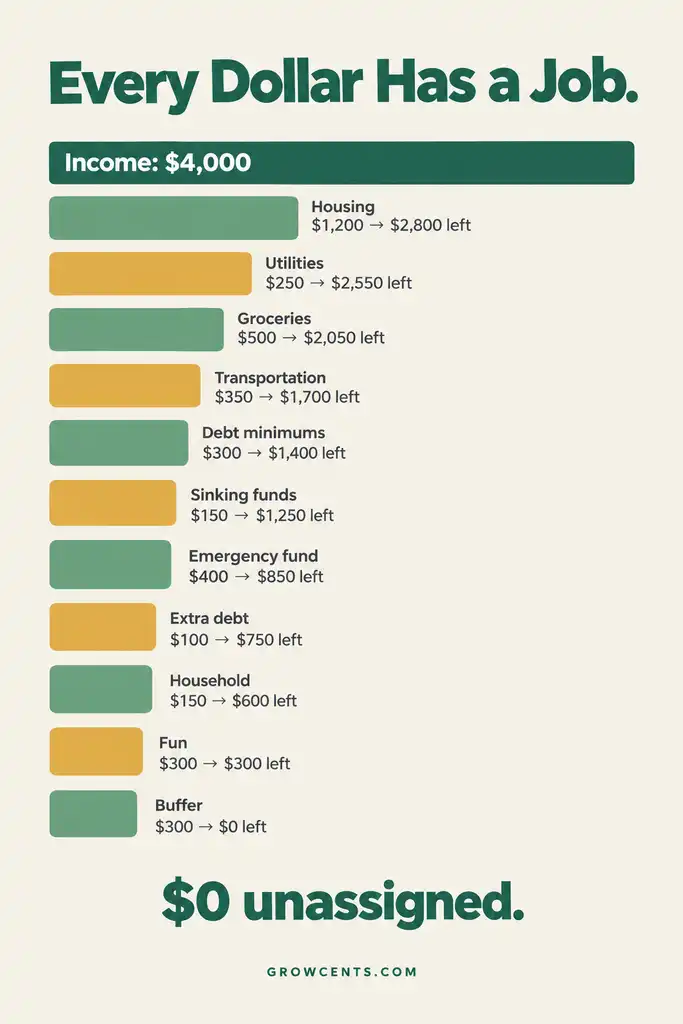
The table below shows one illustrative way a household with $4,000 of monthly take-home pay might assign every dollar. The categories and amounts are examples, not recommendations, and real numbers depend on location, household size, and existing debt.
| Category | Planned Amount |
|---|---|
| Housing (rent or mortgage, insurance) | $1,200 |
| Utilities, phone, and internet | $250 |
| Groceries | $500 |
| Transportation | $350 |
| Minimum debt payments | $300 |
| Sinking funds for irregular expenses | $150 |
| Emergency fund savings | $400 |
| Extra debt payment | $100 |
| Household and personal care | $150 |
| Discretionary spending | $300 |
| Buffer for the unexpected | $300 |
| Total assigned | $4,000 |
Income of $4,000 minus $4,000 of assigned amounts leaves $0 unassigned, but $400 is flowing into an emergency fund, $150 into sinking funds, $100 into extra debt payoff, and $300 into a buffer. The zero is about assignment, not about spending everything.
Every Dollar Has a Job — Infographic
How to Build a Zero-Based Budget, Step by Step
1. Calculate Expected Take-Home Income for the Month
Use the amount that actually lands in the account after taxes and deductions. The FTC’s consumer education site, in its guide to making a budget, starts the same way: count what actually comes in before deciding what goes out. For the full process of gathering income and expenses, the household budgeting guide covers the groundwork.
2. List Every Fixed Expense
Rent or mortgage, insurance, loan minimums, and subscriptions come first because they are known and non-negotiable for the month.
3. Add Variable Expenses Using Real Numbers
Groceries, fuel, and utilities that move month to month are best estimated from the last two or three months of statements, not from memory.
4. Add Savings and Debt Goals as Line Items
Savings and extra debt payments belong in the plan as categories, not as whatever happens to be left. This is where a starter emergency fund contribution gets its own line, and where a sinking fund tracker handles irregular costs.
5. Subtract Until the Result Is Zero
If money remains, assign it to a goal, such as extra savings or debt payoff. If planned spending exceeds income, trim discretionary categories first, since fixed costs are harder to change quickly.
6. Track and Adjust During the Month
When one category runs short, move money from another instead of ignoring the overspend. That keeps the total at zero and shows where the plan was unrealistic. A budget spreadsheet or a zero-based app can handle the tracking.
7. Rebuild the Budget Every Month
The defining habit of the method is starting fresh each month, not copying the last one forward. Income, bills, and goals change, and the monthly rebuild is what keeps the plan matched to real life.
Where Zero-Based Budgeting Gets Hard
- Irregular income. NerdWallet’s explainer on the method notes it can be a poor fit for freelancers and hourly workers whose pay changes. A common workaround is to budget from the lowest typical month and assign any extra when it arrives.
- Irregular expenses. The same explainer cautions that a zero-based budget can leave a household short if annual and seasonal costs are not planned for, which is exactly what sinking funds are for.
- Time. Building and updating the plan every month takes more effort than a looser method. Intuit’s overview of the method lists the time commitment and limited flexibility among its drawbacks.
- Surprise spending. With every dollar assigned, an unplanned expense has to come from somewhere. A buffer line and a funded emergency fund reduce the pressure.
How It Compares With Other Methods
| Method | How It Works | Effort | Best For |
|---|---|---|---|
| Zero-based | Every dollar assigned to a category until income minus plan equals zero | Higher; monthly rebuild | Households that want tight control and have predictable income |
| Percentage-based (such as 50/30/20) | Income split into broad needs, wants, and savings buckets | Lower | People who want simple guardrails |
| Envelope | Each category has a fixed pot that cannot be exceeded (see the envelope budgeting apps guide) | Medium | People who overspend in a few specific categories |
The methods overlap. A zero-based budget can use the 50/30/20 split to decide how big each group should be, then assign every dollar inside those groups. Free tools that support zero-based planning are covered in the guide to free budgeting apps.
Common Mistakes
- Treating zero as “spend it all.” Savings, debt payoff, and a buffer are all valid assignments; the goal is a plan, not a spending spree.
- Using last month’s numbers without checking. Real statements beat memory, and bills change.
- Skipping the buffer. A budget with no margin breaks the first time something unexpected happens.
- Forgetting irregular expenses. Annual costs divided into monthly amounts keep the plan honest.
- Giving up after a messy first month. The first attempt is mostly about finding where the estimates were off, and the second is almost always more accurate.
Frequently Asked Questions
Does zero-based budgeting mean spending every dollar?
No. It means assigning every dollar, including to savings, debt payments, and a buffer. The money in the savings category is still there; it just has a purpose.
Can zero-based budgeting work with irregular income?
It can with adjustments. Budgeting from the lowest typical month and assigning extra income as it arrives keeps the plan realistic. Some people find a looser method easier when income swings widely.
How often should the budget be rebuilt?
Monthly is the standard approach. A major change, such as a new job, a move, or a new dependent, usually calls for rebuilding right away.
What if the budget does not zero out by month end?
Leftover money should be assigned to a goal, such as savings or debt payoff, and overspending in one category should be offset by reducing another. The point of the method is to notice the gap and respond to it.
Is an app required?
No. A notebook, a printed worksheet, or a spreadsheet works. Apps can speed up tracking, but the method itself is just arithmetic and discipline.
How This Guide Was Built
This guide was researched using official consumer finance resources and published explanations of the method rather than personal anecdote or invented statistics. Zero-based budgeting is a personal finance technique rather than a government program, so there is no official government source for the method itself. The definition and clarification that zero does not mean an empty account come from Ramsey Solutions, whose published guide is a primary description of the household method. The limitations for irregular income and expenses come from NerdWallet and Intuit. The general budgeting steps reference the FTC’s consumer.gov budgeting guide. The worked example is an illustration built for this guide, not sourced data, and the amounts add to exactly $4,000. Companies are named descriptively and not as recommendations. GrowCents’ full research and sourcing approach is described on the Editorial Policy page and the About page.
This article is general educational information, not personalized financial advice, and does not account for any individual household’s full financial situation. See the Disclaimer page for details.