
The 52-Week Savings Challenge: How It Works and Who It’s Best For

Last verified: September 2026.
The 52-week savings challenge is one of the most widely shared savings methods because the rule fits on one line: save $1 in week one, $2 in week two, and keep adding $1 each week until week 52. It is an informal method rather than an official program or a researched one, and it comes in several versions. This guide explains how it works, shows the real numbers behind each version, and covers who it suits and where it tends to break down, so a household can choose the version that actually fits its year.
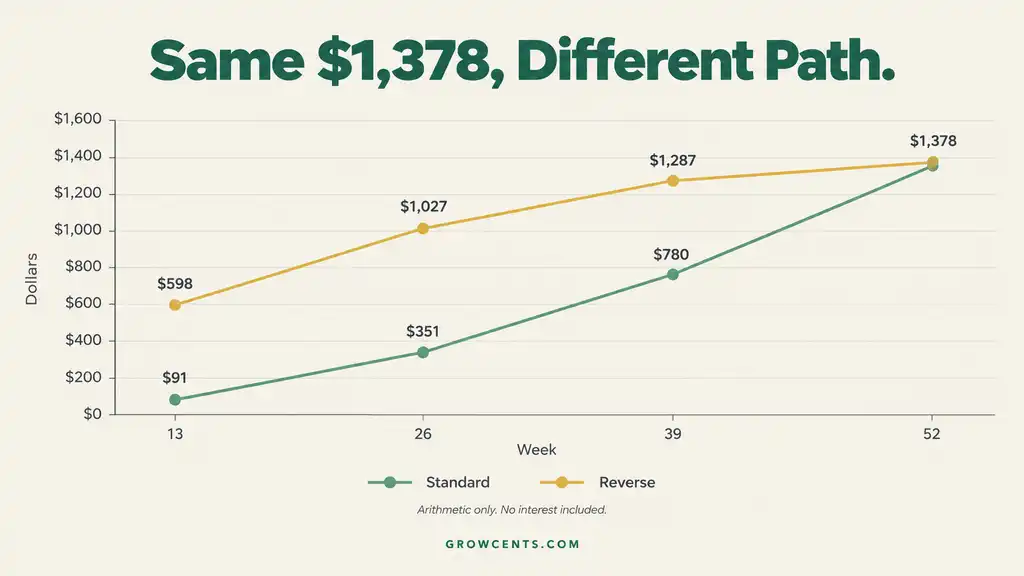
Quick Answer: In the standard version, the weekly deposit rises from $1 to $52 and the full year adds up to $1,378, an average of $26.50 a week. Only about a quarter of that total ($351) is saved by the midpoint, because the large deposits come at the end of the year. A reverse version, starting at $52 and falling to $1, saves the same $1,378 but front-loads the effort. It works best for people who like visible progress and have steady income, and it is a weaker fit for irregular income or for anyone whose budget gets tight around the holidays.
How the Challenge Works
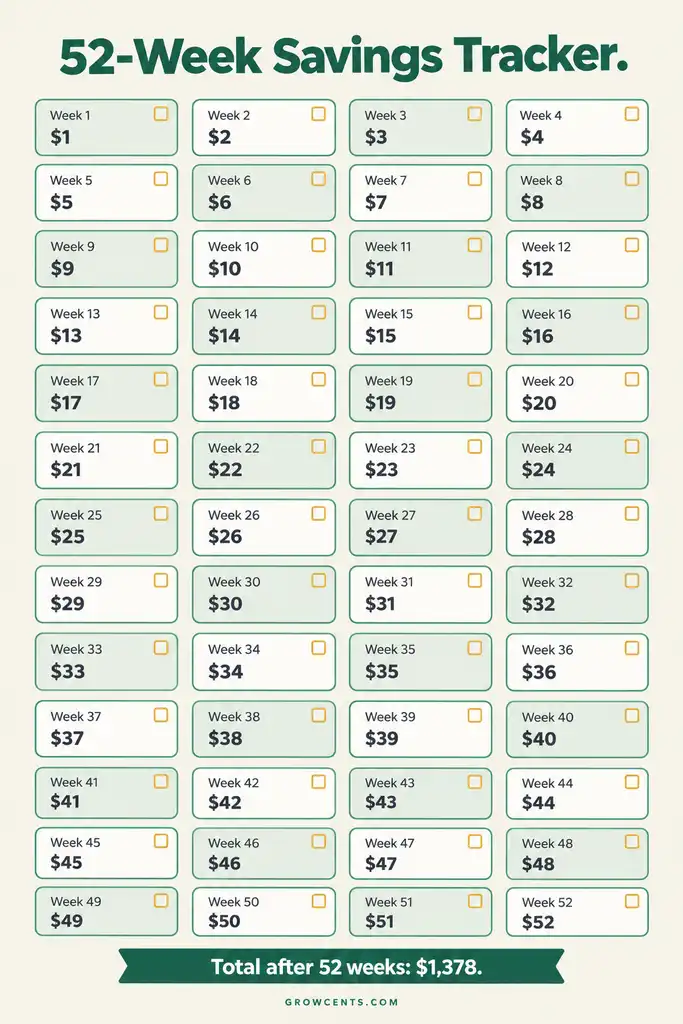
The mechanics are simple. Each week has a deposit amount equal to the week number, the amount is moved into a separate savings place, and the week is checked off on a tracker. After 52 weeks, the deposits total $1,378. Because the total comes from adding the numbers 1 through 52, it does not depend on anything but finishing every week, and it does not require any particular starting month. A household can begin in March or September as easily as January.
Versions of the Challenge and What They Add Up To
| Version | How It Works | Year-End Total | Hardest Stretch |
|---|---|---|---|
| Standard | $1 in week 1, rising by $1 each week to $52 | $1,378 | The final weeks, where deposits are $40 to $52 |
| Reverse | $52 in week 1, falling by $1 each week to $1 | $1,378 | The first weeks, when motivation is high but deposits are largest |
| Fixed weekly amount | The same amount every week, such as $25 | $1,300 at $25 a week | None in particular; the amount is predictable |
| Double-step | $2 in week 1, rising by $2 each week to $104 | $2,756 | The last weeks, where deposits exceed $90 |
| Pay-period version | $2 in the first pay period, rising by $2 over 26 biweekly pay periods to $52 | $702 | The final few pay periods |
All totals above are straightforward arithmetic. There is no interest included, so a savings account that pays interest would add a small amount on top.
Standard vs. Reverse: When the Money Actually Arrives
The two main versions end at the same $1,378 but get there very differently, which matters for staying motivated and for being protected early.
| Point in the Year | Saved in Standard Version | Saved in Reverse Version |
|---|---|---|
| After week 13 | $91 | $598 |
| After week 26 | $351 | $1,027 |
| After week 39 | $780 | $1,287 |
| After week 52 | $1,378 | $1,378 |
In the standard version, the first half of the year adds only $351, about a quarter of the total, and the last three weeks alone require $153. In the reverse version, the last three weeks require just $6. For someone building a starter emergency fund, the difference is concrete: the standard version reaches $500 in week 32 and $1,000 in week 45, while the reverse version reaches $500 in week 11 and $1,000 in week 25.
Standard vs. Reverse: Savings Over the Year — Infographic
Who It Suits Best
- People who like visible progress. A tracker with boxes to check off gives a weekly sense of movement that an automatic transfer does not.
- Households with steady, predictable income. A rising deposit is easier to plan for when the paycheck does not swing from month to month.
- Anyone expecting income to rise during the year. The standard version’s growing deposits can line up with a raise or a bonus.
- People who want a simple, structured goal. The challenge turns an open-ended intention into a clear target with a clear finish.
Where It Tends to Break Down
- The holiday squeeze. A standard version started in January puts its biggest deposits in November and December, the same weeks many households spend the most. Starting in a different month, or choosing the reverse version, avoids that overlap.
- Irregular income. Freelancers and hourly workers can find a fixed schedule of rising deposits hard to meet in a slow stretch; a smaller fixed amount may fit better.
- Tight budgets. Deposits of $40 to $52 a week mean roughly $170 to $225 a month, which is a large ask for a household with little slack. The challenge assumes there is room to find that money.
- Weekly deposits against paychecks that arrive on other schedules. People paid every two weeks or monthly often do better combining weeks into a single pay-period deposit.
52-Week Savings Tracker — Infographic
Making It Fit Real Life
- Pick the version that matches the year. Reverse for people who want early protection or expect a tight Q4, standard for people who want to start gently.
- Choose any start date. The challenge does not need to begin in January to work.
- Use a separate account. A dedicated savings account, such as the kind discussed in the guide to high-yield versus regular savings, keeps the money from blending into everyday spending.
- Automate where possible. A scheduled transfer removes the weekly decision, as covered in the guide to automating savings; some households automate a fixed amount and use the tracker only to see progress.
- Allow catch-ups. Missing a week does not need to end the challenge; adding the missed amount to a later week keeps the total intact.
What $1,378 Can Do
The finished total is modest but useful. According to the Federal Reserve’s survey of household economics and decisionmaking, only 63 percent of U.S. adults in 2024 said they could cover a $400 emergency expense with cash or its equivalent, so $1,378 is more than three times that benchmark. For a household still building a starter emergency fund, the challenge can supply the whole $500 to $1,000 goal and some extra. It is not a full emergency fund, which is usually measured in months of expenses, and it does not replace one.
How It Compares With Other Small-Savings Methods
- The $5 savings challenge keeps the amount small and flat, which is easier on a tight budget but slower.
- The round-up savings challenge adds money passively without any weekly decision.
- A fixed automatic transfer saves the same total with far less effort, which is why the 52-week challenge is best seen as a motivation tool rather than a more efficient way to save.
Common Mistakes
- Starting the standard version in January without a plan for December. The largest deposits collide with the most expensive weeks of the year.
- Treating one missed week as failure. A single gap rarely matters; research on habit formation found that missing one opportunity did not meaningfully derail the process.
- Taking money out for non-emergencies. Dipping into the fund undercuts the point; it works best when held as a separate pot.
- Setting a challenge the budget cannot support. A household budget shows whether $40 to $52 a week is realistic before starting.
- Stopping at week 52 with no next step. Deciding in advance where the $1,378 goes keeps the progress from being absorbed into spending.
Frequently Asked Questions
Is the 52-week challenge an official program?
No. It is an informal method shared widely online and in personal finance circles, with several variations. There is no single official version and no research that tests this specific rule.
Why does it add up to $1,378?
Adding the numbers 1 through 52 gives 1,378. The same total applies whether the deposits rise or fall, as long as every week from 1 to 52 is included once.
What if a week is missed?
The missed amount can be added to a later week or split across several, which keeps the year-end total the same. Skipping the amount entirely lowers the total by that amount.
Is the standard or the reverse version better?
Neither is better for everyone. The reverse version builds protection sooner and avoids heavy deposits at the end of the year, while the standard version starts gently and may suit people with a rising income.
Should this replace automatic saving?
Not necessarily; it works well alongside it. Some people automate a base amount and use the tracker as a visual motivator.
How This Guide Was Built
This guide was researched using government survey data and published research rather than personal anecdote or invented statistics. The challenge itself is an informal method with no official version, and all totals, cumulative figures, and week-by-week milestones in the tables are plain arithmetic that was calculated directly, with no interest included. The context for what $1,378 can do comes from the Federal Reserve’s survey data on unexpected expenses. The “start small and stay consistent” principle comes from the FDIC’s consumer education materials. The habit-formation point draws on University College London’s coverage of the Lally et al. (2009) study. GrowCents’ full research and sourcing approach is described on the Editorial Policy page and the About page.
This article is general educational information, not personalized financial advice, and does not account for any individual household’s full financial situation. See the Disclaimer page for details.