
How to Automate Your Savings Without Feeling the Pinch

Last verified: September 2026.
Most savings plans fail at the same moment: the day money has to be moved by hand. Automation removes that moment. A transfer that happens on its own, at a set time, in an amount small enough not to disrupt the month, turns saving from a decision made over and over into a setting made once. This guide covers why automatic saving works, five practical ways to set it up, and how to size the amount so it does not feel like a pinch.
Quick Answer: Set up a recurring transfer from checking to a separate savings account for the day after each paycheck arrives, starting with an amount small enough to go unnoticed (even $10 to $25 per pay period). Other automatic routes include splitting a direct deposit between accounts, sending part of a tax refund straight to savings, and raising the transfer whenever income rises. The amount can grow over time; the habit is the point at the start.
Why Automation Works
Saving by hand relies on willpower at the exact moment other priorities compete for the same money. Automatic saving takes that moment away. The best-known research on the idea is the Save More Tomorrow program designed by economists Richard Thaler and Shlomo Benartzi, which let employees commit in advance to directing part of future pay raises into retirement savings. The U.S. Department of Labor’s evidence review of the study, in its CLEAR database, notes that savings rates rose more among employees who joined the program than among those who did not. The same review also rates the strength of the causal evidence as low, because the two groups may have differed before the program started. That makes it a useful illustration of the principle rather than proof of an exact effect, and it applied to workplace retirement plans specifically, not to everyday savings accounts.
Five Ways to Automate Savings
| Method | How It Works | Best For |
|---|---|---|
| Split direct deposit | Part of each paycheck goes straight to a savings account, so it never reaches checking | Steady employees whose employer offers split deposits |
| Recurring bank transfer | A scheduled transfer from checking to savings, set for the day after payday | Anyone, including people whose employer does not split deposits |
| Round-ups | Each card purchase rounds up and the difference moves to savings (see the round-up savings guide ) | Frequent card users who like a hands-off approach |
| Tax refund split | Part of a federal refund is deposited directly into savings when the return is filed | Households that receive an annual refund |
| Raise-linked increases | Each time income rises, the automatic transfer rises with it | Anyone expecting raises or new income |
Setting It Up, Step by Step
1. Choose an Amount That Will Not Be Noticed
The right starting amount is the one that can be sustained through an ordinary month without tapping savings back out. Starting small is consistent with the FDIC’s consumer education guidance, which stresses that starting small and staying consistent matters more than the amount. The amount should come from the household budget as its own line item, so it is planned for rather than squeezed out of whatever remains.
2. Pick a Separate Destination
Automatic transfers work best when they land somewhere that is not the everyday checking account, such as a dedicated savings account for a starter emergency fund. The guide to high-yield versus regular savings covers what to look for in that account.
3. Time the Transfer for the Day After Payday
A transfer scheduled for the day after a paycheck arrives happens when the balance is at its highest. A transfer scheduled for the end of the pay period, when checking is usually lowest, is the most likely to trip an overdraft or get canceled.
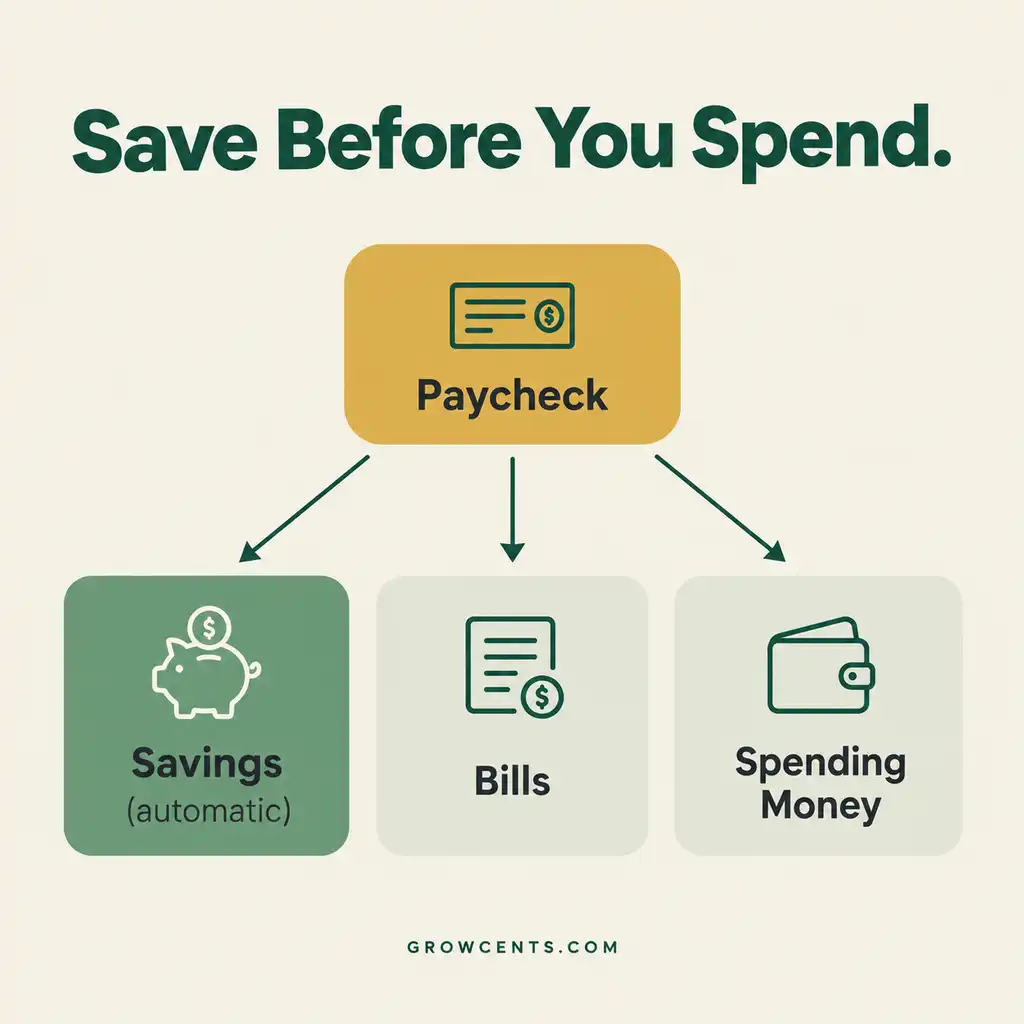
4. Save First, Spend What Is Left
This order is often called “paying yourself first.” Money moved to savings before it can be spent is more likely to stay saved than money meant to be set aside at the end of the month from whatever is left.
5. Raise the Amount When Income Rises
When a raise or a new source of income arrives, increase the automatic transfer by part of it, for example by half of the raise. Because the household never had that money in its monthly spending, the increase is much less likely to be felt.
Payday Split — Infographic
Sizing the Amount So It Does Not Pinch
The table below shows what small, fixed transfers add up to over a year for someone paid every two weeks (26 pay periods). The figures are simple arithmetic, not predictions of any particular outcome.
| Per Pay Period | Per Year (26 Pay Periods) |
|---|---|
| $10 | $260 |
| $25 | $650 |
| $50 | $1,300 |
| $100 | $2,600 |
For anyone building a starter emergency fund, a $500 to $1,000 goal can be reached in well under a year at the middle of this range. For people paid weekly, twice a month, or monthly, the same arithmetic applies with a different number of pay periods.
Using the Tax Refund as an Automatic Boost
A refund is one of the easiest windfalls to save because it arrives as a lump sum the household was not counting on month to month. The IRS allows a refund to be divided in any proportion among up to three accounts, and its guidance on split refunds explains that this is done with Form 8888 or through tax software at filing time. Sending even a portion straight to a savings account means that part of the refund never lands in checking where it can be spent.
When Automation Can Backfire
- Transfers that overdraw checking. An automatic transfer larger than the account can cover can trigger fees or a failed payment elsewhere. Keeping a small cushion in checking and timing transfers right after payday reduces the risk.
- Irregular income. For freelancers or hourly workers, a fixed transfer can be hard to sustain in a slow month; a smaller fixed amount plus an extra manual transfer in strong months is one workable pattern.
- “Set and forget” for too long. A transfer that made sense a year ago may be too low or too high today; a quick review every few months keeps it matched to the budget.
- Automating into an account that is too easy to spend from. If the destination has a debit card attached, the friction that automation is meant to create disappears.
Common Mistakes
- Starting too high. An amount that causes a shortfall in month two often leads to turning the whole thing off, which is worse than starting smaller.
- Never increasing it. A transfer set at $10 and never revisited will not keep pace with a growing income or a growing goal.
- Treating automatic saving as a substitute for a budget. Automation moves money; a budget is what tells a household how much it can afford to move.
- Forgetting irregular expenses. Money that is automatically saved still needs a plan for predictable annual costs, which is the job of a sinking fund tracker.
Frequently Asked Questions
How much should be saved automatically?
There is no single right amount. A common approach is to start with something small and sustainable, then increase it over time as income grows or the budget loosens. The amount should be set by the household’s own budget, not a national rule of thumb.
What if a transfer fails because of low funds?
Policies vary by bank, but a failed transfer can mean fees or a missed savings contribution. Timing the transfer for just after payday and keeping a small cushion in checking are the most common safeguards.
Is it better to split direct deposit or schedule a transfer?
Splitting direct deposit keeps the money from ever reaching checking, which maximizes the “out of sight” effect, but it depends on the employer offering the option. A scheduled transfer is more universally available and easier to adjust. Both accomplish the same goal.
Does automatic saving work for irregular income?
It can, with adjustments. A smaller fixed transfer set to the lowest typical month, plus extra transfers in better months, avoids the problem of a fixed amount that cannot be met in a slow month.
Should I automate saving before paying off debt?
Many households do both at once, with a small automatic transfer to build a starter emergency fund while making payments on debt. The right balance depends on interest rates and personal circumstances, so this guide does not recommend one universal order.
How This Guide Was Built
This guide was researched using official government sources and published research rather than personal anecdote or invented statistics. The behavioral research on automatic saving is described through the U.S. Department of Labor’s CLEAR evidence review of the Thaler and Benartzi study, including its own caution that the causal evidence is rated low. The “start small and stay consistent” principle comes from the FDIC’s consumer education materials. The split-refund option is described in the IRS’s official FAQ. The annual totals in the table are simple multiplication (the per-period amount times 26), not sourced statistics. GrowCents’ full research and sourcing approach is described on the Editorial Policy page and the About page.
This article is general educational information, not personalized financial advice, and does not account for any individual household’s full financial situation. See the Disclaimer page for details.





One Comment
Comments are closed.