
Saving for a Down Payment: A Realistic Timeline for Average Households

Last verified: September 2026.
For many households, the down payment is the biggest single savings goal they will ever set, and it often feels like it sits too far away to start. A realistic plan begins with the numbers: what buyers actually put down, what the minimum can be, and how long different monthly savings amounts take to add up. This guide lays those numbers out, shows where the money can come from, and covers the costs beyond the down payment that are easy to overlook. Whether to buy at all is a personal decision, and renting is the better fit for some households.
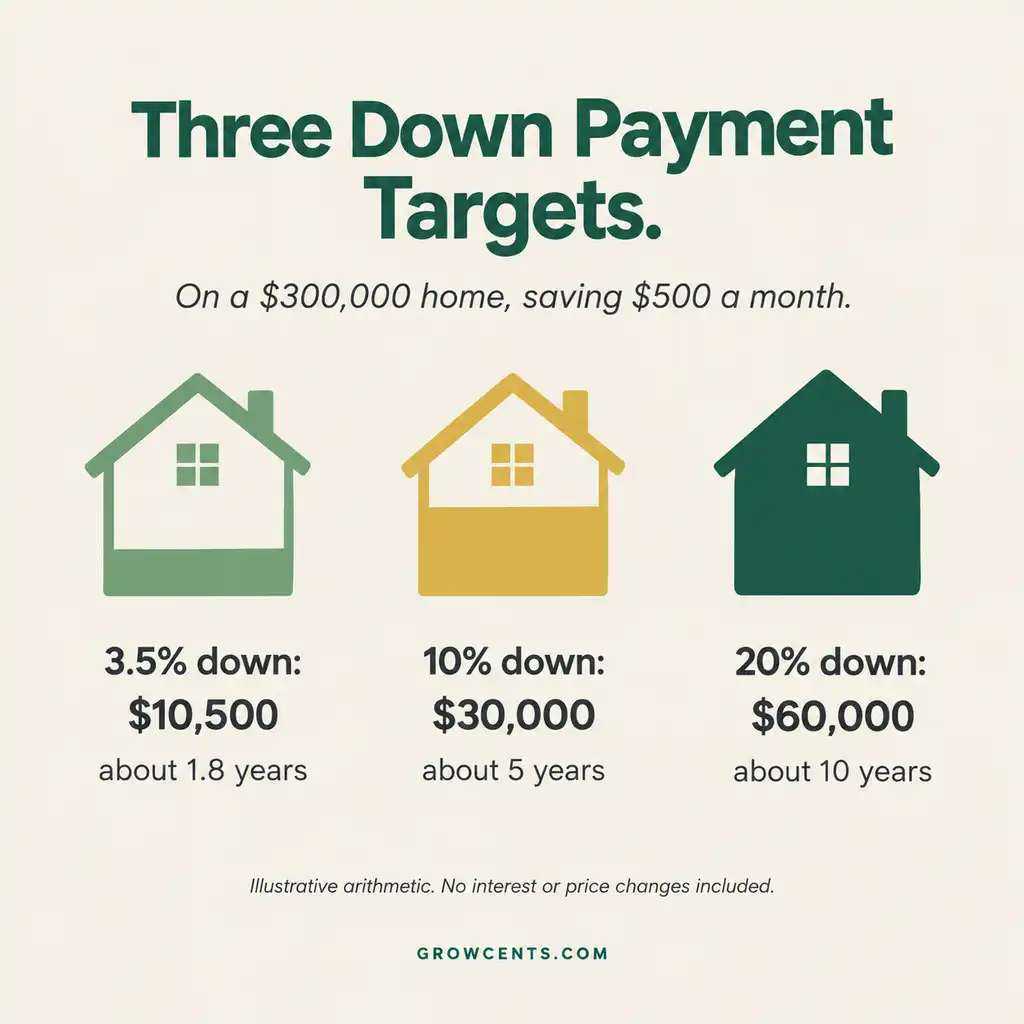
Quick Answer: A down payment can be as low as 3.5% of the purchase price on an FHA-insured loan, according to HUD, while the National Association of REALTORS® reports that first-time buyers put down a median of 10% in its 2025 survey. Putting down less than 20% usually means paying private mortgage insurance. At a $300,000 home price, those percentages work out to $10,500, $30,000, and $60,000, and saving $500 a month would take roughly 1.8 years, 5 years, and 10 years to reach them without counting interest earned.
What a Down Payment Is and Why the Percentage Matters
A down payment is the portion of a home’s price paid in cash up front, with a mortgage covering the rest. The percentage matters in two ways: it determines how much has to be saved before buying, and it affects the monthly cost afterward. According to MyCreditUnion.gov, the consumer site of the National Credit Union Administration, many lenders offer loans requiring less than 20% down, sometimes as little as 5% on conventional loans, but when the down payment is under 20%, lenders usually require private mortgage insurance (PMI), which protects the lender rather than the buyer. The same source notes PMI premiums can add $100 to $200 per month or more, depending on the loan, and that the insurance can generally be removed once the homeowner reaches 20% equity.
What Buyers Actually Put Down
| Benchmark | Figure | Source |
|---|---|---|
| Minimum on an FHA-insured loan | As low as 3.5% of the purchase price | HUD |
| Median down payment, first-time buyers (2025) | 10% | NAR 2025 Profile of Home Buyers and Sellers |
| Median down payment, repeat buyers (2025) | 23% | NAR 2025 Profile of Home Buyers and Sellers |
| Typical threshold to avoid PMI on a conventional loan | 20% | NCUA’s MyCreditUnion.gov |
The FHA minimum comes from HUD’s own FHA loan page, which states that a down payment can be as low as 3.5% of the purchase price. FHA guidelines generally tie that 3.5% minimum to a credit score of 580 or higher, with lower scores generally requiring a larger down payment, so a lender can confirm what a specific household qualifies for. The NAR figures come from its 2025 Profile of Home Buyers and Sellers, based on transactions between July 2024 and June 2025. That report put the first-time buyer median at 10%, the highest since 1989, and the first-time buyer median age at 40. Repeat buyers often put down more because they bring equity from a previous home.
Down Payment Amounts at Different Home Prices
The figures below are simple multiplication (price times percentage) for illustrative home prices, not predictions for any specific market. For context, the U.S. Census Bureau and HUD report that the median sales price of new houses sold in the United States was $410,700 in the second quarter of 2026, per the FRED database. That figure covers new construction only; existing-home prices differ and vary widely by region.
| Home Price | 3.5% Down | 10% Down | 20% Down |
|---|---|---|---|
| $200,000 | $7,000 | $20,000 | $40,000 |
| $300,000 | $10,500 | $30,000 | $60,000 |
| $400,000 | $14,000 | $40,000 | $80,000 |
How Long It Takes: A Realistic Timeline
The table below shows how long it takes to reach each target on a $300,000 home at three monthly savings amounts. It uses plain division with no interest earned, so interest in a savings account would shorten each timeline slightly. It also assumes the home price stays the same, which it may not.
| Target (on a $300,000 Home) | $200 a Month | $500 a Month | $1,000 a Month |
|---|---|---|---|
| 3.5% down ($10,500) | About 52 months (4.4 years) | 21 months (1.8 years) | About 10 months (0.9 years) |
| 10% down ($30,000) | 150 months (12.5 years) | 60 months (5 years) | 30 months (2.5 years) |
| 20% down ($60,000) | 300 months (25 years) | 120 months (10 years) | 60 months (5 years) |
These numbers show why a single monthly amount rarely fits every goal: the same $500 a month that reaches a minimum down payment in under two years takes a decade to reach 20%. They also show why increasing the monthly amount over time, through a raise or a lower-cost stretch in the budget, shortens the timeline more than almost any other change.
Three Down Payment Targets — Infographic
Where the Money Can Come From
- Regular savings. A dedicated account with an automatic transfer after each paycheck is the most reliable source, and the high-yield versus regular savings guide covers where to keep it.
- Windfalls. Tax refunds, bonuses, and one-time income can be sent straight to the down payment account.
- Selling items. A decluttering-to-cash challenge can add a modest lump sum.
- Gifts from family. Lenders have their own rules about gift funds, so a lender should be asked about documentation before any gift is counted.
- Down payment assistance. HUD points buyers to state and local government programs that can help with a down payment, and state housing finance agencies run many of them. Eligibility rules vary, so a HUD-approved housing counselor (reachable through HUD at (800) 569-4287) can explain what exists locally.
One caution applies to every route: USA.gov states plainly that the federal government does not offer grants or “free money” to individuals to buy a home, and that websites or ads claiming otherwise are often scams. Legitimate help comes through lenders, state or local programs, and HUD-approved counselors.
Costs Beyond the Down Payment
The down payment is only part of the cash needed at purchase. Closing costs, inspection fees, moving expenses, and immediate repairs or furnishing all come on top, and the lender’s Loan Estimate itemizes the closing costs for a specific loan. After the purchase, a home brings ongoing costs that rent did not: property taxes, homeowners insurance, maintenance, and repairs. MyCreditUnion.gov recommends reviewing the monthly spending plan to estimate what can be afforded, including the mortgage, property taxes, insurance, maintenance, and utilities. This is where a household budget does real work.
Starting Without Draining the Emergency Fund
A down payment fund and an emergency fund do different jobs. Using the emergency fund for a down payment leaves a household with a new mortgage and no cushion for the first major repair or a gap in income, which is exactly when homeowners most need one. A sequence many households follow is to build a starter emergency fund first, then direct new savings to the down payment while keeping the emergency fund intact.
Common Mistakes
- Counting only the down payment. Closing costs and moving-in costs can add up quickly, and leaving them out makes the savings goal too low.
- Spending the emergency fund on the down payment. A house with no cash reserve is a more fragile position than renting with a healthy emergency fund.
- Ignoring the monthly cost of a smaller down payment. A lower down payment can mean PMI or FHA mortgage insurance premiums, so the lender should show the full monthly payment, not just the principal and interest.
- Waiting for a perfect number. Prices, rates, and personal circumstances all change, so a plan reviewed every few months works better than a fixed number set once.
- Trusting “free government money” offers. Real assistance goes through state or local programs and approved lenders, not unsolicited ads.
Frequently Asked Questions
Is 20% down required to buy a home?
No. HUD states an FHA down payment can be as low as 3.5%, and conventional loans are available with as little as 5% down in many cases. Putting down less than 20% usually adds a mortgage insurance cost, which is the main trade-off.
What is the median down payment for first-time buyers?
The National Association of REALTORS® reported a 10% median for first-time buyers in its 2025 survey, which covered transactions from July 2024 through June 2025. Individual households vary widely around that median.
How much should be saved beyond the down payment?
That depends on the loan and the home, which is why the lender’s Loan Estimate is the best guide to closing costs. Households also generally want a separate emergency fund and a budget for ongoing homeownership costs.
Can retirement accounts be used for a down payment?
Some retirement accounts allow withdrawals or loans for a home purchase, but the rules, taxes, and penalties vary by account type and personal situation, and the long-term cost to retirement savings can be significant. A tax professional or financial professional can explain the specifics before any withdrawal.
Should a household keep renting while saving?
Often yes, since saving for a down payment typically happens while renting. Whether renting or buying is the better choice depends on local prices, expected time in the home, and personal goals, and neither is right for everyone.
How This Guide Was Built
This guide was researched using official government sources and the primary report for buyer survey data rather than personal anecdote or invented statistics. The FHA minimum down payment comes from HUD. Median down payments and first-time buyer age come from the National Association of REALTORS®’ 2025 Profile of Home Buyers and Sellers, an industry trade association survey rather than a government statistic. PMI and lower-down-payment details come from MyCreditUnion.gov. The warning about “free government money” comes from USA.gov. The new-home median price comes from FRED, using Census Bureau and HUD data. The down payment amounts and timelines in the tables are simple arithmetic on illustrative prices, not sourced statistics or predictions. GrowCents’ full research and sourcing approach is described on the Editorial Policy page and the About page.
This article is general educational information, not personalized financial, mortgage, or legal advice, and loan terms vary by lender and borrower. Anyone considering a purchase may want to speak with a HUD-approved housing counselor or a licensed lender. See the Disclaimer page for details.