
High-Yield Savings Accounts vs. Regular Savings: What’s the Real Difference?

Last verified: September 2026.
A high-yield savings account and a regular savings account do the same basic job: they hold cash safely and pay a little interest for the privilege. The difference is mostly one number, the interest rate, and that number matters more the larger the balance and the longer it sits. This guide explains what “high-yield” actually means, shows the dollar difference with a clearly labeled example, and covers what stays the same and what can differ between the two types of account.
Quick Answer: “High-yield” is a marketing label for a savings account that pays a higher interest rate than most, not a separate legal category. According to the FDIC’s published national average, the typical savings account pays about 0.38% APY as of July 2026, so a higher-paying account can earn many times more on the same balance. Deposit insurance protection is the same at any FDIC-insured bank, and the interest earned is taxable either way. The best fit depends on balance size, how soon the money is needed, and how much the account’s rate, fees, and transfer rules matter to the household.
What “High-Yield” Actually Means
There is no legal or regulatory definition of a high-yield savings account. The term simply describes an account whose annual percentage yield (APY) sits well above the national average, and it is most often used by online banks that have lower overhead than banks with large branch networks. A regular savings account at a traditional bank, by contrast, often pays a rate close to the national average. Both are savings accounts, and both work the same way day to day: money goes in, interest is credited, and funds can be moved out by transfer.
The National Average vs. a Higher Rate: A Dollar Example
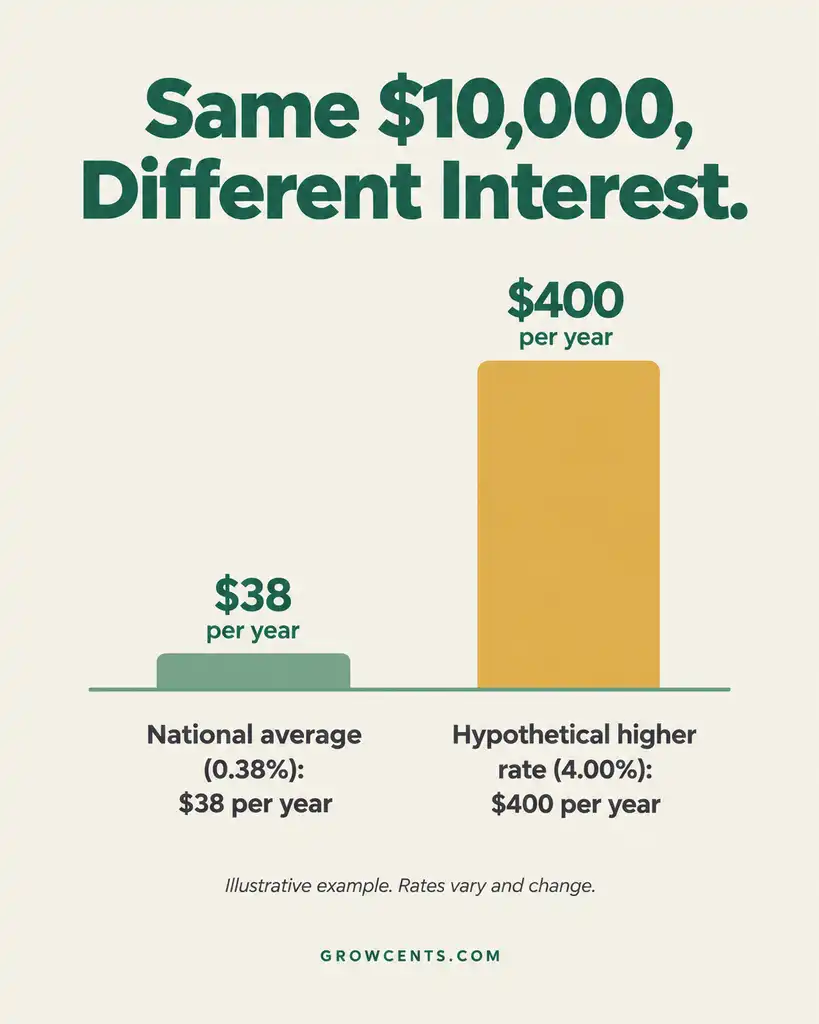
The FDIC publishes a monthly national average rate for savings accounts, which the Federal Reserve Bank of St. Louis republishes in its FRED database. That figure was 0.38% for July 2026. The table below compares one year of interest at that national average with a hypothetical 4.00% APY. The 4.00% figure is an illustration only, not a quote of any bank’s current rate, since rates vary by institution and change over time.
| Balance | One Year at 0.38% (National Average) | One Year at 4.00% (Hypothetical) | Difference |
|---|---|---|---|
| $1,000 | $3.80 | $40.00 | $36.20 |
| $5,000 | $19.00 | $200.00 | $181.00 |
| $10,000 | $38.00 | $400.00 | $362.00 |
On a $1,000 starter emergency fund, the difference is real but modest. On $10,000 the gap becomes meaningful. This is also why the rate matters less in the first months of building a starter emergency fund than getting the saving habit started in the first place.
Same Money, Different Interest — Infographic
What Stays the Same
Deposit insurance does not depend on how high the interest rate is. At any FDIC-insured bank, balances are protected up to $250,000 per depositor, per insured bank, per ownership category, as laid out in the FDIC’s coverage guidance; credit unions have a parallel federal insurance program through the NCUA. A higher rate does not mean higher risk of losing the deposit, as long as the institution is federally insured. The purpose of the account stays the same too: it is a place for cash that may be needed within months or a few years, not for money meant to be invested for the long term.
What Can Differ Between the Two
| Feature | Typical Regular Savings | Typical High-Yield Savings |
|---|---|---|
| Interest rate | Often near the national average | Often several times the national average |
| Where it is offered | Traditional banks and credit unions, often with branches | Frequently online banks, though some traditional banks offer them too |
| Minimum balance or fees | May charge a monthly fee unless a minimum balance is kept | Often no monthly fee, though minimums for the advertised rate vary |
| Transfer speed | Often immediate within the same bank | Often one to two business days to move money to an outside checking account |
| Withdrawal limits | Varies by bank | Varies by bank; some set their own monthly limit, for example Ally Bank states ten withdrawals and transfers per statement cycle on its savings account |
| Branch or ATM access | Usually available | Often limited or unavailable |
These are tendencies, not rules. Each account’s own terms are the only reliable guide, and they can change.
Rates Are Variable, and the Interest Is Taxable
Savings account rates are variable, meaning a bank can raise or lower them at any time, so a rate that looks strong today is not locked in. Interest is also taxable income. The IRS states that all taxable interest must be reported on a federal return, even without a Form 1099-INT, which banks generally issue when interest reaches $10 or more for the year. A higher rate therefore increases a household’s taxable interest income as well as its earnings, a trade-off that is usually still favorable but worth knowing about.
Who Benefits Most From a Higher Rate
- Larger balances held for months or years, such as a fully built emergency fund or money saved for a planned expense, where the dollar gap grows.
- Households comfortable with online banking, since the best-paying accounts are often online-only.
- Savers who do not need same-day access, because transfers to an outside account may take a business day or two.
Someone with a small balance who values branch access, or who would find it hard to keep up with an additional account, may reasonably decide the extra interest is not worth the change.
How to Compare Accounts
- Compare the APY, and check whether it is an ongoing rate or a temporary promotional one.
- Confirm the account is insured by the FDIC (banks) or the NCUA (credit unions).
- Look for monthly fees and minimum balance requirements, including any minimum needed to earn the advertised rate.
- Check how long transfers to and from a checking account take.
- Read the withdrawal limits and any fees for exceeding them.
Common Mistakes
- Chasing a promotional rate without reading the terms. A rate that drops after a few months can end up no better than a regular account.
- Keeping a large emergency fund in an account paying close to nothing. The money is safe, but the gap in interest compounds over time.
- Moving the whole fund to an account that cannot be reached quickly. A transfer that takes two business days is fine for a planned expense and frustrating in a real emergency; some households keep a small buffer in checking for that reason.
- Splitting money across too many accounts. Each extra account is one more login and one more thing to track, which can outweigh a small difference in rate.
- Forgetting that the rate can change. Revisiting the rate once or twice a year keeps a once-competitive account from quietly falling behind.
Frequently Asked Questions
Is a high-yield savings account safe?
If it is held at an FDIC-insured bank or an NCUA-insured credit union, deposits are protected up to the standard limits, the same as any other account at that institution. The word “high-yield” says nothing about safety on its own, so confirming the insurance status is the step that matters.
Why do online banks usually pay more?
Online banks generally have lower overhead costs, with no branch network to maintain, and many pass part of that difference along as a higher rate. That is a tendency across the industry, not a guarantee for any specific bank.
Can the rate change after opening the account?
Yes. Savings account rates are variable and can rise or fall at the bank’s discretion, often following changes in the broader interest rate environment.
Is a certificate of deposit (CD) better than a high-yield savings account?
They suit different needs. A CD usually locks in a rate for a fixed term in exchange for a penalty on early withdrawal, while a savings account keeps funds flexible at a rate that can change. For an emergency fund that might be needed at any time, flexibility usually matters more than locking in a rate.
Do I need to report the interest if it is only a few dollars?
The IRS requires reporting of all taxable interest, even if a bank does not send a Form 1099-INT because the amount was under $10. For most households with small balances this adds only a line or two to a tax return.
How This Guide Was Built
This guide was researched using official government data and the institutions’ own published terms rather than personal anecdote or invented statistics. The national average savings rate (0.38% as of July 2026) comes from the FDIC’s monthly National Rates and Rate Caps data, as republished by the Federal Reserve Bank of St. Louis in FRED. Deposit insurance details come from the FDIC’s official coverage guidance. The tax reporting rule comes from the IRS’s Topic No. 403 on interest received. The 4.00% rate in the example table is hypothetical and used only for illustration; it is not a quote from any bank. Ally Bank is named once as an example of a published withdrawal limit, not as a recommendation. GrowCents’ full research and sourcing approach is described on the Editorial Policy page and the About page.
This article is general educational information, not personalized financial or tax advice, and does not recommend any specific bank or account. Rates and terms change frequently and should be confirmed with the institution. See the Disclaimer page for details.







One Comment
Comments are closed.