The Round-Up Savings Challenge: How Spare Change Adds Up Over Time
Last verified: September 2026.
A round-up savings challenge works in the background of spending that already happens: every purchase gets rounded up to the next whole dollar, and the small difference moves automatically into savings or investing. There is no behavior to change and nothing to remember day to day, which makes it one of the easiest savings methods to start and one of the easiest to overestimate. This guide covers how round-ups actually work, the real difference between a bank savings version and an investing version, and how to run the same idea manually with no app at all.
Quick Answer: Round-up savings round every purchase up to the nearest dollar and move the difference somewhere separate — either an FDIC-insured savings account through a bank program, or an investment account through an app, which carries market risk and is not insured the same way. Either version works automatically once set up, and the same idea can be done manually with no program at all by tracking purchases and transferring an estimated round-up total weekly.
How Round-Up Savings Actually Works
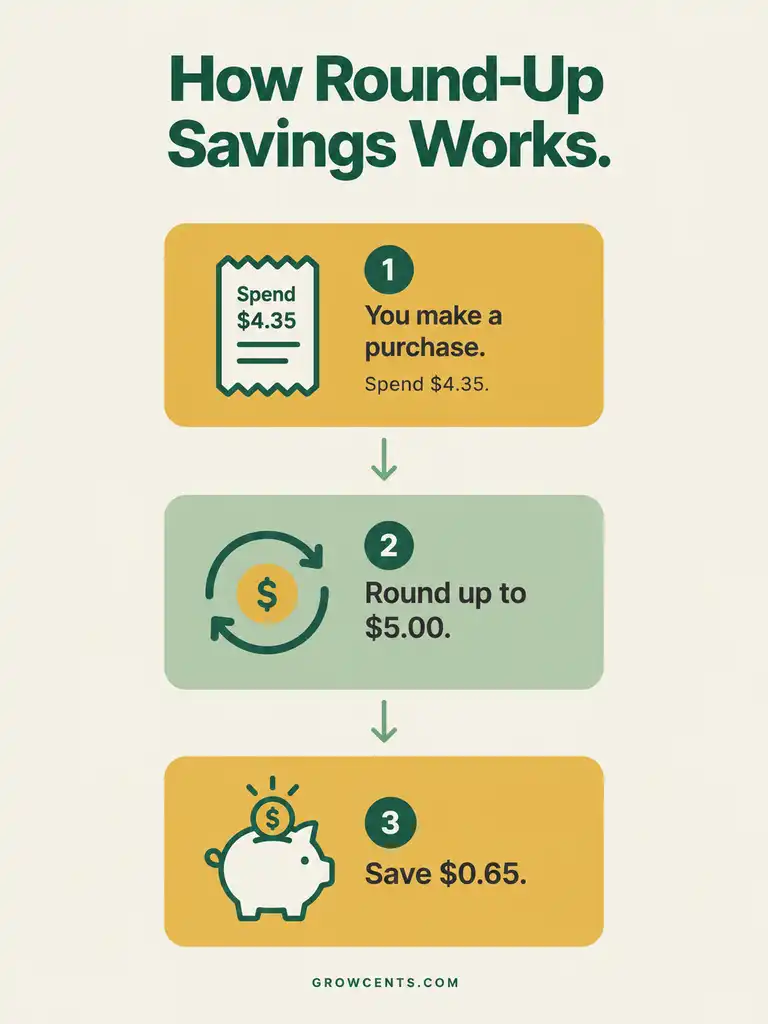
The mechanic is the same across every version: a $4.35 purchase rounds up to $5.00, and the $0.65 difference is set aside. Done across dozens of small purchases a month, the individual amounts are tiny, but the total adds up without requiring a separate decision for each one. The meaningful differences are not in the rounding itself but in where that rounded-up money actually goes.
Bank Round-Ups vs. Investing Round-Ups vs. Doing It Manually
| Version | Where the Money Goes | Protection | Example |
|---|---|---|---|
| Bank round-up program | A linked savings account at the same bank | FDIC-insured up to $250,000, like any bank deposit | Bank of America’s Keep the Change program rounds up debit card purchases and transfers the difference to a savings account daily |
| Investing round-up app | An investment account holding ETFs or similar assets | Not FDIC-insured; subject to market gains and losses like any investment | Acorns’ Round-Ups feature invests spare change once it accumulates to at least $5 |
| Manual round-up | Wherever the household chooses to transfer it | Depends entirely on where it is kept | Tracking purchases and transferring an estimated round-up total to savings weekly, with no app at all |
The distinction between the first two matters more than it might seem. According to Bank of America’s own program description, Keep the Change round-ups are transferred into a savings account, which carries the same FDIC deposit insurance protection as any other bank deposit. Acorns, by contrast, describes its Round-Ups feature as an investing product, with round-ups transferred into a brokerage account once they reach $5 and then invested in a portfolio of funds. Money in an investment account can lose value, which is a meaningfully different kind of “savings” than a dollar sitting in an insured bank account.
The Simple Math of Round-Up Savings
The actual amount accumulated depends entirely on spending habits and how often a card is used for small purchases, so there is no single accurate figure for what any specific household will save. As a rough illustration only: a household making 20 card purchases a week with an average round-up of $0.50 per purchase would accumulate about $10 a week, or roughly $520 over a year. A household that pays mostly in cash or makes fewer, larger purchases would accumulate far less, since round-ups depend on transaction count more than on total spending.
How Round-Up Savings Works — Infographic
Can This Replace Other Savings Methods?
Round-up savings works best as a supplement, not a replacement, for an intentional savings plan. The amounts are small and unpredictable month to month, which makes round-ups a poor substitute for the deliberate, specific-goal approach used in building a starter emergency fund. It pairs well, however, with a method like the $5 savings challenge, since both rely on the same underlying idea: small, automatic amounts that do not require an active daily decision.
Setting Up Round-Up Savings Without an App
A household that prefers not to link an account to a bank program or a third-party app can still run a version of this manually:
- Keep a running tally (a notebook or a simple spreadsheet row) of purchases for the week, noting the round-up amount for each one
- Total the week’s round-ups and transfer that amount to a savings account manually, once a week
- Alternatively, round up to a fixed larger amount instead of the nearest dollar (for example, rounding every purchase up to the nearest $5) to accumulate savings faster without tracking individual transactions as precisely
This version takes more manual effort than an automated program but avoids linking any account to a third party and keeps full control over exactly where the money goes.
Common Mistakes
- Treating an investing round-up as insured savings. Money in an investment account can lose value; it is not the same protection as an FDIC-insured bank deposit.
- Linking a credit card instead of a debit card where that changes the mechanics. Depending on the specific program, round-ups from a credit card may work differently than from a debit card tied directly to a checking account; reading the program’s own terms before enrolling avoids surprises.
- Not checking what happens during a low-balance day. Some bank programs, including Keep the Change, skip the round-up transfer entirely on any day the checking account lacks sufficient funds, so round-up savings should never be counted as guaranteed.
- Expecting round-ups alone to build a full emergency fund. The amounts are genuinely small; round-ups work best stacked alongside a deliberate plan, not instead of one.
What to Do With the Money
Because round-up amounts accumulate passively, it is easy to forget they exist until checking the account balance. Periodically moving accumulated round-ups toward a specific goal, rather than letting them sit indefinitely in a linked account, keeps the small amounts connected to an actual purpose, whether that is a starter emergency fund or a specific short-term goal.
Frequently Asked Questions
Is round-up savings worth setting up if the amounts are so small?
For most households, yes, mainly because it requires no ongoing effort once set up; the amounts are a genuine, if modest, addition to savings rather than a primary strategy on their own.
Do round-up programs cost anything?
This varies by provider; a bank savings-based round-up program is generally free, while an investing-based round-up app may charge a monthly subscription fee, so checking a specific program’s current fee structure before enrolling is worth doing.
What happens to round-ups if a purchase is refunded?
This also varies by provider; some programs keep the round-up transfer in place even if the original purchase is later canceled or refunded, since the transfer already completed separately from the purchase itself.
Can round-ups be adjusted to save more than just spare change?
Some programs allow a multiplier (rounding up by two or three times the normal amount, for example) for someone who wants to accelerate the pace without tracking manual transfers.
Is round-up investing safe?
It carries the same general risks as any investment account: the value can go up or down, and it is not insured against market losses the way a bank deposit is insured against bank failure.
How This Guide Was Built
This guide was researched using the companies’ own program descriptions and official deposit insurance guidance rather than personal anecdote or invented statistics. The bank round-up mechanics come from Bank of America’s Keep the Change program page. The investing round-up mechanics come from Acorns’ Round-Ups program page. Deposit insurance details are sourced from the FDIC’s official coverage guidance. The illustrative math above ($0.50 average round-up across 20 weekly purchases) is a simple arithmetic example built for this guide, not sourced data, and specific companies are named descriptively, not as an endorsement or recommendation. GrowCents’ full research and sourcing approach is described on the Editorial Policy page and the About page.
This article is general educational information, not personalized financial or investment advice, and does not recommend any specific product for any individual household. See the Disclaimer page for details.