Meal Planning on a Budget: A Weekly System That Actually Saves Money
Last verified: October 2026.
Meal planning saves money for a simple reason: most grocery overspending comes from decisions made in the store or at 6 p.m. with an empty fridge, not from the price of any single ingredient. A plan moves those decisions to a calm moment, uses what is already at home, and keeps food from going to waste. This guide lays out a weekly system in seven steps, with a sample plan built around “cook once, eat twice,” the food safety rules that make leftovers and freezing work, and a look at how much money food waste actually costs.
Quick Answer: Set a weekly food budget, check what is already in the fridge and pantry, then plan four or five dinners that share ingredients, one “clean-up” meal to use leftovers, and one flexible night. Write the shopping list from the plan minus what is on hand, shop once, and cook in batches so leftovers get eaten or frozen within three to four days. The USDA estimates the average family of four loses about $1,500 a year to uneaten food, so preventing waste is as much a part of the savings as finding lower prices.
Why a Plan Saves More Than Coupons
The groceries themselves are only part of the cost. The U.S. Department of Agriculture’s consumer guidance notes that the average American family of four loses $1,500 a year to uneaten food. That is about $125 a month, or roughly $29 a week, simple division of the USDA figure. Cutting that loss in half would be worth about $750 a year without buying anything cheaper, which is why a plan that uses what is already on hand often saves more than hunting for discounts. The guide to cutting a grocery bill covers price-focused tactics such as unit pricing and store brands, and meal planning is the system that ties them together.
Step 1: Set the Weekly Food Budget
Start with a number, not a menu. The best source is actual spending: a 30-day spending tracker shows what groceries cost now. The USDA also publishes monthly cost reports for four food plans, called Thrifty, Low-Cost, Moderate-Cost, and Liberal, which price a nutritious diet cooked mostly at home for different ages and household sizes and are updated every month. Media summaries of the report, such as WTOP’s July 2026 coverage, put the Thrifty plan for a family of four with two school-age children at roughly $1,000 a month, though the exact figure changes monthly. These are benchmarks, not targets; a household’s own budget, local prices, and dietary needs come first. Once the weekly number is set, a grocery envelope, cash or digital, keeps spending inside it.
Step 2: Shop the Fridge and Pantry First
Before planning anything, take inventory. University of Nebraska–Lincoln Extension, summarizing USDA food-waste guidance, lists shopping the refrigerator before going to the store as the first tip for cutting waste. Write down proteins, vegetables, grains, and anything that needs to be used soon. The plan then starts from ingredients that already exist, which is the cheapest food in the house.
Step 3: Build the Week Around Overlap
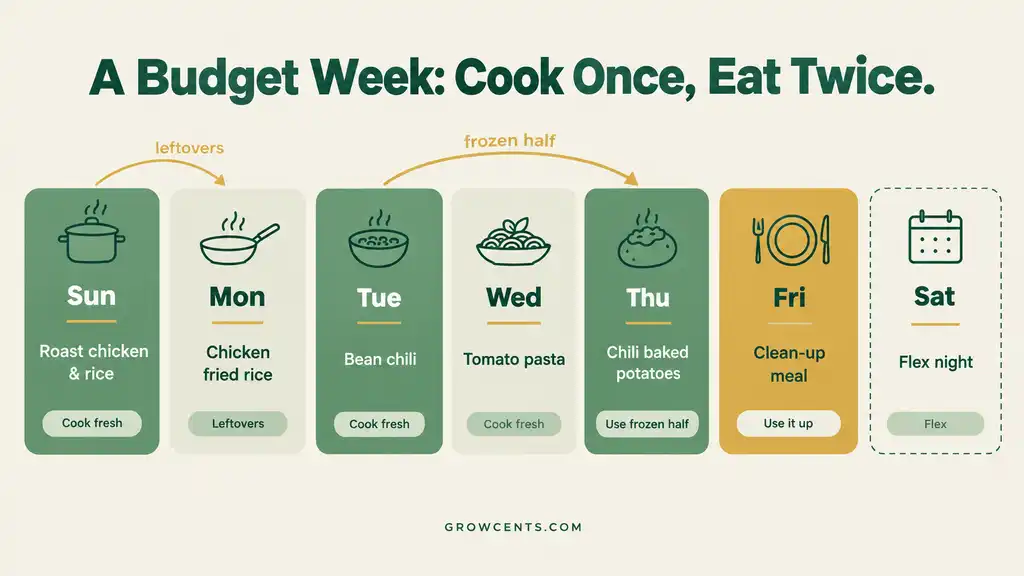
The core of a budget meal plan is ingredient overlap: choosing meals that share ingredients so nothing is bought for just one dish. The table below shows an illustrative plan for four people. The meals are examples, and any version works if the logic holds.
| Day | Dinner | Planning Logic |
|---|---|---|
| Sunday | Roast chicken, rice, and vegetables | Cook a larger batch of chicken and rice on purpose |
| Monday | Chicken fried rice with frozen vegetables | Uses Sunday’s leftover chicken and rice |
| Tuesday | Bean and vegetable chili | Large pot; half is frozen for later |
| Wednesday | Pasta with tomato and vegetable sauce | Shares canned tomatoes, onions, and carrots with the chili |
| Thursday | Chili over baked potatoes | Uses the chili held back from Tuesday |
| Friday | Clean-up meal: vegetable frittata or sandwiches | Uses whatever is left that needs to be eaten |
| Saturday | Flex night: pantry meal or eating out | Built-in room for a change of plans |
The Friday “clean-up” meal comes straight from USDA advice: its waste-reduction tips suggest allowing one night a week to be a clean-up meal that uses leftovers before they become waste. The flex night matters too. A plan with no slack tends to collapse the first time a schedule changes, and a collapsed plan produces the wasted food it was meant to prevent.
Ingredient Overlap in the Sample Week
| Ingredient | Used In |
|---|---|
| Chicken | Sunday roast, Monday fried rice |
| Rice | Sunday dinner, Monday fried rice |
| Dried or canned beans | Tuesday chili, Thursday baked potatoes |
| Canned tomatoes | Tuesday chili, Wednesday pasta sauce |
| Onions and carrots | Sunday, Tuesday, Wednesday, Friday |
| Frozen vegetables | Monday fried rice, Friday frittata |
| Eggs | Friday frittata and breakfasts |
One Week, Cooked Once and Eaten Twice — Infographic
Step 4: Write the List From the Plan, Minus What Is on Hand
Go through each planned meal, list the ingredients, and cross off anything already in the house. Group the remaining items by store section to make the trip faster, and keep to the list. USDA’s MyPlate guidance on eating healthy on a budget also begins with planning meals ahead, and a written list built from that plan keeps unplanned purchases out of the cart. Comparing unit prices on the items that are needed is where the price tactics from the grocery guide fit in.
Step 5: Shop Once, With a Cap
One planned trip a week beats several small ones, because every extra trip adds unplanned purchases. Taking a fixed amount, in cash or in an envelope-style balance, creates a hard limit that makes trade-offs visible at the shelf.
Step 6: Cook in Batches and Handle Leftovers Safely
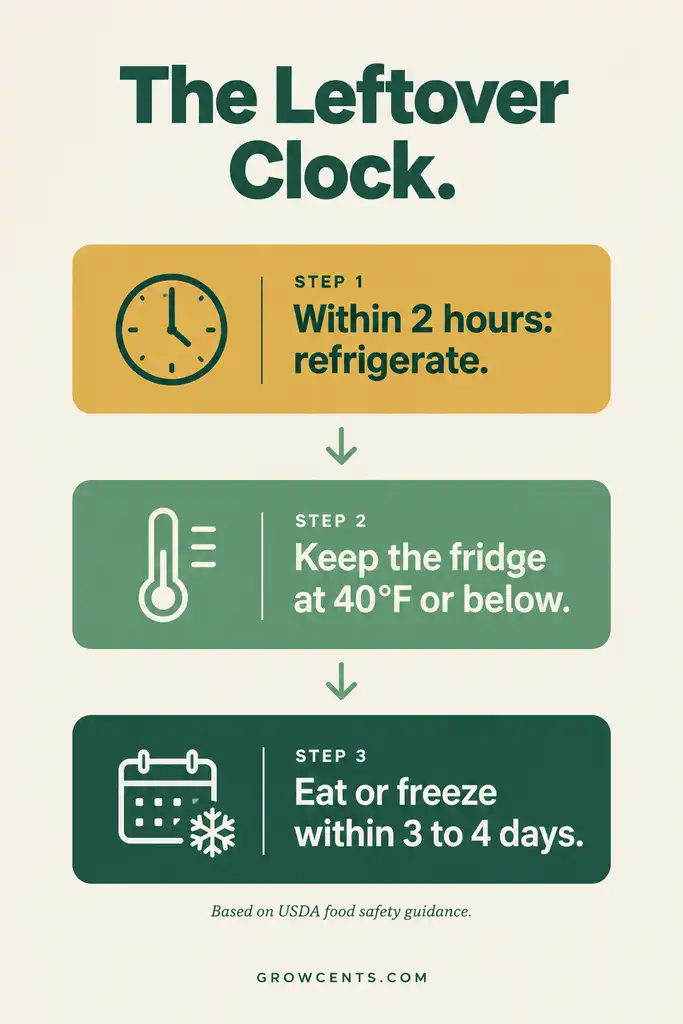
Batch cooking is where meal planning pays off, but it only saves money if the food is actually eaten. The USDA-based tips summarized by University of Nebraska–Lincoln Extension are simple: keep the refrigerator at 40°F or below, refrigerate leftovers within two hours, and eat them within three to four days or freeze them. The USDA’s consumer guidance likewise says to freeze leftovers within three to four days to extend their life, and notes that properly handled food is generally still safe after a date label passes in home storage until spoilage is evident. Confusion over date labels is estimated to cause about 20 percent of consumer food waste, so understanding them matters. For specific storage times, the USDA’s FoodKeeper tool covers hundreds of foods.
The Leftover Clock — Infographic
Step 7: Review the Week and Adjust
At the end of each week, take two minutes to note what was wasted, what ran short, and what was never cooked. A recurring pattern, such as always throwing away half a bag of salad, points to a fix: buy a smaller amount, swap it for a frozen vegetable, or move that meal earlier in the week. After three or four weeks, the plan tends to settle into a rotation that takes less time to build.
Three Planning Styles
| Style | How It Works | Best For | Watch Out For |
|---|---|---|---|
| Full weekly plan | Every dinner assigned to a day | Busy households that want no daily decisions | Brittle if the schedule changes often |
| Theme nights | Each night has a category, such as pasta, soup, or eggs | People who like routine and flexibility inside it | Can get repetitive without variety in the rotation |
| Pantry-first flex plan | Plan three or four meals, leave the rest to what is on hand | Small households and unpredictable schedules | Needs a stocked pantry and some cooking confidence |
Common Mistakes
- Planning meals that share nothing. Seven unrelated recipes mean seven separate ingredient lists and more waste.
- Skipping the fridge check. Buying what is already at home is the most common source of avoidable cost.
- Planning every meal with no slack. A flex night and a clean-up night keep the plan alive when life interferes.
- Cooking in bulk without a storage plan. Food that sits past three or four days either gets thrown away or becomes a safety risk, so freezing portions early is key.
- Chasing a perfect plan. A rough plan used most weeks beats an ideal one abandoned in week two.
- Ignoring the budget number. A plan without a spending cap can still overshoot. The household budget sets the limit.
Frequently Asked Questions
How long does meal planning take?
Many people find it takes about 15 to 30 minutes a week once they have a routine, including checking the fridge and writing the list. Reusing a rotation of favorite meals shortens it further.
What if plans change during the week?
Swapping two days costs nothing, and a flex night absorbs the rest. The only rule is to move the perishable meal earlier, so the ingredients get used.
Is batch cooking and freezing safe?
Yes, if the food is cooled and refrigerated within two hours, and leftovers are eaten or frozen within three to four days, following USDA guidance. Dividing large batches into shallow containers helps them cool faster.
Do I need an app?
No. A notebook, a note on a phone, or a spreadsheet works. Apps can help with recipes and lists, but the savings come from the habit of planning, not the tool.
Does meal planning work for one person?
It does, with some adjustments: smaller batches, more freezing, and a flexible plan that is not tied to cooking every night. Freezing individual portions of a batch keeps variety without waste.
How This Guide Was Built
This guide was researched using U.S. Department of Agriculture materials and a university extension summary of USDA guidance rather than personal anecdote or invented statistics. The $1,500 annual food waste figure and the freezing and date-label guidance come from the USDA’s consumer tips on preventing food waste. The shop-the-fridge, 40°F, two-hour, and three-to-four-day guidance come from University of Nebraska–Lincoln Extension, and the clean-up meal idea from a USDA tip list republished by Alliance Times. Food plan benchmarks come from the USDA’s monthly cost of food reports, with the approximate Thrifty figure for a family of four taken from WTOP’s July 2026 coverage. Budget planning guidance comes from MyPlate and storage times from FoodSafety.gov’s FoodKeeper. The sample week and ingredient overlap are illustrations built for this guide, and the weekly and monthly waste figures are simple division of the USDA’s $1,500. GrowCents’ full research and sourcing approach is described on the Editorial Policy page and the About page.
This article is general educational information, not personalized financial, nutrition, or food safety advice, and does not account for any individual household’s needs, allergies, or dietary restrictions. See the Disclaimer page for details.