Thrift Shopping 101: How to Find Quality Items Without Wasting Time
Last verified: October 2026.
Thrifting has a reputation for two opposite problems: people either find incredible bargains by luck, or spend three hours sorting through racks and leave with nothing. The difference is rarely luck. A short plan before leaving home, a handful of quality checks in the store, and a clear list of items that are not worth buying used turn thrift shopping from a treasure hunt into a repeatable way to spend less. This guide covers where to shop, how to prepare, what to inspect, a worked example that measures savings per hour, and the safety rules that matter most.
Quick Answer: Go with a specific list, sizes and measurements, and a time limit. Check new prices on a phone so a “deal” can be judged, inspect every item for stains, wear, odors, missing parts, and damage, and walk away from anything that is not clearly better than the new price. Skip or carefully check items where used is risky, including car seats, anything that may have been recalled, and upholstered or curbside furniture that could carry bed bugs. Measure success in dollars saved per hour, not per trip.
Why Secondhand Can Make Financial Sense
Clothing is a modest but steady expense. In the Bureau of Labor Statistics’ 2024 Consumer Expenditure Survey, apparel and services accounted for 2.5% of average household spending, which works out to roughly $2,000 a year on average for a typical household. That is not a huge share, but it is the kind of flexible category where changing habits works. Secondhand buying also reduces waste: the EPA estimated that U.S. textile generation reached 17 million tons in 2018, with 11.3 million tons going to landfills, as laid out on its textiles data page. Secondhand shopping fits naturally with a low-buy year, since it lets a household keep buying what it truly needs while lowering what it spends.
Where to Shop, and What Each Is Good For
| Source | Best For | Watch Out For |
|---|---|---|
| Charity thrift stores | Everyday clothing, housewares, books, and low prices; sales support the charity | Unsorted racks and variable quality, so time and patience matter |
| Consignment and resale shops | Curated clothing and furniture in better condition | Higher prices than charity stores, so compare against new |
| Online resale marketplaces | Specific items, brands, or sizes, searchable from home | Shipping costs, sizing uncertainty, and limited ability to inspect |
| Garage, estate, and yard sales | Furniture, tools, and household goods, often with room to negotiate | Everything is sold as-is, with no returns |
| Local sharing and buy-nothing groups | Free or near-free items from neighbors | Needs flexibility on timing and pickup |
Many shoppers use two or three of these rather than one. A charity shop is good for casual basics, a resale site for a specific item, and a yard sale for furniture.
Before You Go: A Ten-Minute Plan
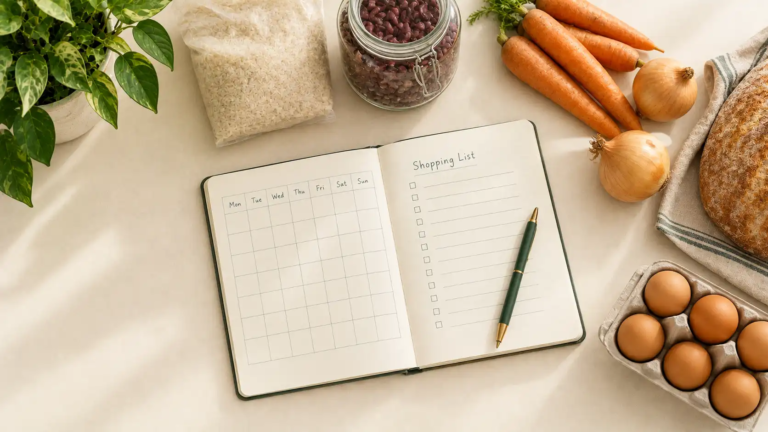
- Write a list. A short list of needs keeps the trip from becoming a browse. “Winter coat, medium, and a skillet” is a plan; “see what they have” is not.
- Bring sizes and measurements. Sizes vary widely in used clothing, so a measuring tape and a note of key measurements for clothes, furniture, and doorways prevent mistakes.
- Know the new price. A quick phone check of what an item costs new lets a shopper tell a real deal from a used price that is nearly the same as retail.
- Set a spending cap and a time limit. A cap of one hour and a fixed dollar amount keeps the trip efficient and the budget intact. The amount can come from a line in the household budget.
- Go with a clear walk-away rule. For example: only buy an item if it is at least half the new price and passes every quality check.
In the Store: Quality Checks by Category
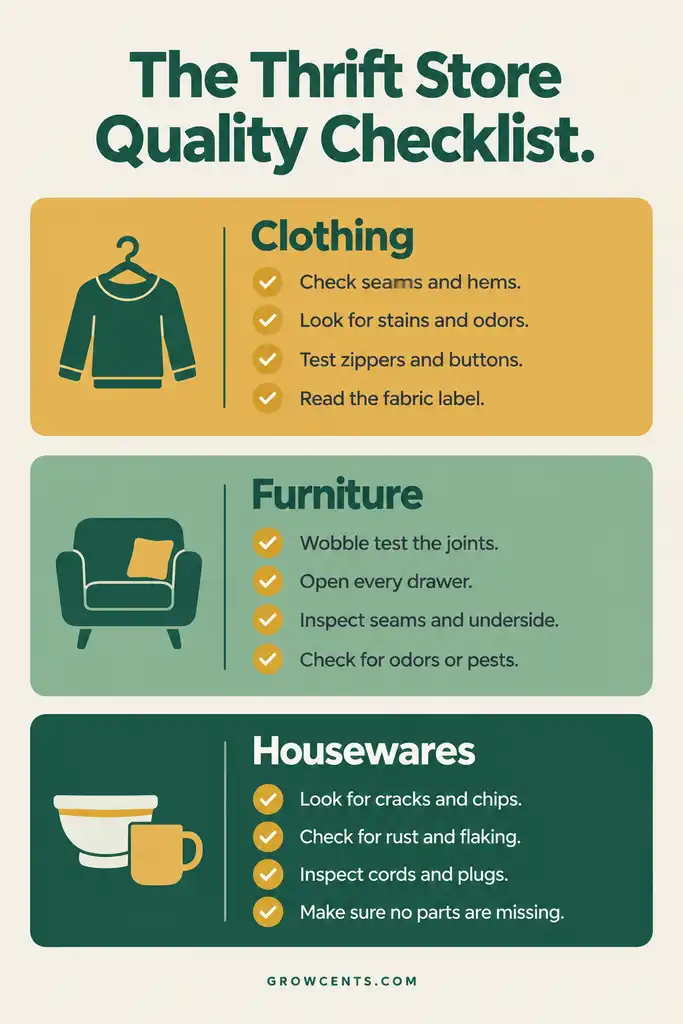
| Category | What to Check |
|---|---|
| Clothing | Fabric content label, seams and hems, underarms and collars for stains, zippers and buttons, pilling, and any odor that will not wash out |
| Shoes | Sole wear, heel condition, interior lining, and whether the fit feels right immediately |
| Furniture | Sturdiness, joints that do not wobble, solid construction, drawers that slide, and signs of pests or odors |
| Kitchenware | Cracks, chips, warping, and rust; cookware with deep scratches or flaking coatings is not worth buying |
| Small appliances and electronics | Frayed cords, missing parts, and whether the store has an outlet to test them |
| Books and media | Complete sets, intact bindings, and no mold or musty smell |
A good rule is to inspect an item as if it were a purchase from a seller who does not accept returns, because many secondhand sales are exactly that.
Thrift Store Quality Checklist — Infographic
A Worked Example: Is It Worth the Time?
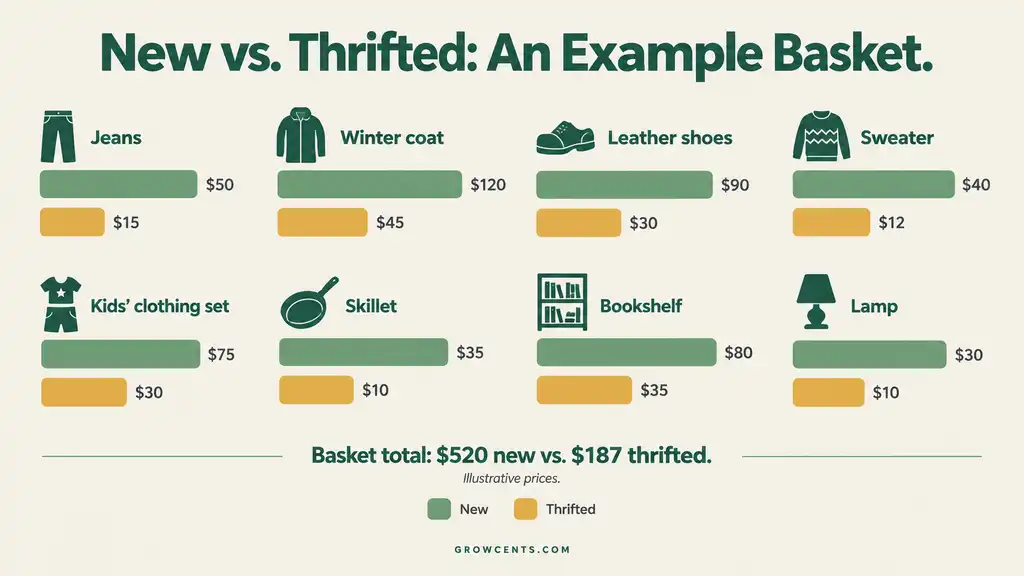
The table below shows an illustrative basket of eight items, comparing a typical new price with a typical secondhand price. The prices are examples built for this guide, not survey data, and real secondhand prices vary widely by store and item.
| Item | Illustrative New Price | Illustrative Thrifted Price |
|---|---|---|
| Jeans | $50 | $15 |
| Winter coat | $120 | $45 |
| Leather shoes | $90 | $30 |
| Sweater | $40 | $12 |
| Set of five children’s clothing items | $75 | $30 |
| Cast iron skillet | $35 | $10 |
| Bookshelf | $80 | $35 |
| Lamp | $30 | $10 |
| Total | $520 | $187 |
In this example the thrifted basket costs $333 less, about 64% below the new price. If gathering those eight items took four trips of an hour and a half each, or six hours total, the savings come to about $55 an hour. That figure is a useful test: when a trip yields much less than that, or when the thrifted price is close to the new price, the time is better spent elsewhere. The point of the exercise is to measure savings per hour, not just savings per item.
New vs. Thrifted: An Example Basket — Infographic
What to Skip or Check Carefully
Most secondhand items are low-risk, but a few categories carry real safety concerns, and these are worth treating differently.
- Car seats. The National Highway Traffic Safety Administration’s used car seat checklist says a secondhand seat may be okay only if it has never been in a moderate or severe crash, has labels showing the date of manufacture and model number, has no recalls, has all its parts, and has its instruction book. Because a seller’s crash history cannot always be verified, many buyers choose to buy car seats new.
- Recalled products. It is illegal to resell recalled products, and the Consumer Product Safety Commission states that this applies to individuals as well as stores. Items for children, such as cribs, strollers, and sleepers, deserve a recall check on CPSC.gov before purchase, since recalled items sometimes still turn up in secondhand sales.
- Upholstered furniture, mattresses, and curbside finds. Used furniture can carry bed bugs. An Oklahoma State University Extension fact sheet advises inspecting any used furniture before bringing it home and not taking furniture from curbs, since it may have been thrown out because of an infestation.
- Protective gear. Items meant to protect the user, such as helmets, can have hidden damage that is hard to see, so many buyers choose to buy them new.
After You Buy: Clean, Check, and Keep Receipts
Wash or clean clothing and housewares before use, inspect furniture in a garage or entryway before it goes into a living area, and test any appliance or electronic item right away while a return is still possible. Where a store has a short return window, keep the receipt. A simple habit is to put new finds through the same routine every time, so nothing is missed on a busy day.
Selling to Fund Thrifting
Secondhand buying and selling work as a pair. Items outgrown or no longer used can be sold or donated to offset what is spent on replacements, as covered in the decluttering-to-cash challenge. A household that tracks its clothing budget in a sinking fund, with a set amount for seasonal replacements, avoids the panic purchases that cost the most.
Common Mistakes
- Buying because it is cheap, not because it is needed. A $5 item that is never worn is not a saving. The list protects against this.
- Skipping the inspection. Stains, odors, and missing parts are easy to miss on a quick look and hard to fix later.
- Paying near-new prices. Some resale and boutique prices are close to retail, so checking the new price matters.
- Ignoring sizing. Used clothing is often mislabeled or shrunken, so try items on or compare measurements.
- Buying risky items used. Car seats, recalled products, and infested furniture can cost far more than they save.
- Letting it become a hobby that costs money. If thrifting leads to more items rather than fewer purchases overall, the budget gains disappear.
Frequently Asked Questions
Is thrifting always cheaper than buying new?
No. It depends on the store and the item. Some secondhand prices are close to retail, and cheap items that are never used are not savings. Comparing against the new price keeps the comparison honest.
What are the best days or times to shop?
This varies by store. Many stores restock on a regular schedule and run sales on particular days, so asking the staff when new items are put out is the most reliable way to find out.
How do I get rid of musty smells?
Washing fabrics and airing items out removes many odors, but a smell that persists after one wash is a sign to leave the item behind rather than keep fighting it.
Can thrifting work for children’s clothing?
Yes, since children outgrow items quickly and many pieces are barely worn. The exceptions are items with safety standards or recalls, such as cribs and car seats, which need extra checking.
Does thrifting really help the environment?
Extending the life of existing goods reduces demand for new production and keeps items out of landfills. Government data on textile waste show the scale of the problem, though the effect of any one household’s choices is small and depends on whether secondhand purchases replace new ones.
How This Guide Was Built
This guide was researched using U.S. government data and safety agencies rather than personal anecdote or invented statistics. Household apparel spending comes from the Bureau of Labor Statistics’ 2024 Consumer Expenditure Survey, with the roughly $2,000 figure calculated as 2.5% of the $78,535 average annual spending reported there. Textile waste figures come from the EPA’s materials and waste data. Car seat guidance comes from NHTSA, recall rules from the CPSC, and used-furniture guidance from Oklahoma State University Extension. The example basket and the savings-per-hour calculation are illustrations built for this guide, calculated directly and not sourced data. GrowCents’ full research and sourcing approach is described on the Editorial Policy page and the About page.
This article is general educational information, not personalized financial or product safety advice, and does not account for any individual household’s needs. Product recalls and safety guidance change, so check current information before buying used items for children. See the Disclaimer page for details.