
How to Cut Your Monthly Utility Bills Without Sacrificing Comfort
Last verified: October 2026.
Utility bills are one of the few household expenses that can be reduced without cutting anything people actually enjoy. Most of the savings come from a handful of changes, many of them free, that affect how much energy and water a home wastes rather than how comfortable it feels. This guide covers where the money in a typical home actually goes, six steps in order of payoff, a worked example with clearly stated assumptions, and the assistance programs that exist for households that are struggling to pay.
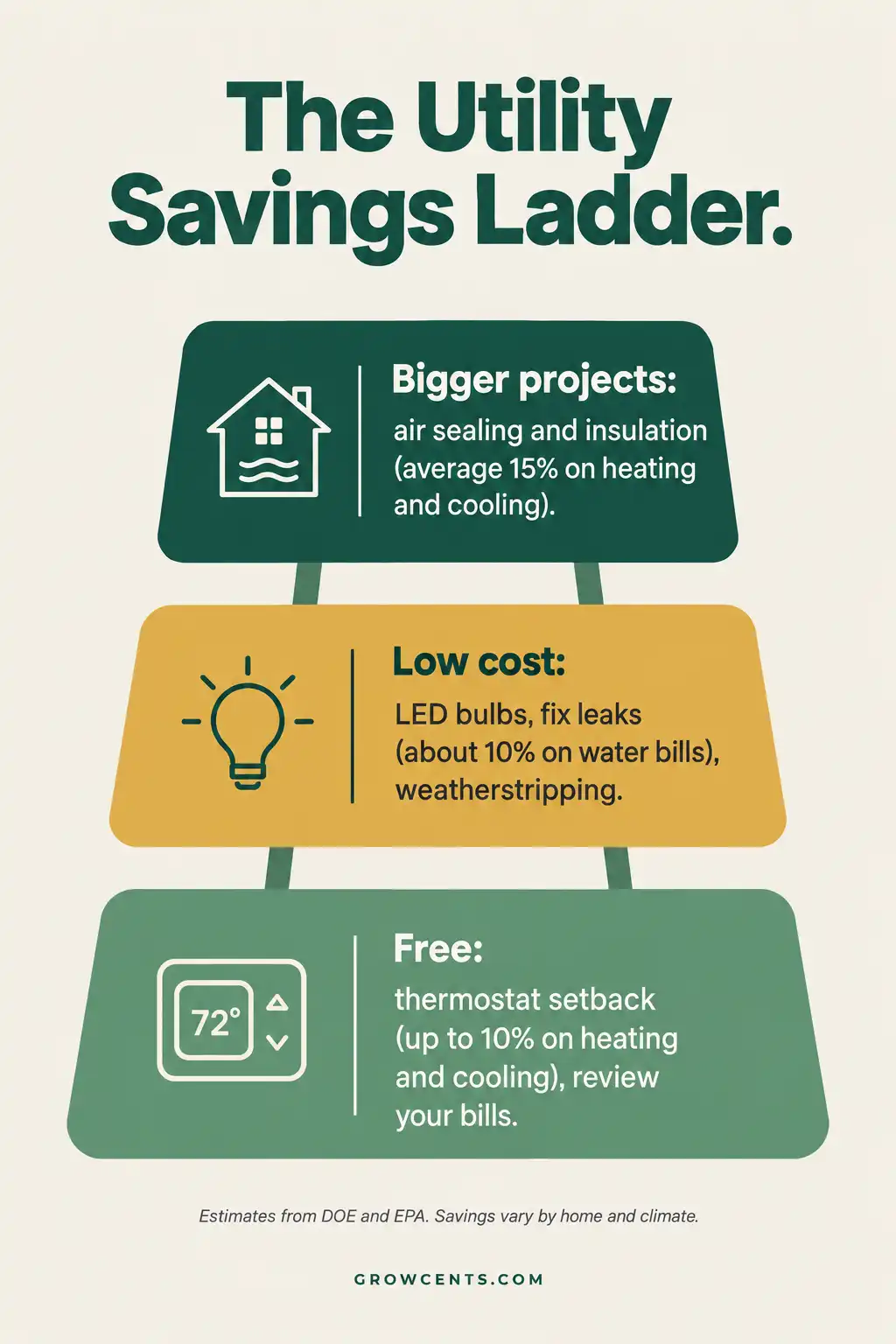
Quick Answer: Start with heating and cooling, which account for more than half of home energy use. Turning the thermostat back 7° to 10°F for eight hours a day can save up to 10% a year on heating and cooling, sealing air leaks and adding insulation saves an average of 15% on heating and cooling according to the EPA, and fixing easy water leaks saves about 10% on water bills. Switching to LED bulbs, checking the water heater setting, and reviewing each bill for errors add smaller savings. Households that cannot keep up with bills can check LIHEAP and weatherization help through USA.gov.
Where the Money Actually Goes
Effort is best spent where the energy goes. According to the U.S. Energy Information Administration, more than half of the energy used in U.S. homes goes to heating and air conditioning, while water heating, lighting, and refrigeration together accounted for about 25% in 2020. The EIA also notes that heating and cooling take a much smaller share of energy in apartments than in detached single-family homes, so the exact split depends on the type of home and climate. The practical lesson is that unplugging a phone charger matters far less than how a home is heated and cooled.
Six Steps, in Order of Payoff
| Step | Typical Cost | Savings Estimate | Source |
|---|---|---|---|
| Set back the thermostat 7°–10°F for 8 hours a day | Free | Up to 10% a year on heating and cooling | U.S. Department of Energy |
| Air seal and add insulation | Low to moderate; DIY options exist | Average of 15% on heating and cooling, or 11% on total energy costs | EPA / ENERGY STAR |
| Switch to LED bulbs | Low | At least 75% less energy than incandescent bulbs, lasting up to 25 times longer | U.S. Department of Energy |
| Fix easy water leaks | Low | About 10% on water bills | EPA WaterSense |
| Check the water heater setting and fixtures | Free to low | Reduces hot water energy use; amounts vary | DOE and EPA guidance |
| Review bills, plans, and assistance options | Free | Varies by provider and household | Utility and USA.gov |
These are estimates and averages, not guarantees. Savings depend on climate, home size, current insulation, and habits.
The Utility Savings Ladder — Infographic
Step 1: Read the Bills Before Changing Anything
Pull out the last twelve months of bills for each utility and note the amount used, not just the amount owed. Comparing a month with the same month a year earlier shows whether usage or price changed. Look for fixed monthly charges, estimated readings, and sudden jumps. A bill that is far above normal without any change in habits can point to a leak, a malfunctioning appliance, or a billing error worth reporting to the provider. A 30-day spending tracker can show how utilities compare with the rest of the budget.
Step 2: Adjust Heating and Cooling Habits
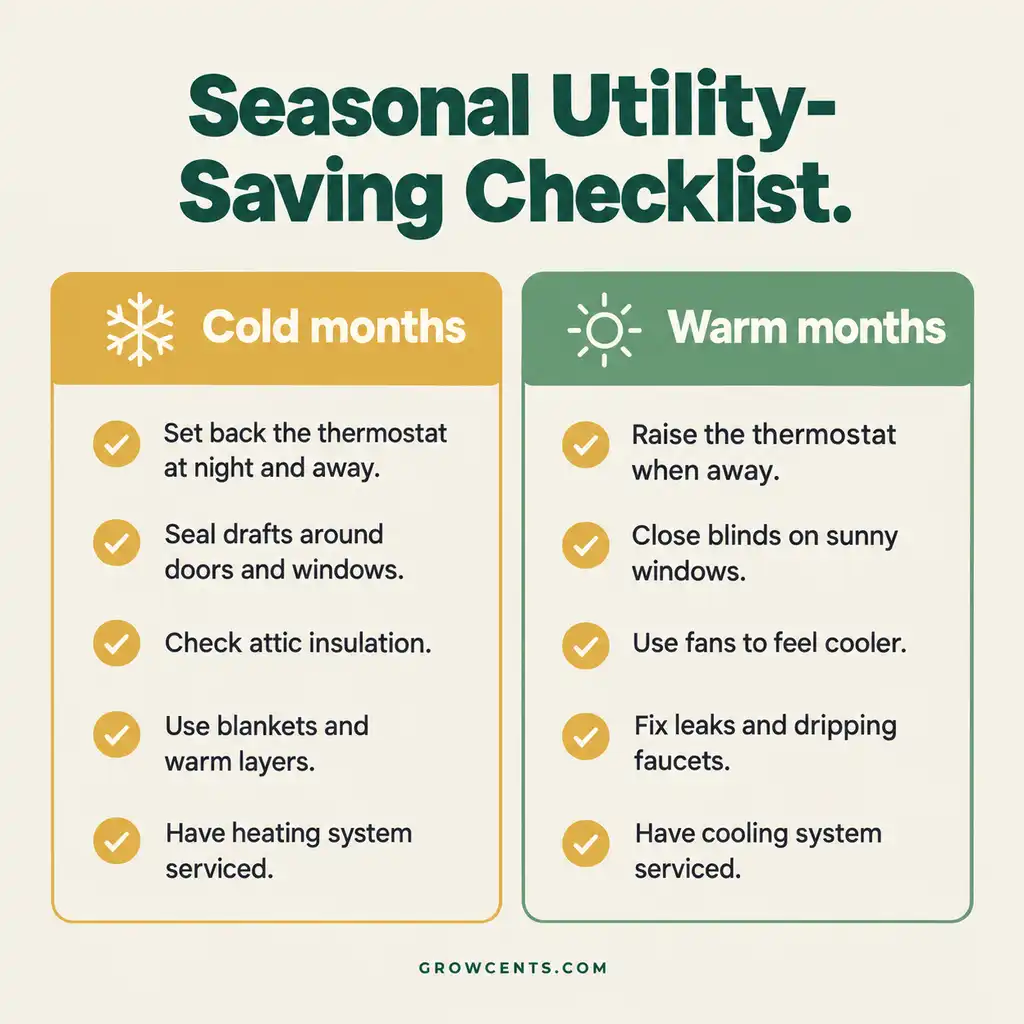
The Department of Energy’s thermostat guidance states that turning a thermostat back 7° to 10°F for eight hours a day from its normal setting can save as much as 10% a year on heating and cooling. In winter, it suggests around 68°F to 70°F while awake and lower while asleep or away. The agency also addresses a common misconception: a furnace does not use extra energy to recover from a setback that cancels the savings, because a house loses heat more slowly at a lower temperature. One caveat applies to heat pumps. When a heat pump is in heating mode, setting the thermostat back can make it run inefficiently and cancel out the savings, so heat pump owners should follow their manufacturer’s guidance.
A programmable or smart thermostat makes this automatic, but the savings come from the schedule, not the device. A manual adjustment before leaving for work or going to bed works too.
Step 3: Seal Air Leaks and Add Insulation
Air leaking through gaps around doors, windows, attics, and foundations wastes heated and cooled air. ENERGY STAR reports that EPA estimates homeowners can save an average of 15% on heating and cooling costs, or 11% on total energy costs, by air sealing their homes and adding insulation in attics, floors over crawl spaces, and basements. The savings vary by climate zone: ENERGY STAR’s methodology shows total-house savings ranging from about 5% in the warmest zones to about 16% in the coldest. Weatherstripping, caulk, and door sweeps are low-cost starting points, and the attic is usually the first place to look. Renters can use door sweeps, window film, and heavy curtains, and can ask a landlord about larger fixes.
Step 4: Switch to LEDs and Trim Standby Use
The Department of Energy says residential LEDs, especially ENERGY STAR-rated ones, use at least 75% less energy and last up to 25 times longer than incandescent lighting, and its lighting page estimates the average household saves about $225 a year by using LED lighting. The exact savings depend on which bulbs are being replaced, so a household that already uses LEDs will see little change. Turning off lights and electronics that are not in use, or using a power strip to cut standby draw, adds small additional savings. These are worthwhile but modest next to heating and cooling.
Step 5: Fix Water Leaks and Reduce Hot Water Use
The EPA’s WaterSense program estimates that the average household’s leaks account for nearly 10,000 gallons of wasted water a year, that about 10% of homes have leaks wasting 90 gallons or more per day, and that fixing easily corrected leaks can save about 10% on water bills. A simple toilet test is to add a few drops of food coloring to the tank and wait ten minutes without flushing; if color appears in the bowl, the flapper is leaking. Dripping faucets and showerheads are other common culprits. A family of four whose winter water use exceeds 12,000 gallons a month likely has a serious leak, according to the EPA.
For hot water, two low-cost steps help: install water-saving showerheads and faucet aerators, and check the water heater’s temperature setting. A city green-building guide summarizing Department of Energy and WaterSense guidance notes that 120°F is generally enough for comfort, reduces the risk of scalding, and uses less energy, and that WaterSense-labeled showerheads and aerators can save an average family thousands of gallons a year. Water heater manufacturers’ instructions should be followed when adjusting the setting.
Step 6: Check Plans, Programs, and Assistance
- Call the provider. Many utilities offer payment plans, budget billing, time-of-use rates, or free home energy checks. Availability varies by company and state. Budget billing smooths payments across the year but does not by itself lower the total.
- Ask about disconnections early. Contacting the utility before missing a payment usually opens more options than waiting until after a shutoff notice.
- Look into federal help. USA.gov’s guide to help with energy bills explains that the Low Income Home Energy Assistance Program (LIHEAP) can help pay heating or cooling bills or provide emergency services during an energy crisis, and the Weatherization Assistance Program (WAP) helps with home improvements that save energy. Eligibility is based on income, and each state sets its own requirements.
A Worked Example With Stated Assumptions
Take a household that pays $200 a month for electricity and gas and $60 for water and sewer. For illustration, assume half of the $200 energy bill ($100) goes to heating and cooling. This is a rough assumption, since the real share varies by home. The table applies the government estimates above to those assumptions, using the upper-end “up to” figure for the thermostat, so the result is a best-case illustration rather than a prediction.
| Change | Calculation | Monthly Savings |
|---|---|---|
| Thermostat setback | 10% of $100 heating and cooling | $10.00 |
| Air sealing and insulation | 15% of the remaining $90 | $13.50 |
| Fixing easy leaks | 10% of the $60 water bill | $6.00 |
| Total | $29.50 a month, about $354 a year |
That is roughly 11% of the combined $260 monthly bill. The sealing savings are applied after the thermostat savings because the two overlap, and the true results will depend on the home. The point is that a few steady changes can add up to hundreds of dollars a year, which can go toward a starter emergency fund through an automatic transfer.
Fall and Winter vs. Spring and Summer — Checklist Infographic
Common Mistakes
- Chasing tiny savings first. Unplugging chargers feels productive but matters far less than the thermostat, air leaks, and water leaks.
- Buying gadgets without checking payback. A device only saves money if it changes how much energy is used.
- Shutting heating or cooling off completely. A moderate setback saves energy without risking frozen pipes or an uncomfortable recovery, and heat pumps need different handling.
- Ignoring a bill that suddenly jumps. A leak or equipment problem can be costly the longer it runs.
- Treating budget billing as a discount. It evens out payments but does not reduce usage.
- Skipping the planning for seasonal bills. Winter heating and summer cooling spikes belong in a sinking fund so they do not strain the monthly budget.
Frequently Asked Questions
Is it cheaper to leave the heat or air conditioning at one temperature all day?
According to the Department of Energy, no. Setting the thermostat back for part of the day saves energy because the home loses heat more slowly at a lower temperature, and the extra energy to recover does not cancel the savings. Heat pumps in heating mode are an exception.
Do smart thermostats save more than basic ones?
The savings come mostly from the schedule and setback habits, not the device itself. A smart or programmable thermostat can make a good schedule easier to follow, but a manually adjusted thermostat can achieve similar results.
What can renters do?
Renters can use door sweeps, window film, heavy curtains, LED bulbs, and water-saving showerheads that can be swapped back, and can report leaks and ask a landlord about insulation or sealing.
Is it worth paying for an energy audit?
It can be, especially for older homes, since an audit can pinpoint where air leaks and insulation gaps are. Some utilities offer discounted or free home energy checks, so asking the provider first is a good idea.
What if I cannot afford my utility bill?
Contact the utility before missing a payment to ask about payment plans, and check LIHEAP and weatherization help through USA.gov. Both are income-based and run through state offices.
How This Guide Was Built
This guide was researched using U.S. government energy and consumer sources rather than personal anecdote or invented statistics. Home energy use shares come from the U.S. Energy Information Administration. Thermostat savings and heat pump guidance come from the Department of Energy. Air sealing and insulation savings come from ENERGY STAR. LED information comes from the Department of Energy’s LED lighting page and lighting page. Water leak figures come from the EPA’s WaterSense Fix a Leak Week. The water heater setting and fixture savings come from a city government summary of DOE and EPA guidance. Assistance programs come from USA.gov. The worked example uses stated assumptions (a $200 energy bill, half of it for heating and cooling, and a $60 water bill) and is an illustration built for this guide, not sourced data. GrowCents’ full research and sourcing approach is described on the Editorial Policy page and the About page.
This article is general educational information, not personalized financial, engineering, or HVAC advice, and savings vary widely by home, climate, and utility. Consult a qualified professional before making changes to heating, cooling, or water heating equipment. See the Disclaimer page for details.