
90-Day Debt Payoff Sprint: A Structured Challenge for Motivated Savers

Last verified: September 2026.
A 90-day debt payoff sprint is a short, intense focus period aimed at making the fastest possible dent in a specific debt, using every available tool at once: a clear payoff method, extra income redirected from other challenges, and weekly tracking instead of a once-a-year check-in. It will not eliminate a large balance in three months on its own, but for someone with some financial flexibility and the motivation to focus hard for a short stretch, it can meaningfully speed up the start of a payoff plan. This guide covers how to structure the 90 days, choose a payoff method, and set realistic expectations for what the sprint can and cannot do.
Quick Answer: List every debt with its balance, interest rate, and minimum payment. Choose between paying the highest-interest debt first (the avalanche method, which saves the most money) or the smallest balance first (the snowball method, which builds momentum). Free up extra money using short-term tactics like a no-spend month or decluttering for cash, then track progress weekly rather than waiting until the end of the 90 days to check in.
Who This Sprint Is a Good Fit For
This structure works best for someone who already has a household budget covering essentials, has at least a small starter emergency fund in place, and has some room to redirect spending for a focused 90 days. It is not aimed at someone currently struggling to cover basic needs or facing debt collection pressure; those situations call for a broader plan, and the Consumer Financial Protection Bureau’s Your Money, Your Goals toolkit and free nonprofit credit counseling are better starting points than an intense short-term sprint.
Step 1: List Every Debt
Before choosing a strategy, write down every debt in one place:
| Debt | Current Balance | Interest Rate (APR) | Minimum Payment |
|---|---|---|---|
| Example: Credit Card A | $1,200 | 22% | $35 |
| Example: Credit Card B | $400 | 18% | $20 |
| Example: Personal Loan | $2,500 | 11% | $85 |
This list is the foundation for everything else in the sprint; without accurate current balances and rates, neither payoff method below can be applied with any precision.
Step 2: Choose a Payoff Method
| Method | How It Works | Best For |
|---|---|---|
| Avalanche | Pay minimums on everything, put all extra money toward the highest-interest debt first | Saving the most money in interest over time |
| Snowball | Pay minimums on everything, put all extra money toward the smallest balance first | Staying motivated through visible wins, especially in a short 90-day window |
For a short sprint specifically, the snowball method often has an edge: paying off an entire small balance within 90 days produces a concrete result by the end of the sprint, which the avalanche method may not if the highest-interest debt is also the largest. The current average credit card interest rate sits above 21 percent according to Federal Reserve data, which is why the avalanche method remains the better choice mathematically when the goal is minimizing total interest paid rather than finishing something quickly.
Step 3: Find Extra Money for 90 Days
The sprint depends on finding money beyond the minimum payments already planned in the budget. A few short-term tactics pair naturally with a 90-day window:
- A no-spend month, run once or even twice during the 90 days, with the paused discretionary spending redirected to the target debt instead of savings
- A decluttering-to-cash challenge, with proceeds sent directly to the debt rather than a savings goal for this sprint
- Cutting the grocery bill for the 90 days and redirecting the difference
- Any temporary extra income (overtime, a side gig, selling specific items) earmarked entirely for the sprint before it is earned
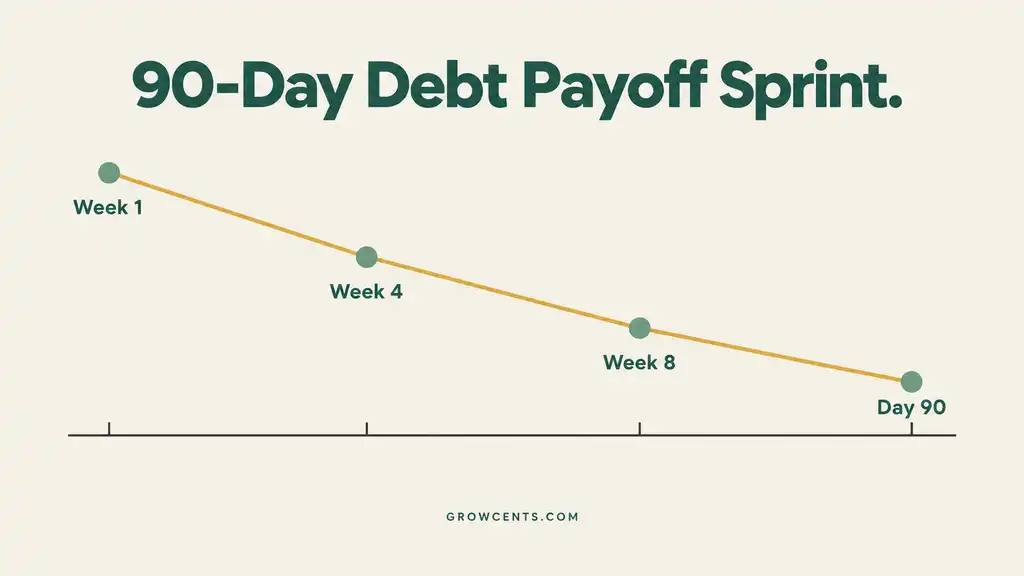
90-Day Sprint: Balance Trending Down — Infographic
Step 4: Automate and Track Weekly
Set the minimum payments on every debt to automatic, so a missed payment never happens during the sprint, and schedule the extra “sprint” payment manually once the money is available each week rather than waiting until the end of the month. A weekly check-in (even five minutes, comparing the running balance to the plan) catches a stalled week early enough to adjust, which a single check-in at day 90 does not allow.
What’s Realistic in 90 Days
For most households, a 90-day sprint is enough to pay off one small debt entirely, or to make a substantial dent in a medium-sized one; it is not enough to eliminate a large balance such as a car loan or a significant credit card debt built up over years. The value of the sprint is less about reaching zero and more about proving that a focused, structured push can move a number that had otherwise felt stuck, which often builds the motivation to continue the same approach at a sustainable pace after day 90.
Common Mistakes
- Starting without an emergency fund at all. A sprint that leaves no buffer for a genuine emergency often ends with new debt replacing the old.
- Switching methods partway through. Moving between snowball and avalanche mid-sprint usually loses the progress tracking that makes either method work.
- Not automating minimum payments. A missed minimum payment during an intense sprint can trigger late fees and a interest rate increase that undoes much of the progress.
- Treating 90 days as a permanent lifestyle. The intensity that makes a short sprint effective is usually not sustainable indefinitely; a slower, ongoing pace typically follows.
- Ignoring new charges during the sprint. Extra payments toward an existing balance are undone if new spending is added to the same card at the same time.
After the 90 Days: What’s Next
At the end of the sprint, recalculate the full debt list and decide whether to run another focused sprint on the next-highest-priority debt, or shift to a steady, ongoing payoff pace that fits permanently into the household budget. Either way, the specific tactics used during the sprint (a no-spend period, decluttering for cash) can be repeated periodically rather than treated as one-time events.
Frequently Asked Questions
Should the emergency fund be paused to speed up debt payoff?
Most approaches keep at least a small starter emergency fund intact throughout a debt sprint, since an emergency without any savings buffer often leads to new debt that cancels out the sprint’s progress.
Is snowball or avalanche better for a short sprint specifically?
Snowball tends to produce a visible result (one debt fully paid off) within a short window more reliably, while avalanche saves more in interest if the highest-rate debt is realistically payable within the 90 days.
What if income is irregular during the 90 days?
Setting the minimum payments as the fixed, automated baseline and treating any extra sprint payment as variable (based on whatever extra income actually arrives that week) keeps the sprint from depending on a stable paycheck it may not have.
Can this work for multiple debts at once instead of one at a time?
Both the snowball and avalanche methods are designed around focusing extra payments on one debt at a time while maintaining minimums on the rest, which concentrates the sprint’s impact rather than spreading it thin.
What if the sprint doesn’t go as planned?
Any progress made, even partial, is still progress; recalculating and either extending the sprint or switching to a steadier pace is more useful than treating an imperfect 90 days as a failure.
How This Guide Was Built
This guide was researched using official Federal Reserve data and consumer education resources rather than personal anecdote or invented statistics. The average credit card interest rate referenced comes from the Federal Reserve Bank of St. Louis’s FRED database, sourced from the Federal Reserve Board’s G.19 Consumer Credit release. The debt-planning framework references the Consumer Financial Protection Bureau’s Your Money, Your Goals toolkit. The example debt figures in the table above are illustrative only, not sourced data. GrowCents’ full research and sourcing approach is described on the Editorial Policy page and the About page.
This article is general educational information, not personalized financial or credit counseling advice, and does not account for any individual household’s full financial situation. Anyone facing serious debt difficulty or collection activity may want to consult a nonprofit credit counseling agency or the CFPB’s resources directly. See the Disclaimer page for details.