Budgeting for Couples: How to Combine Finances Without Losing Independence

Last verified: September 2026.
Combining finances is one of the biggest practical steps a couple takes, and there is no single right way to do it. Some couples pool everything. Others keep every account separate and split the bills. Many land somewhere in between. This guide covers the three common account setups, three fair ways to split shared bills with a fully worked example, a simple monthly money meeting, and the legal and safety points that are easy to overlook. It applies to married and unmarried partners alike, although the legal details differ by location and relationship status.
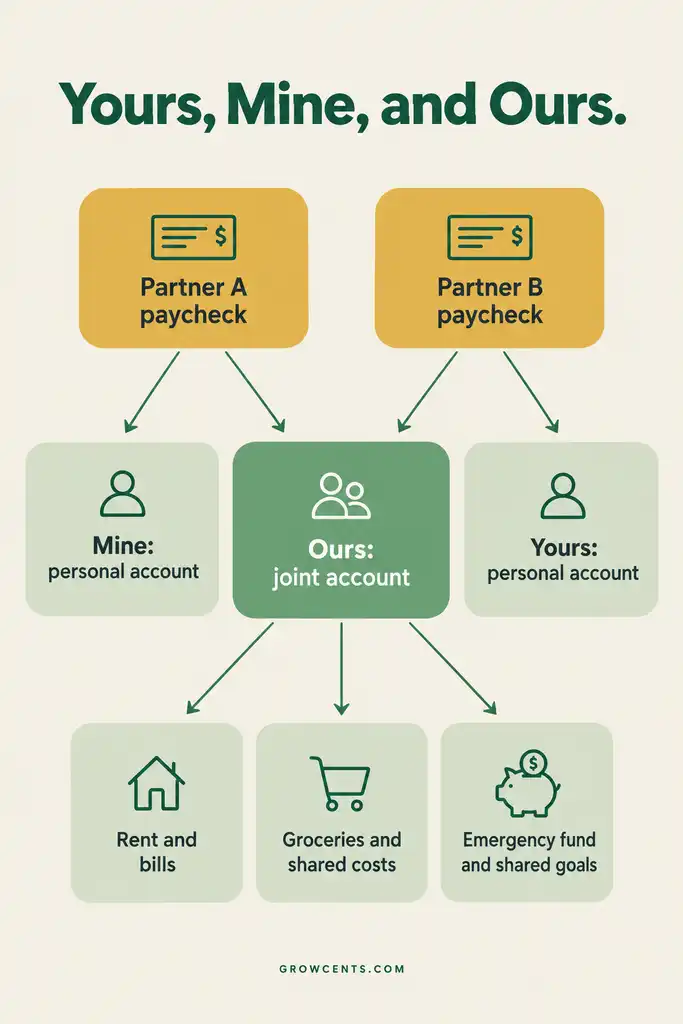
Quick Answer: A popular middle path is “yours, mine, and ours”: each partner keeps a personal account, and both contribute to a joint account that pays shared bills and funds shared goals. Contributions can be equal, proportional to income, or set so each person keeps the same amount afterward. Whatever the structure, agree on it in advance, hold a short monthly money meeting, and understand that joint accounts and joint credit make both partners legally responsible.
Why the Conversation Comes Before the Spreadsheet
Account structure matters less than whether both partners understand and agree on how money will be handled. Research points the same way. A Kansas State University-led study of more than 4,500 couples, described in the university’s news release, found that arguments about money, especially early in a marriage, were a strong predictor of later divorce, even after the researchers controlled for income, debt, and net worth. It was an observational study, so it shows an association rather than proving that money arguments cause breakups. Co-author Jeffrey Dew has suggested, in comments reported by HuffPost, that fights about money may point to deeper issues or to stress from financial setbacks such as a job loss. The researcher also recommended talking through hard topics in advance, such as student loan payments or how money will be allotted if one partner stays home with children.
The CFP Board, the professional body for certified financial planners, offers similar practical advice in its guidance for couples: schedule a specific time to talk about money instead of raising it in the middle of an argument, and divide financial tasks according to each partner’s strengths. Its earlier couples guidance adds a point worth remembering: if either partner keeps a separate account, say so openly rather than leaving it unspoken.
Three Ways to Organize Accounts
| Setup | How It Works | Main Advantage | Main Drawback |
|---|---|---|---|
| All joint | All income goes into shared accounts and all bills are paid from them | Simple, transparent, and easy to budget as one unit | Individual purchases can feel scrutinized, and spending styles can clash |
| All separate | Each partner keeps their own accounts and shared bills are split or divided between them | Strong autonomy and fewer arguments about personal spending | Splitting bills and tracking who owes what gets more complicated |
| Hybrid (“yours, mine, ours”) | Each partner keeps a personal account and both fund a joint account for shared costs and goals | Combines shared accountability with personal freedom | Needs agreement on how much each person contributes |
This breakdown follows the pros and cons laid out in a San Diego County Credit Union guide to joint and separate finances, which describes the hybrid approach as one that often combines the benefits of both. A joint account also works best when talking about money is already comfortable. A certified financial planner quoted in a GOBankingRates piece republished by Nasdaq warned that if money conversations are hard now, sharing an account may make them harder, and suggested agreeing on rules for contributions, spending, and what happens if the account is overdrawn.
Three Fair Ways to Split Shared Bills
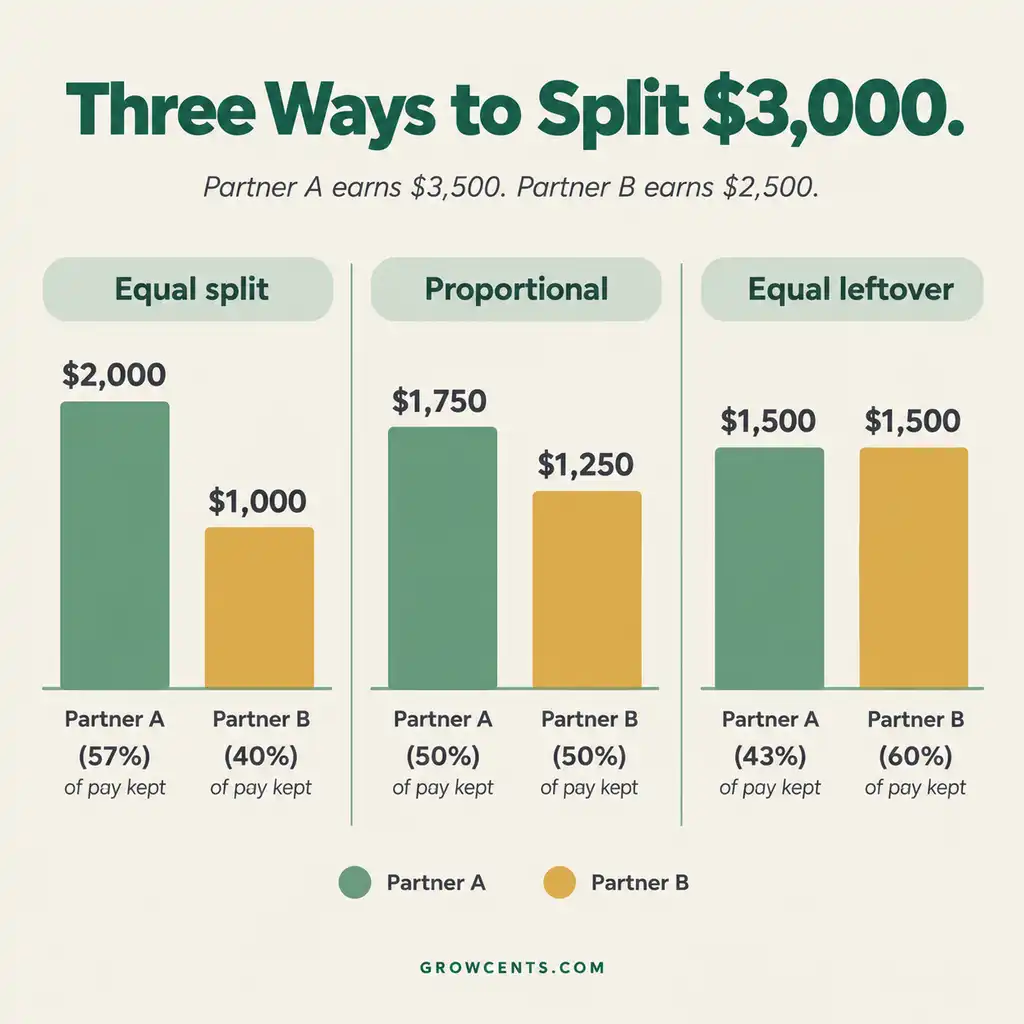
Once a joint account exists, the next question is how much each partner puts into it. The example below uses Partner A with $3,500 of monthly take-home pay, Partner B with $2,500, and $3,000 of shared monthly costs. All figures are illustrative.
| Method | How It Works | Partner A Pays | Partner B Pays | A Keeps | B Keeps |
|---|---|---|---|---|---|
| Equal split | Each pays half of shared costs | $1,500 | $1,500 | $2,000 (57% of pay) | $1,000 (40% of pay) |
| Proportional to income | Each pays the same percentage of their pay, here 58.3% and 41.7% | $1,750 | $1,250 | $1,750 (50% of pay) | $1,250 (50% of pay) |
| Equal leftover | Each keeps the same dollar amount after shared costs | $2,000 | $1,000 | $1,500 (43% of pay) | $1,500 (60% of pay) |
Each method is fair by a different definition. The equal split treats the bills as identical obligations, but it leaves the lower earner with a much smaller share of their own pay. The proportional method keeps the same percentage for each person, so both feel the shared costs equally. The equal-leftover method guarantees identical personal spending money, which some couples prefer when their incomes differ widely. The right choice is the one both partners genuinely agree to, and it can be revisited when circumstances change.
Three Ways to Split $3,000 — Infographic
A “Yours, Mine, and Ours” Budget in Practice
Using the proportional method, the two partners contribute $1,750 and $1,250 to a joint account every payday cycle, a total of $3,000. The joint account pays only the shared costs and shared goals:
| Joint Account Line | Monthly Amount |
|---|---|
| Rent | $1,300 |
| Utilities and internet | $250 |
| Groceries | $550 |
| Shared transportation costs | $300 |
| Insurance | $200 |
| Joint emergency fund | $250 |
| Shared goals, such as travel | $150 |
| Total | $3,000 |
Whatever remains in each partner’s personal account covers their own expenses, such as a phone plan, personal debts, and personal savings, along with a personal spending amount that is theirs to use without explanation. The details of the joint budget can be built with the zero-based method or the 50/30/20 rule, using the shared income as the starting number.
Yours, Mine, and Ours — Infographic
A 30-Minute Monthly Money Meeting
A short, regular meeting keeps small issues from growing and replaces tense one-off conversations. A simple agenda:
- Income and upcoming changes. Raises, reduced hours, or expected one-time income.
- Last month’s joint spending against the plan. Where it matched and where it did not.
- Irregular costs coming up. Annual bills and seasonal expenses that need a sinking fund.
- Progress on shared goals. Emergency fund, debt payoff, a trip, or a down payment.
- Decisions to make together. Any large purchase or change to the plan.
Choosing a fixed time, ending on something positive, and keeping the meeting short make it easier to repeat. A shared spreadsheet or a couples-oriented app, such as the free option covered in the guide to budgeting apps for beginners, can show both partners the same numbers.
Rules Worth Agreeing on in Advance
- A spending threshold. A dollar amount above which each partner talks to the other before buying, chosen to suit the household’s size of budget.
- Personal spending money. A fixed amount for each person that needs no justification, in the same dollars or the same percentage for both.
- Who handles which tasks. Paying bills, tracking the budget, and managing savings can be divided by preference, with both partners able to see everything.
- How debts are treated. Whether existing debts stay with the person who brought them or become shared goals, and how they will be paid down.
- What happens if income drops. A plan for reducing contributions or cutting spending, agreed before it is needed. A partner with irregular pay can use the baseline method in the guide to budgeting on variable income.
- Overdraft rules. Who covers a shortfall in the joint account and how it is repaid.
Protect Both of You: Legal and Practical Points
- Either owner of a joint account can typically access all of it. Joint accounts are built on trust, since each co-owner can generally withdraw the full balance.
- Deposit insurance is per co-owner. The FDIC explains in its guide to joint accounts that each co-owner is insured up to $250,000 across all joint accounts at the same insured bank, which matters mainly for couples with large balances.
- Joint credit means shared liability. Consumer Action’s explainer on account ownership notes that a joint account holder is legally responsible for the bill, and that until a joint account is paid off and closed, all parties are liable even if only one person made the charges. An authorized user, by contrast, is not legally responsible for paying.
- Know each other’s credit picture. Reviewing each partner’s credit report is a sensible early step. The FTC notes that AnnualCreditReport.com is the only authorized source for free credit reports under federal law.
- Keep some individual footing. Maintaining at least one account in each partner’s own name, and each person’s own credit history, keeps both partners able to act independently if circumstances change.
- Laws differ. Property and debt rules for married and unmarried couples vary by state and country, so a local attorney is the right source for questions about ownership, prenuptial agreements, or what happens to shared assets and debts.
One more point deserves plain mention. Disagreements about money are normal, but control is different. According to the National Network to End Domestic Violence, financial abuse can look like forbidding a partner to work, withholding money, restricting access to accounts, or concealing information about the family’s finances. Anyone who recognizes this pattern can reach the National Domestic Violence Hotline at 1-800-799-SAFE (7233), by chat at thehotline.org, or by texting START to 88788.
When Incomes Are Very Different or One Partner Has No Income
When incomes differ widely, the proportional method keeps the burden fair. When one partner has no income, for example while caring for children or between jobs, the household is effectively spending one income, and it helps to decide explicitly that both partners have equal access to the money and an equal personal spending amount. Treating the household’s income as shared, not as one person’s money that the other receives, protects both the budget and the relationship, and the non-earning partner should be able to see all accounts and have access to funds.
Common Mistakes
- Merging accounts before talking. Setting up joint accounts first and discussing rules later is a common source of conflict.
- Hiding accounts or debts. Surprises erode trust more than the underlying numbers do.
- Assuming “fair” means “equal.” An equal split can be quietly unfair when incomes differ widely.
- Making one person the permanent money manager with no visibility for the other. Dividing tasks is fine; hiding information is not.
- Having no plan for a change in income. A job loss, a new baby, or a career change is much easier to handle when the rules were set in advance.
- Skipping the shared emergency fund. A joint emergency fund prevents one partner’s setback from becoming a crisis for both.
Frequently Asked Questions
Should couples combine all their money?
There is no universally right answer. Some couples prefer one pool for simplicity, while others value separate accounts for autonomy. Many choose a hybrid. The best structure is the one both partners understand and agree to.
Is a joint account the same for married and unmarried couples?
Banks treat joint accounts the same way regardless of marital status, but other legal consequences, such as property rights and responsibility for debts, can differ. A local attorney can explain the specifics.
How should a couple handle one partner’s student loans or other debt?
Some couples treat existing debt as a shared goal, while others leave it with the person who owes it. Either can work as long as it is discussed openly and built into the budget.
What if one partner is a much bigger spender?
Personal spending amounts and a spending threshold for joint decisions give each partner freedom while limiting surprises. A monthly meeting helps catch drift early.
Do couples really need a monthly money meeting?
It is not required, but a short, regular check-in tends to prevent larger conflicts. Some couples go quarterly once their system is running smoothly.
How This Guide Was Built
This guide was researched using university research, federal and nonprofit consumer resources, and professional planning organizations rather than personal anecdote or invented statistics. The research on money arguments comes from the Kansas State University news release and the co-author’s comments reported by HuffPost. Communication and account-structure advice comes from the CFP Board’s 2017 and 2014 guidance, the San Diego County Credit Union, and a GOBankingRates article on Nasdaq. Deposit insurance comes from the FDIC, credit liability from Consumer Action, free credit reports from the FTC, and financial abuse information from the National Network to End Domestic Violence. The income figures, bill splits, and joint budget in the tables are illustrations built for this guide, calculated directly and not sourced data. GrowCents’ full research and sourcing approach is described on the Editorial Policy page and the About page.
This article is general educational information, not personalized financial, legal, or relationship advice, and does not account for any couple’s full circumstances. Laws on property and debt vary by location. See the Disclaimer page for details.