30-Day Decluttering-to-Cash Challenge: Turn Unused Items Into Savings
Last verified: September 2026.
Most households have money sitting in closets, garages, and drawers in the form of things that are no longer used. A decluttering-to-cash challenge turns that fact into a structured 30-day project: one small area of the home per day, sorted into keep, sell, donate, or discard, with anything sellable listed and the proceeds sent toward a specific savings goal. This guide covers a day-by-day plan, what to check before listing anything for sale, and how to sell safely online.
Quick Answer: Tackle one small area a day for 30 days rather than the whole house at once. Sort each area into four piles: keep, sell, donate, and discard. Before listing anything for sale, check it against current safety recalls. List sellable items on a local marketplace or consignment option, and send the proceeds directly to a specific goal, such as a starter emergency fund, rather than letting the cash blend into everyday spending.
How the Challenge Works
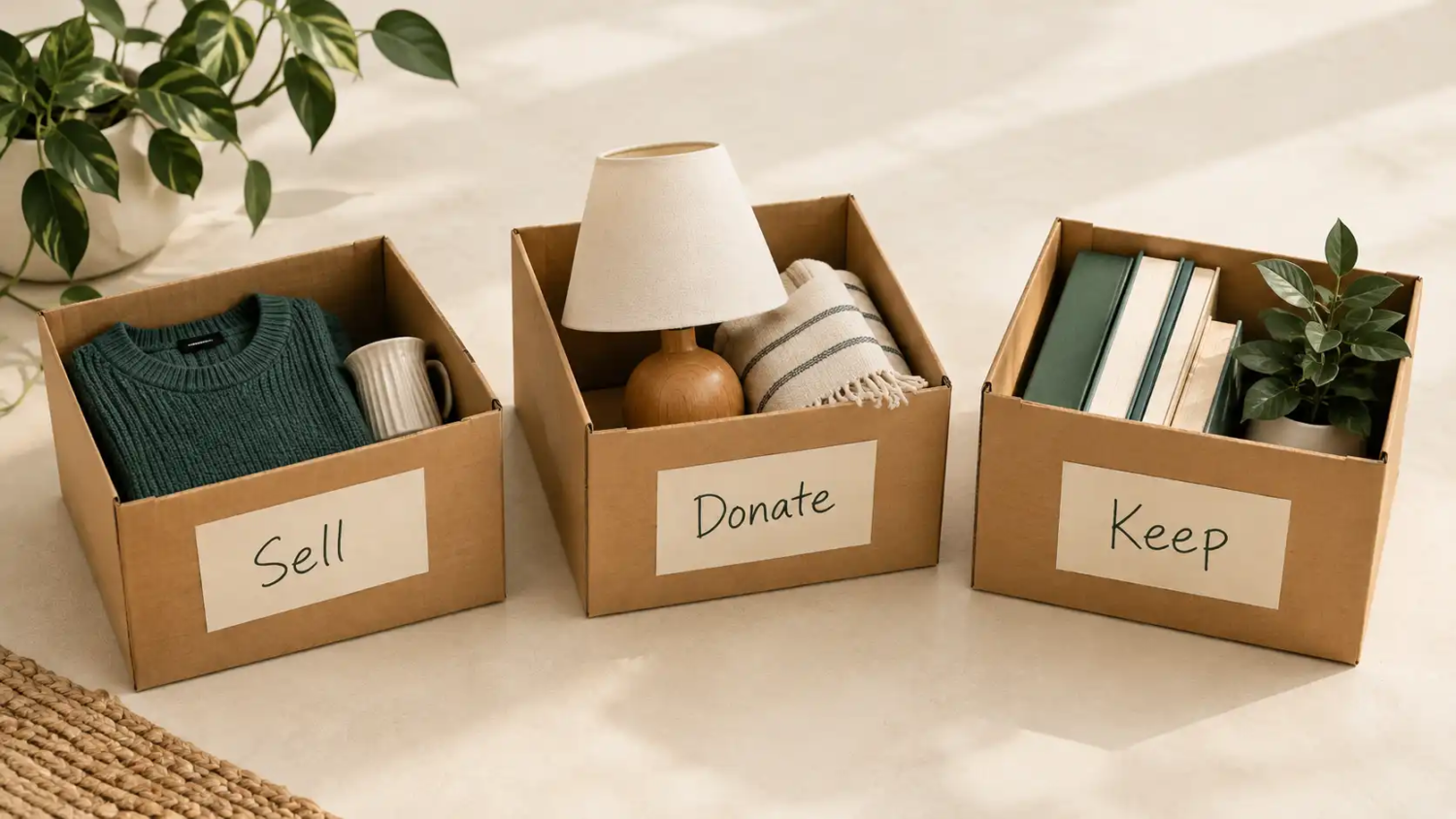
The structure is what makes this manageable: instead of “declutter the house” as one overwhelming task, the month is broken into 30 small, specific areas (one drawer, one shelf, one section of the closet). Each area gets sorted into four categories on the spot: items to keep, items in good enough condition to sell, items to donate, and items to discard. Working in small daily areas keeps any single day’s task to well under an hour, which is what allows the challenge to actually get finished instead of stalling after the first weekend.
A 30-Day Room-by-Room Plan
The specific areas below are a starting template; any household can rearrange them to match its own layout.
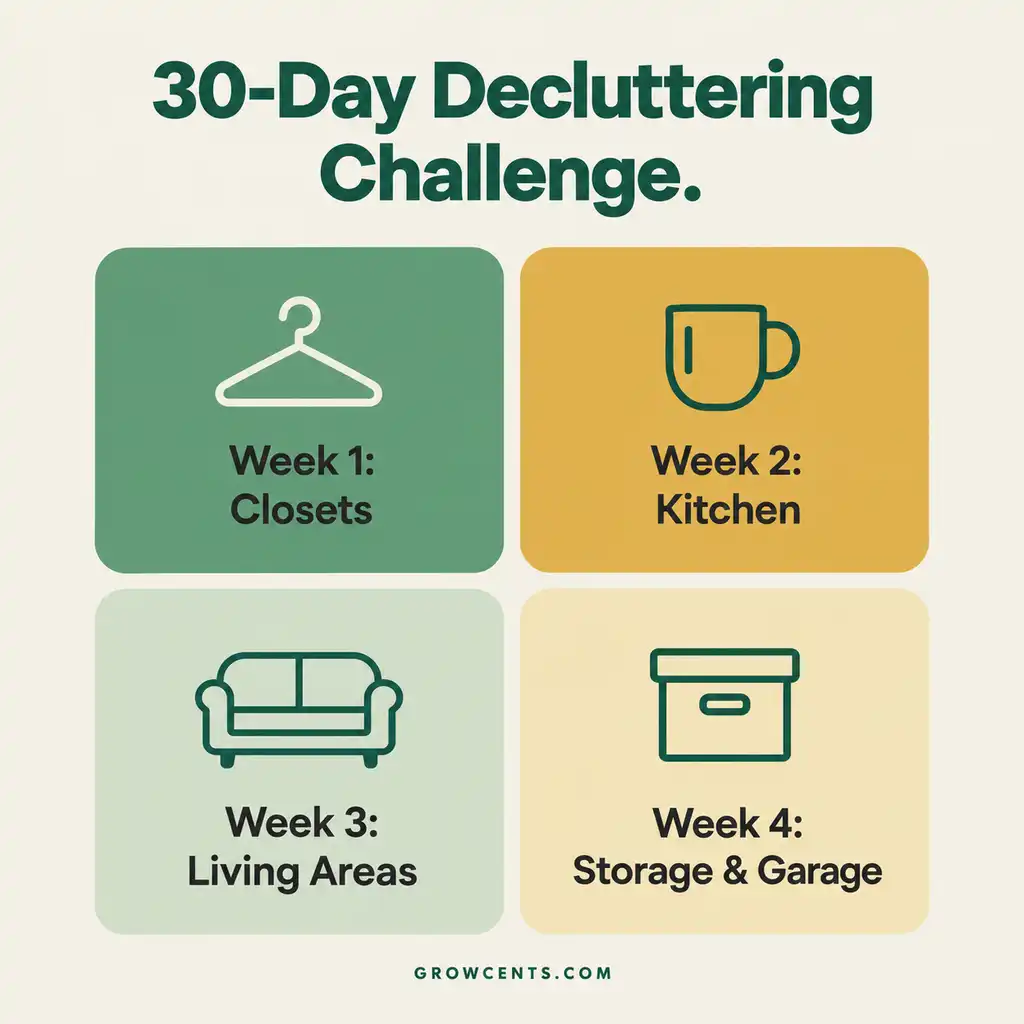
| Week | Focus | Example Daily Areas |
|---|---|---|
| Week 1 | Closets and clothing | One drawer or shelf per day: everyday clothes, seasonal clothes, shoes, accessories, coats |
| Week 2 | Kitchen and dining | One cabinet or drawer per day: small appliances, dishware, food storage containers, cookware, pantry |
| Week 3 | Common living areas | One category per day: books and media, electronics and cables, decor, toys and games, linens |
| Week 4 | Storage, garage, and miscellaneous | One zone per day: garage shelving, seasonal decorations, tools, sporting goods, a final catch-all pass |
Weekly Focus Areas — Infographic
Deciding What to Sell, Donate, or Discard
A simple rule helps most decisions: if it is in good working or wearable condition and has resale value, it is a sell candidate; if it is usable but not worth the time to list, it is a donation candidate; if it is broken, incomplete, or unsafe, it gets discarded. Sentimental items are worth setting aside in their own separate box rather than forcing a decision under the pressure of the daily timer — a decluttering challenge works better as a spending and space reset than as a forced purge of things that genuinely matter.
Before Listing Anything: Check for Recalls
Before any item goes up for sale, it is worth checking whether it has been the subject of a safety recall. Under federal law, it is illegal to resell a recalled product, and the U.S. Consumer Product Safety Commission notes that this rule applies to individual consumers reselling secondhand items, not just stores, whether the sale happens online or in person. This matters most for children’s items (cribs, high chairs, baby gear), electronics, and anything with a motor or heating element. Checking a product against CPSC’s recall list takes a minute and applies to any household clearing out a garage or nursery closet full of items that have not been used in years.
Where to Sell
Sellable items generally fall into a few paths: general online marketplaces and local buy-and-sell groups, category-specific apps (clothing, electronics, furniture), consignment or resale shops, and in-person options like a yard sale for a larger volume of smaller items at once. The right channel usually depends on the item: higher-value single items (furniture, electronics) tend to do better on general marketplaces where buyers can see photos and ask questions, while a large volume of smaller items (clothing, kitchenware, toys) is often faster to clear through a single yard sale or a donation drop rather than listing each one individually.
Staying Safe When Selling Online
Selling used items online, unfortunately, also attracts scammers. The FTC has documented a common scheme in which a buyer claims to have overpaid through a payment app and asks the seller to refund the difference before the original payment has actually cleared, leaving the seller out both the item and the refunded amount. The agency’s guidance on avoiding these scams recommends logging into a payment account directly (never through a link in an email or message) to confirm a payment has actually arrived before shipping anything or refunding any amount, and treating any “I sent too much, please send some back” message as a warning sign regardless of how convincing the accompanying screenshot looks. For local sales, meeting in a public place and accepting cash or an in-person, verified payment reduces most of this risk entirely.
What to Do With the Money
Deciding where the money goes before the first sale, rather than after, makes a real difference in whether it actually gets saved. A dedicated envelope, a note in a banking app, or a specific savings sub-account earmarked for the challenge keeps the proceeds separate from everyday spending money. Many households direct decluttering proceeds toward a starter emergency fund, since the money is unplanned income rather than a cut from an existing budget category, which makes it easier to save in full rather than partially spend along the way.
Common Mistakes
- Starting with the hardest room. A garage or basement that has accumulated items for years can stall the whole challenge in week one; starting with a smaller, easier area builds momentum first.
- Listing items without checking condition or recalls. Beyond the legal issue with recalled products, listing broken or unsafe items damages trust with local buyers.
- No plan for the “maybe” pile. Items that do not clearly sort into keep, sell, donate, or discard tend to pile up separately; setting a firm decision deadline (a week, not “eventually”) keeps this pile from becoming permanent storage.
- Letting listings sit indefinitely. An item that has not sold after a reasonable window is often better donated than left listed for months at a declining price.
- Spending the proceeds as they come in. Without a set destination, small individual sales are easy to spend immediately rather than accumulate toward a goal.
Frequently Asked Questions
What if a whole month feels like too much?
A shorter version, such as one weekend focused on a single room, works the same way at a smaller scale. The daily structure is a tool for consistency, not a requirement.
Should broken items be listed “for parts”?
Some categories (electronics, appliances) do have a for-parts resale market, but this is a smaller and slower channel than selling working items; for most households, it is not worth the time compared to donation or responsible disposal.
How do I know if an item has been recalled?
The CPSC’s recall search lets anyone check a product by name or category before listing or donating it.
Is it worth paying for professional photos or listings?
For most everyday household items, clear photos taken with a phone in good lighting are sufficient; paid listing services generally make more sense for higher-value items like furniture or collectibles.
What should happen to items that don’t sell or donate easily?
Many communities have specific recycling or disposal programs for items like electronics, mattresses, or paint that cannot simply go in the regular trash; checking local municipal guidelines avoids both wasted effort and improper disposal.
How This Guide Was Built
This guide was researched using official government safety and consumer protection resources rather than personal anecdote or invented statistics. The legal requirement against reselling recalled products comes from the U.S. Consumer Product Safety Commission. Online selling scam patterns are sourced from the Federal Trade Commission’s consumer alerts. GrowCents’ full research and sourcing approach is described on the Editorial Policy page and the About page.
This article is general educational information, not personalized financial, legal, or safety advice, and does not account for any individual household’s full situation. See the Disclaimer page for details.