Practical Ways to Cut Your Grocery Bill This Month
Last verified: September 2026.
Groceries are one of the few household budget categories that can be cut within days rather than months, since the results show up the very next time a cart gets checked out. According to USDA Economic Research Service data, households in the lowest income quintile spent an average of 33% of their before-tax income on food in 2024 — making groceries one of the categories where small changes have an outsized effect on a tight budget. This guide covers specific, practical ways to lower a grocery bill starting this month, without resorting to skipping meals or cutting nutrition. Anyone building a full household budget can use these changes to free up room in the grocery category specifically.
Quick Answer: The fastest wins are planning meals around what is already on sale, comparing unit prices instead of shelf prices, sticking to a written list, choosing store brands for staples, and reducing food waste by using what is already in the fridge and freezer before buying more. None of these require a special app, membership, or extra time investment beyond a few minutes at the store.
Why Groceries Respond Faster Than Other Budget Categories
Rent, insurance, and loan payments are fixed for months or years at a time; the grocery bill resets every single shopping trip, which means a change made this week shows up in this week’s total, not next year’s. That makes groceries one of the most useful categories to target first when a budget needs to be adjusted quickly, or when building toward a goal like a starter emergency fund.
Before You Shop: Plan and Take Inventory
Two minutes before making a list saves more than an hour of comparison shopping in the store. Check the refrigerator, freezer, and pantry first, and plan meals around what is already there plus what happens to be on sale that week — a method USDA’s MyPlate guidance lists as the first step to eating well on a budget. Meals that “stretch” one expensive ingredient across several servings — soups, stews, casseroles, stir-fries — get more meals out of the same grocery spend than dishes built around several separate proteins.
10 Practical Ways to Cut a Grocery Bill This Month
1. Plan Meals Around What’s on Sale
Check the store’s weekly sale flyer or app before writing the meal plan, rather than after. Building meals around discounted meat, produce, or pantry staples usually saves more than hunting for coupons on items already decided in advance.
2. Compare Unit Prices, Not Shelf Prices
The price tag on the shelf usually shows a small “unit price” (cost per ounce, pound, or count) below the total price. Comparing unit prices is the only reliable way to tell whether a larger package or a different brand is actually cheaper, since packaging sizes vary widely between brands.
3. Build a List and Stick to It
A written list, made after checking the fridge and pantry, reduces the impulse purchases that typically inflate a grocery bill by items that were never part of the plan. Shopping the store’s perimeter first (produce, dairy, meat) before the center aisles also tends to reduce impulse add-ons, since many packaged and discretionary items sit in the middle aisles.
4. Choose Store Brands for Staples
Store-brand versions of staples — pasta, canned goods, flour, spices, dairy — are frequently made in the same facilities as name-brand products, at a lower price. Reserving name-brand purchases for the few items where a household has a strong, specific preference (rather than defaulting to name brands across the board) can meaningfully lower a total bill without changing what actually gets eaten.
5. Track Prices with a Simple Tool
A basic price notebook, spreadsheet, or one of the budgeting tools already in use for the household budget can track what staple items typically cost at different stores, making it easier to recognize an actual sale versus a marked-up “sale” price.
6. Reduce Food Waste
Food that spoils before it gets used is money thrown away regardless of how cheaply it was purchased. Storing items properly and using older items before newer ones (a simple “first in, first out” habit) extends how long groceries last; the USDA’s FoodKeeper tool provides specific storage timelines for hundreds of food and beverage items for households that want more precise guidance than “when in doubt, throw it out.”
7. Batch Cook and Freeze Portions
Cooking a larger batch of a freezer-friendly meal and portioning the extra into the freezer reduces both the temptation to order delivery on a busy night and the small amount of food that tends to go bad when cooked “just for tonight” every time.
8. Buy in Bulk Only for What Gets Used
Bulk pricing only saves money if the item is actually used before it spoils or expires; shelf-stable staples (rice, dried beans, pasta) are usually safe bulk purchases, while perishable bulk items are a savings only for households that will realistically use the full quantity.
9. Shop on a Full Stomach, on a Schedule
Shopping hungry, or shopping without a set schedule (making frequent small trips instead of fewer planned ones), both tend to increase impulse purchases. A single planned trip per week, right after a meal, reduces both effects at once.
10. Compare the Bill to the Budget Every Month
Comparing the actual monthly grocery total against the amount planned in the household budget is what turns these individual changes into a lasting habit rather than a one-time effort; see the household budgeting guide for how to set that category amount in the first place.
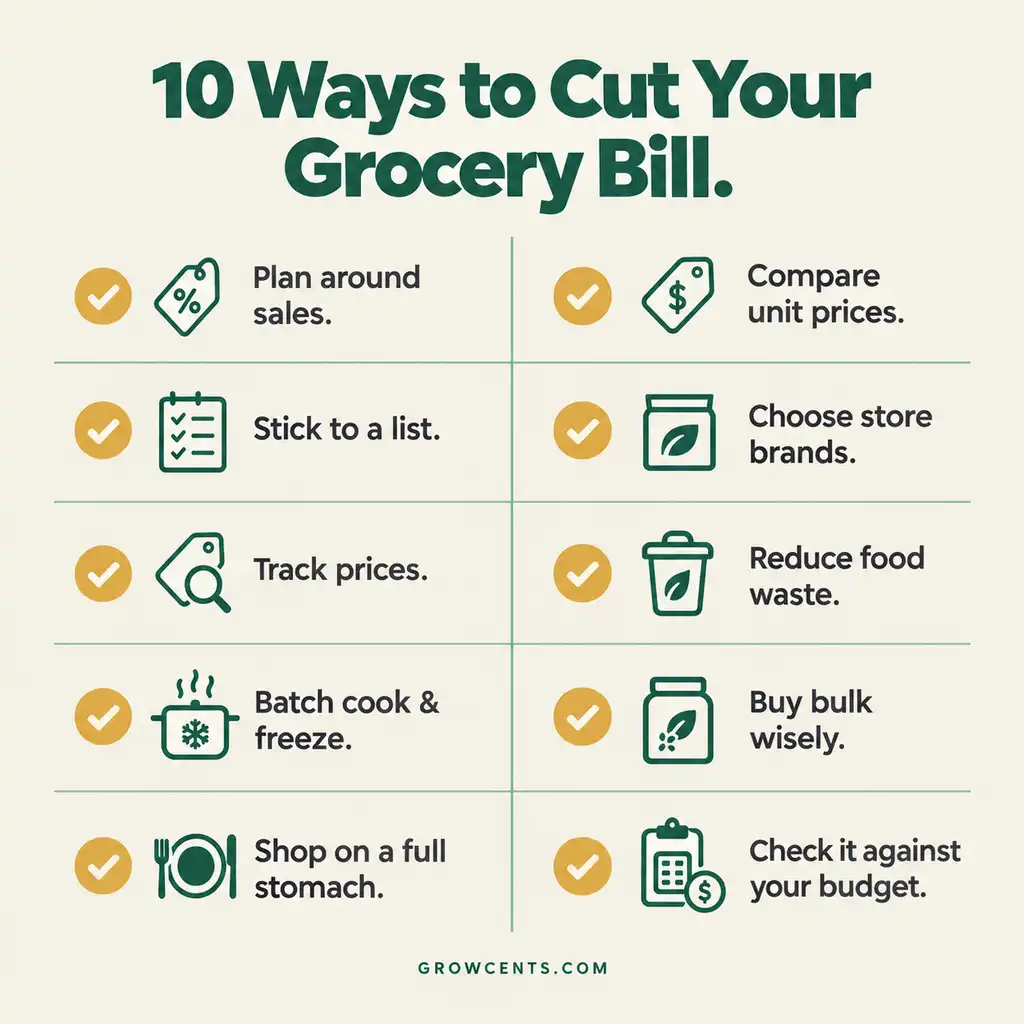
10 Ways to Cut a Grocery Bill — Infographic
Where a Typical Grocery Bill Goes
The table below is a simplified, illustrative breakdown of a hypothetical $600 monthly grocery budget for a household of four — not a target or a national average, since actual spending varies widely by household size, location, and dietary needs.
| Category | Illustrative Monthly Amount | % of Grocery Budget |
|---|---|---|
| Meat, poultry, and seafood | $140 | 23% |
| Produce (fruits and vegetables) | $110 | 18% |
| Dairy and eggs | $80 | 13% |
| Grains, bread, and pasta | $70 | 12% |
| Pantry staples and canned goods | $60 | 10% |
| Snacks and beverages | $70 | 12% |
| Household and paper goods | $40 | 7% |
| Miscellaneous / unplanned items | $30 | 5% |
Common Grocery Budget Mistakes
- Shopping without checking the pantry first. Duplicate purchases of items already on hand are a quiet but frequent source of overspending.
- Comparing brands by shelf price instead of unit price. A larger package at a higher shelf price is often the cheaper option per unit, and the reverse is also common.
- Treating “on sale” as the same as “needed.” A discount on an item that would not otherwise have been purchased is not a saving; it is added spending.
- Letting fresh food spoil unused. Produce and proteins that go bad before use erase whatever was saved buying them cheaply.
- Not revisiting the grocery budget after prices change. A category amount set months ago may no longer match current prices in either direction.
How Much Could This Actually Save?
The realistic savings from these changes depend heavily on current habits: a household that already plans meals and compares prices will see smaller gains than one starting from no plan at all. As a rough, illustrative example only, a household spending $600 a month on groceries with little planning in place might realistically reduce that bill by 10–15% (roughly $60–$90) within the first month simply from meal planning, list discipline, and reduced food waste, before any brand-switching or bulk-buying changes are factored in. This is an estimate for illustration, not a guaranteed outcome.
Frequently Asked Questions
Does buying organic always cost more?
Organic products are frequently priced higher than conventional versions, though the gap varies by item and store; comparing unit prices item by item is more reliable than assuming a fixed percentage difference.
Are wholesale club memberships worth it for groceries?
It depends on household size and how consistently bulk quantities get used before spoiling or expiring; a membership fee only pays for itself if the bulk savings realized exceed that fee plus any waste from unused quantities.
Is meal planning worth the time it takes?
Most of the savings from meal planning come from reduced impulse purchases and reduced food waste rather than from the plan itself, so even a rough 10-minute weekly plan tends to produce most of the benefit.
Should coupons still be part of a grocery strategy?
Coupons help when they apply to items already on the list; using a coupon to justify purchasing an item that was not otherwise needed generally increases spending rather than reducing it.
How often should a grocery budget be reviewed?
A monthly review, alongside the rest of the household budget, is usually enough to catch price changes or spending drift without requiring a review after every single trip.
How This Guide Was Built
This guide was researched using publicly available government data and consumer education resources rather than personal anecdote or invented statistics. Household food spending figures come from the USDA Economic Research Service’s food spending data. Meal-planning and shopping guidance draws on USDA MyPlate’s Eat Healthy on a Budget tip sheet. Food storage and waste-reduction guidance is sourced from the USDA/FDA’s FoodKeeper tool. The sample budget table and savings estimate above are illustrative examples built for this guide, not sourced statistics, and are labeled as such. GrowCents’ full research and sourcing approach is described on the Editorial Policy page and the About page.
This article is general educational information, not personalized financial or nutritional advice, and does not account for any individual household’s full situation. See the Disclaimer page for details.