How to Cancel Subscriptions You Forgot You Had (And Save Hundreds a Year)
Last verified: October 2026.
Subscriptions are designed to be easy to start and easy to forget. A free trial becomes a paid plan, an annual renewal arrives months after anyone remembers signing up, and a $9 charge on a statement looks small enough to ignore. Added together, those small charges can reach hundreds of dollars a year for services nobody uses. This guide covers how to find every subscription, how to decide what stays, how to cancel in a way that sticks, what the law currently says about cancellation, and what to do if a company keeps charging after a cancellation.
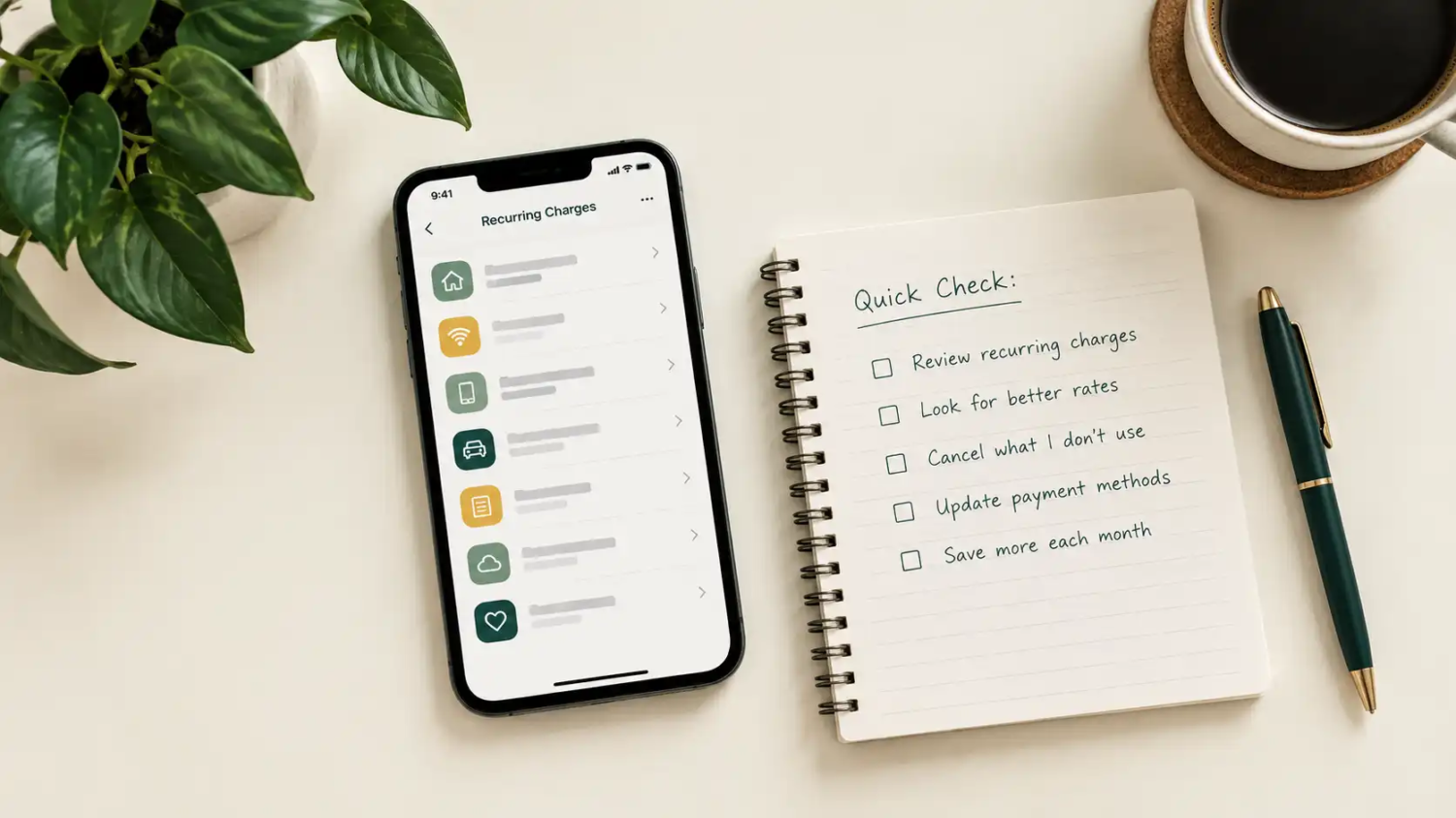
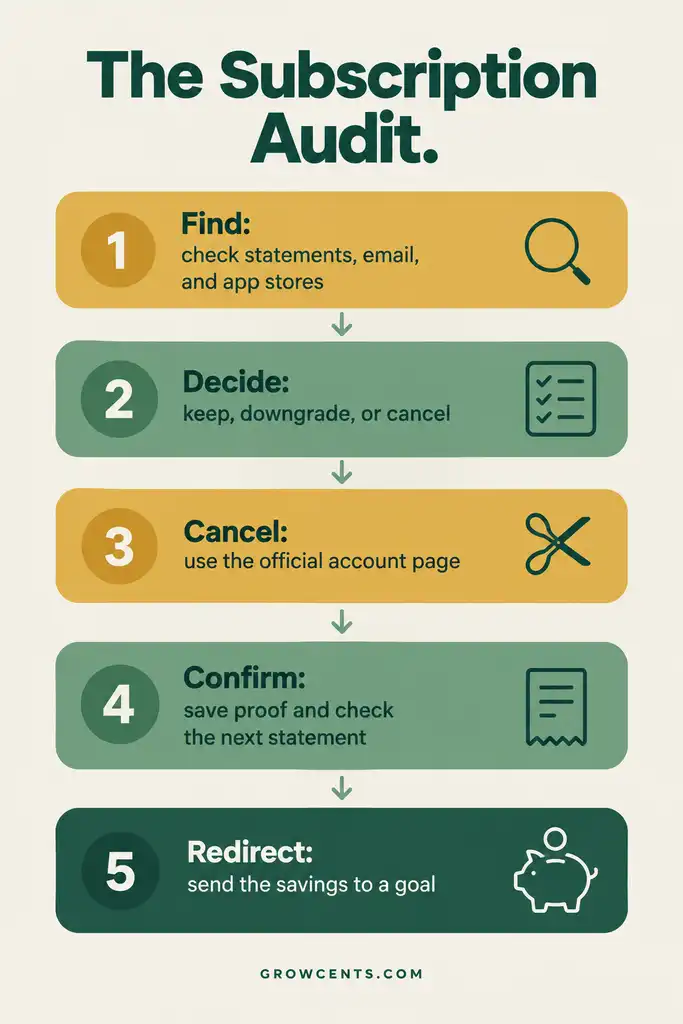
Quick Answer: Review two to three months of bank and card statements, plus the subscription lists inside app store accounts, and write down every recurring charge with its cost and renewal date. Mark each one keep, downgrade, or cancel based on whether it was actually used in the past 60 days. Cancel through the official account page before the renewal date, save the confirmation, and check the next statement. If a company keeps charging, dispute the charge with the card issuer and report it to the FTC. In the illustrative example below, canceling four unused services saves $384 a year.
How Subscriptions Slip Through
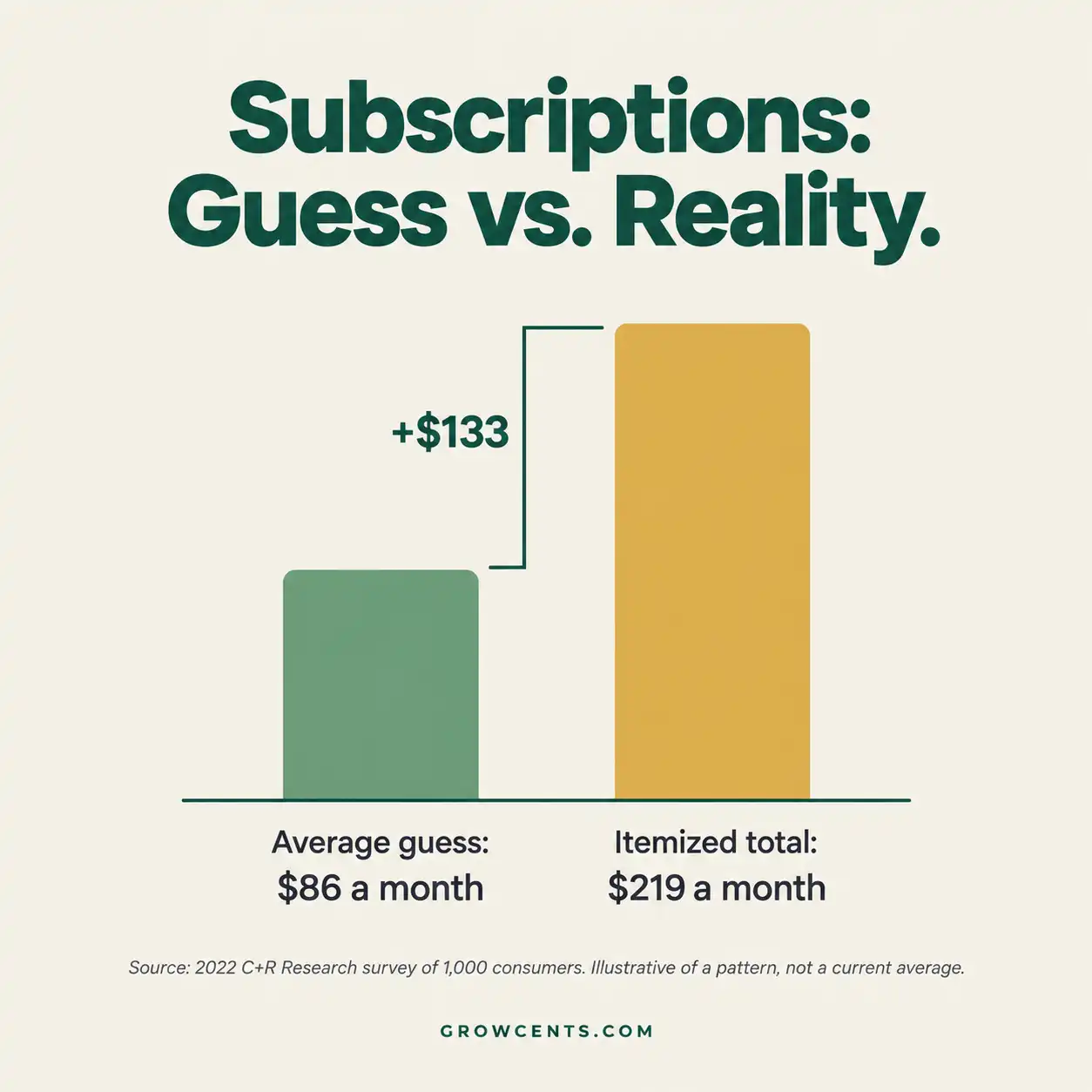
Most people underestimate what they pay. A 2022 survey of 1,000 consumers commissioned by market research firm C+R Research, reported by CNBC, found that people’s offhand guess of their monthly subscription spending averaged $86, while their itemized spending across specific categories averaged $219, about $133 more. In the same survey, 42% said they had forgotten they were still being charged for a subscription they no longer used, and 86% had at least some subscriptions on autopay. This is a commissioned survey from a few years ago, so the exact dollar figures are best treated as illustrations of a pattern rather than current averages. The pattern, though, is consistent: guessing misses what a line-by-line review finds.
What People Think vs. What They Spend — Infographic
Step 1: Find Every Subscription
A thorough audit uses several sources, because no single list is complete:
- Bank and card statements. Review two to three months, or longer to catch quarterly and annual charges. Look for the same merchant name repeating at the same amount.
- Email. Searching an inbox for words like “receipt,” “renewal,” “trial,” and “subscription” often turns up services that no longer appear obvious on a statement.
- App store and payment accounts. Apple and Google both list active subscriptions in their account settings, and payment services keep their own lists of automatic payments. Charges billed through these accounts show up under the store’s name on a statement, not the service’s.
- Annual charges. A yearly renewal is the easiest to miss. A 30-day spending tracker will not catch it, so a look back across twelve months is worth doing once.
- Shared and family accounts. Check whether anyone else in the household is paying for something that overlaps.
List what is found in a simple table. The sample below is illustrative, and the amounts are not tied to any real service.
| Service | Monthly Equivalent | Billing | Last Used | Decision |
|---|---|---|---|---|
| Video streaming A | $15 | Monthly | This week | Keep |
| Video streaming B | $10 | Monthly | 3 months ago | Cancel |
| Music streaming | $11 | Monthly | Daily | Keep |
| Fitness app | $13 | Monthly | 5 months ago | Cancel |
| Cloud storage | $3 | Monthly | In use | Keep |
| Online news | $5 | Monthly | 2 months ago | Cancel |
| Software ($120 a year) | $10 | Annual | Weekly | Keep |
| Magazine ($48 a year) | $4 | Annual | Rarely opened | Cancel |
| Total | $71 a month | Cancel: $32 a month |
In this example, the eight subscriptions cost about $71 a month, or $852 a year, and the four marked for cancellation add up to $32 a month, or $384 a year. That is the kind of result a review can produce. Another household’s number could be higher or lower.
Step 2: Decide What Stays
| Question | Action If the Answer Is No |
|---|---|
| Was it used in the last 60 days? | Cancel, or pause if the service offers it and a return is likely |
| Is it worth its cost per use? | Downgrade to a cheaper tier or switch to an annual or ad-supported plan if one exists |
| Does another subscription or a free option cover the same need? | Cancel the duplicate |
| Would the household notice if it disappeared for a month? | Cancel now and resubscribe later if it is truly missed |
For streaming and similar services, many households rotate: subscribe to one service at a time, watch what is wanted, then cancel and move on. Canceling is not permanent, since most services let people return, though prices and promotions may change.
The Subscription Audit in Five Steps — Infographic
Step 3: Cancel Properly
- Cancel before the renewal date, not on it, so there is no chance of one more charge. Calendar reminders help with annual plans.
- Use the same channel that was used to sign up. A subscription bought through an app store usually has to be canceled in that store’s account settings, not on the service’s own website.
- Look for the account or billing page first. Phone and chat cancellations can be slower and may involve retention offers.
- Save proof. A confirmation email, a screenshot of the canceled status, or a reference number makes any later dispute much easier.
- Check the end date. Many services keep working until the current billing period ends, which is normal and not a sign the cancellation failed.
- Remove stored card details if possible, a step the consumer group PIRG recommends in its guide to canceling subscriptions, so a lingering account cannot bill again.
- Check the next statement. Confirm that the charge did not return.
What the Law Says Right Now
The rules on canceling are in flux, so it is worth knowing what currently applies. In October 2024, the FTC adopted amendments to its Negative Option Rule, widely called “click-to-cancel,” which would have required companies to make canceling as easy as signing up. In July 2025, the Eighth Circuit Court of Appeals vacated that rule on procedural grounds. As summarized by law firm Gibson Dunn, the FTC has since restarted the rulemaking process, and the scope of any new rule is still open. As of this writing, the click-to-cancel rule is not in force, and anyone relying on it should check the FTC’s site for the latest status.
That does not mean consumers have no protection. Other laws still apply:
- ROSCA. The Restore Online Shoppers’ Confidence Act, which the FTC continues to enforce, requires clear disclosure of material terms, express consent before charging, and a simple way to cancel. The FTC’s own consumer alert on subscriptions says businesses must provide simple ways to cancel an unwanted subscription.
- State auto-renewal laws. Several states have their own rules. Perkins Coie notes that California’s updated automatic renewal law took effect July 1, 2025, requires easy cancellation, and restricts “save” attempts meant to talk people out of canceling.
Laws differ by state and change over time, so this is general information rather than legal advice.
If They Keep Charging After You Cancel
- Contact the company in writing with the cancellation proof and ask for a refund of any charge made after the cancellation date.
- Dispute the charge with the card issuer. The FTC advises that if a company charges without consent and will not refund the money, a consumer should dispute the charge with the credit or debit card company right away. Credit cards generally offer stronger protections: PIRG notes that cards have greater protections than debit cards under the Fair Credit Billing Act. Issuers’ billing-rights notices, such as this one from a credit union, explain that billing errors generally must be reported within 60 days after they appear on a statement, so acting quickly matters.
- Report it. The FTC accepts reports at ReportFraud.ftc.gov, and a state attorney general’s consumer protection office is another place to complain.
- Replace the card number if needed. If a merchant keeps billing a card, asking the issuer for a new card number can help stop further attempts, alongside the written request and dispute above.
Keep It From Happening Again
- Put every trial on a calendar the day it starts, with a reminder set for a day or two before the trial ends.
- Read the sign-up page carefully. The FTC specifically warns consumers to look for pre-checked boxes and to confirm how to cancel before signing up.
- Use a credit card, not a debit card, for recurring charges, for the stronger dispute protections noted above.
- Give subscriptions their own line in the budget. A fixed monthly amount makes it easier to notice when a new one pushes past it. Annual plans belong in a sinking fund tracker so the renewal is planned for and visible.
- Repeat the audit twice a year. A ten-minute review in spring and fall is enough to catch drift.
Where the Savings Go
A canceled subscription only saves money if the money goes somewhere. Redirecting the freed-up amount, such as the $32 a month in the example, into a starter emergency fund through an automatic transfer turns a one-time cleanup into steady progress. For a stronger reset, a no-spend month is a good time to pause subscriptions entirely and see which ones are missed. The overall figure is worth comparing against the rest of the household budget.
Common Mistakes
- Deleting the app without canceling. Removing an app does not end the subscription, and billing continues.
- Canceling on the renewal day. A cancellation can miss the cutoff, so earlier is safer.
- Canceling in the wrong place. A subscription billed through an app store often has to be canceled there.
- Not saving proof. A dispute is much harder to win without a confirmation.
- Forgetting annual charges. A year-long audit catches renewals that a monthly view misses.
- Replacing canceled services with new ones. The savings disappear if freed-up money goes straight to a new subscription.
Frequently Asked Questions
Will I lose my data if I cancel?
It depends on the service. Some keep accounts for a time, while others delete data soon after. Downloading anything important before canceling is a sensible precaution.
Is pausing better than canceling?
Pausing is useful if a return is likely, but it can also lead to forgetting the account exists. A calendar reminder for the end of the pause keeps it from becoming another forgotten charge.
What if I cannot find a cancel button?
Look in account, billing, or membership settings, then try the help center. If there is genuinely no way to cancel online, the FTC says businesses must provide a simple method, and a phone call or written request should be documented. Reporting the problem to the FTC and a state attorney general is appropriate if the company does not cooperate.
Can a company refuse a refund after I cancel?
Refund policies vary by company and by what the terms said at sign-up. If the charge was made after a proper cancellation, or without consent, disputing it with the card issuer is the most direct route.
Are subscription tracking apps worth it?
They can help, but they usually need access to bank or card data, which carries privacy trade-offs. A manual review every few months works at no cost and shares nothing with anyone, as covered in the guide to free budgeting apps.
How This Guide Was Built
This guide was researched using Federal Trade Commission consumer guidance, legal summaries of current rules, and consumer advocacy resources rather than personal anecdote or invented statistics. The spending-gap figures come from a 2022 C+R Research survey reported by CNBC, which is commissioned market research. Cancellation rights come from the FTC’s consumer alert and legal summaries from Gibson Dunn and Perkins Coie. Practical cancellation and dispute advice draws on PIRG and a credit union’s billing-rights notice. The audit table and its $71 and $32 monthly totals are an illustration built for this guide, calculated directly and not sourced data. Rules on subscriptions are changing, and readers should confirm the current status with the FTC and their state. GrowCents’ full research and sourcing approach is described on the Editorial Policy page and the About page.
This article is general educational information, not personalized financial or legal advice, and laws on automatic renewals vary by location and change over time. See the Disclaimer page for details.